Julio López
 Hablan las calles de Buenos Aires, escritos, poemas de amor, pintadas políticas...s
 Hablan las calles de Buenos Aires, escritos, poemas de amor, pintadas políticas...s
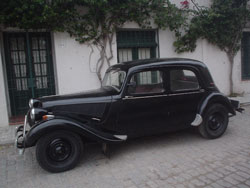
The day was almost as dark as Johnnie Carr's countenance when the shaggy haired journalist stepped hurry-skurry upon the damp sidewalk outside the quaint colonial style lodging where he had dreampt of the good old days when you could take a swing around town, waving at the girls while huddled in the rumble seat of a model T Ford. Perhaps he was wondering whether those good old days were really as good as they were made out to be. In any event, he didn't have time for such idle thoughts: he was a bit late for his interview with Johnnie Carr, so he decided to risk his life zig-zagging across a lonely street in the colonial quarter Colonia, Uruguay, where in the bye-gone days Portuguese and Spanish conquistadores would play something like an antique version of Tom and Jerry.
"Hey! You're not in Buenos Aires!" resounded the melodious voice of a driver who was obviously not an Argentine, although he might well have been a distant cousin of the great great grandfather of José Gervasio Artigas.
Judging by his clothes, he wasn't a Spanish conquistador nor did he have the penchant for goldish-yellow that obsessed the Portuguese adventurers. He was clean-shaven, wore no sword, no helmet and haad his body stuffed into a one-size-too-big English tweed coat that made him appear to slump over the wheel of what could have been a sputtering 1950 Plymouth.
"Here in Colonia we use the sidewalks. That's what they are made for."
With that bit of practical philosophy, illustrative of the the Mercosur's present hang ups when it comes to couple relationships, the driver sped away at about 15 miles per hour, leaving the journalist's mind a twirl.
After all, maybe he's right, he thought. I mean porteños do have a propensity for forgetting that streets are for cars and sidewalks for people...but why be so dogmatic? Aren't laws made to be broken, or at least taken seriously only when the remaining variables are, shall we say, less than convenient? Or maybe its just a deep seated rivalry between the che's and the charrua's? A sort of Jung style impulse to revenge the past, when Artigas and San Martín and Guemes and Belgrano and O'Higgens and Urquiza and the whole lot of them thought they were struggling against a common enemy, only to end up plotting artificial boarders and saying this is mine and we are like this, not like you over there on the other side, across the river, over that mountain peak. I mean there was absolutely no traffic on that street, not even the street peddlers you so often see in Buenos Aires...until that Uruguayan fellow rumbled out of nowhere. Anyway, I don't think Johnnie likes Johnnie-come-laters and it's already ten after ten and on this side of the river people think they live in Switzerland or something because they always arrive on time.
Luckily, Johnnie was waiting patiently, just as agreed, near the statue of Artigas, that Uruguayan independence hero who almost always is seen in civilian clothes, no sword, an almost happy face, in sharp contrast to the more glum mugs one usually associates with the forefathers. By the way, why doesn't anyone talk about the foremothers? There probably is a pretty solid explanation: the ladies at that time had to stay home and make dinner and babies and wash diapers and gossip and iron and mend clothes and go to church on Sunday morning, so they probably didn't have time to go around lambasting Indians (who weren't even from India), shooting cannon at the king of Spain's Rambo forces or exercising their dagger jabs at the expense of guys wearing the wrong colors. Those thoughts didn't seem very apt as a platform from which to launch an ice-breaker capable of paving the ground for the interview with Johnnie Carr, but the journalist just couldn't get the idea out of his head. So he walked right up to Johnnie and blirted out the first thing that came to mind:
"Tell me the truth: are you really Johnnie?"
"Yea...well, at least here in Colonia that's what most people call me."
"I see...It's just that your're features are so delicate, so refined, almost of female softness, and Johnnie sounds so macho."
Johnnie laughed for a minute or so, wholeheartedly, exhibiting a kind of freedom that one encounters very rarely in today's globalized world. The cachinnation bubbled so wholesomely that any Tom, Dick or Harry crossing the street corner at that very moment might have been amazed to see Johnnie's blackness sparkle with every ha-ha-ha-ha-ah-ah-ha-ha. In fact, instead of beaming eyes, Mr. Carr seemed to be equiped with high beam headlights. (To tell the truth, he was secretely fascinated by the interviewer's rather unconventional information gathering technique.)
"Let me tell you something," Johnnie said when his giggling died out. "Once I had a girlfriend who looked so much like me people thought we were twins and they would always get our names mixed up."
"Really? What was her name?"
"Lizzie...actually Elizabeth, but everyone called her Lizzie. She was a real black beauty."
"You mean a Negro, oh, pardon me, I mean an Afro-american..."
"No. She was just black like me, beautiful."
"I imagine it was only the name that led to the mix-up."
"Oh yes indeed! We were actually quite different."
"Did you, I mean...did anything...did you ever...you know...did things ever get beyond the starting point?"
The interview definitely didn't seem to be getting anywhere, or at least not to where the journalist wanted to take it. But that should not surprise anyone. Cristopher Columbus thought he was going to India, didn't he? You start out in one direction and end up someplace else but maybe the place you end up in is more exciting than the place you wanted to go to or maybe it's the place you wanted to go to but by the time you get there it has changed so much you can't recognize it as the place your wanted to go to in the first place. Anyway, it seemed the appropriate moment to change the subject.
"Tell me something about your life. For example, where were you born."
"There's a bit of confusion about that but my mother invented a rather suggestive nickname for me: De-troit."
"Sounds like like Detroit, Michigan, the hang-out of Ford, Chrysler and General Motors."
"That's right. So I always imagined that I was born there. I've never been back, though, because I hear it's a bit dirty, filled with smog and dusty smoke stacks."
"So you came to Colonia still swathed in soft white linen."
"A bit later, I'd say, but in time to become a fan of Carlos Gardel."
"Really? The bitter-sweet voice of Argentine tango!"
"He was Uruguayan, born in Taquarembo."
"French, actually."
"From Taquarembo! I swear! I used to take him around town. He'd hum like a bumble bee or practice some song he was working on and that really attracted the gals. And in those days they were really sweet. They'd put their hair up in curlers for hours, sprinkle themselves with perfumes you could smell a mile away and then stroll around the square and pretend they were more innocent than they really were and they just loved to be waved at and honestly I was a better waver than Gardel, although I must admit that my voice was no match to his. That didn't matter though because with my waving and his singing we managed to pick up some pretty enticing young ladies..."
"So your're a playboy!"
"No, I wouldn't go that far. But love is a wonderful thing. Wasn't that what Frank Sinatra once said?"
"If I'm not mistaken, rather than talking about love being a wonderful thing he sang about it.."
"O.K. You're right again. But love is super, the greatest thing ever, and I've been there."
"Would you mind telling our readers how to get there?"
"There's no address. You just stop, look and listen and you're there before you even know it."
"And you've been there. Tell me: what is love for you Johnnie?"
"It's going in the right direction, together. You feel she's beside you, almost inside your head, under your skin, right there when you need her. But you have to know how to shift gears when the riding gets rough."
"Sounds like a metaphor."
"The best things in life are metaphors. Just think of this: the first car was propelled by steam and steam is what comes out of your mouth when you kiss on a cold winter morning."
"True, but sometimes people get all steamed up and blow their tops!"
"Look! Are you interviewing me or judging me?"
Things had begun to take a nonsensical turn, so the journalist puckered up his lips and just stared at Johnnie for a full 37 seconds. Then, tired of standing, he opened the door and sat down beside him.
"Politics...are you a conservative or a revolutionary?"
"Both."
"Both?"
"What's so strange about that? I try to place the best moments of the past in my back seat memory seat while I steer myself towards change, towards a world without beggars on the streets, without ugly skyscrapers, with green trees interspersed with houses in the form of mushrooms, and enough social equality so a guy has time to dream and laugh and play rather than always thinking of money and dollar bills and foreign debts and silly wars and struggles for power and fame and glory and stupidities of the sort."
"You know Johnnie, I think your're right there."
"As you probably have suspected, I'm no longer a youngster but I've lived through lot's of God damn horrible stuff. This thing about being the Switzerland of Latinamerica, for example, if you ask me that's quite a joke. Besides a couple of decades ago there was a dictatorship here too. Once while I was driving on the outskirts of town I saw some men grab a woman by the hair and toss her into a car. They told me later that the poor thing was lambasted like a nasty mosquito in a God-forsaken lock-up and the kidnappers got off the hook, as usual. They did absolutely horrible things in the name of their supposed defense of our republican institutions and way of life. Imagine."
Johnnie was crying. The tears rolled off his blackness and splashed onto the street. The journalist was caught off guard, not knowing what to ask, how to handle the delicate moment. Johnnie Carr suddenly seemed like another person. Who was that girl he had mentioned? Was she his loved one? And yet he still seems so full of life. Perhaps it's age, you get riper as the years go ripping by. It isn't that you forget. You get riper. Things take on a different perspective.
"Johnnie...please forgive me...in these interviews it's difficult not to touch on some sore spot. So I'll just bother you with a last question: What do you think of people?
"They use me and abuse me. But I don't care, really. I know where I'm headed. I love the way I am, the way I look, every single moment in my life and so I'm driving towards the inevitable end with pride mixted with tears. I know I could have had a better life but I've lived it to the hilt. Now I'm running out of gas, but so is the world."
"Johnnie, believe me it has been a pleasure talking with you and I wish you the best of luck...Maybe some of the people who have read this interview might want to contact you. How?"
A coy smile slipped over Johnnie Carr's face. The journalist went through the usual goodbye ceremonies, opened the door. On Johnny Carr's running board the journalist spotted a presentation card which said:
"Visit me when you come to Uruguay. My telephone is 24731.
My address: Taquarembo 246.
| Have you ever tried a nice soybean cutlet and imagined, just for a fleeting instant, that you had had a relapse to your meat eating youth? Well, the little bean has not yet become a big deal on the menu in Argentina or in most of what used to be euphemistically called the West. But there are millions in Asia that gobble up the beans--after transformation into many different nutritional products. And if you are an Argentine you most certainly are happy that a fast moving market does exist for the not-so-tasty but highly nutricious bean......because soybean production is rapidly becoming one of the country's leading export items. According to the Buenos Aires "Bolsa de Cereales" (Clarín, Jan. 4,2007) more than 16 million hectares have been planted for this harvest season and those in the know are talking about reaping some 43 or 44 million tons of soybean. There's a good reason why farmers have gone flip-flop over soybeans: prices over the past year have zoomed ahead by 20%. Just a word of caution for those who tend to look a little bit further into the future or who still have a soft spot somewhere for good old Mother Nature. º Most of the new areas under cultivation have been snatched from regions housing valuable native species or wilderness areas that will now go under extensive cultivation. What effect will this have on the soil and the climate? º Lot's of multinational firms, though still questioning the not-so-orthodox economic policies of President Néstor Kirschner, have begun to grab up cheap and rich agricultural lands. º Oddities of the market. China is perhaps the world's biggest consumer of soybeans but prefers to manufacture its own products. Argentina also has many factories dedicated to manufacturing soybean oils, crushed soybeans, soybean flower, etc. so...it is having a bit of difficulty providing China with the raw materials it seeks. Solution? Argentina imports soybeans from neighboring countries, such as Paraguay, and re-exports to China. º Oh, now that we are on the subject of cereals, what about corn? Due to the fuel crisis, a number of alternative energy possibilities have emerged. One is the use of corn to produce a less contaminating fuel. That means that corn farmers in the U.S. are literally speaking having a "hey day." But it also means that the price of corn is going up and up. Well....might not some wise investors also cast their eyes on Argentina, where land is, well, dirt cheap. Once again, progress and the preservation of good old Mother Nature's natural reserves seem to be on the rocks. |
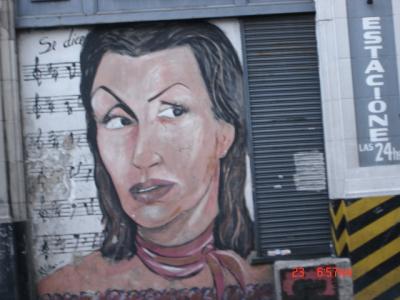
Te conocí en una pared llena de nostalgías, las mías, las tuyas, las de una ciudad abrumada por el tiempo pasado, viví tus pasiones, compartí contigo el dolor de tu mirada y por un instante, largo, como la espera del enamorado, mi cuerpo tembló ante la certeza de haberte conocido. Entonces, te invité a salir, a caminar un rato al lado mío, sentir por un breve minuto que dos seres solos y sin remedio una muda comunicación podrían compartir. Te conocí y siempre guardaré un lugar de lujo en mi memoria para tí, aunque muera yo víctima de la más bella tristiza.
| Durante y después de la Segunda Guerra Mundial el poema en idish de Mordejai Gebirtig, "Nuestra aldea está en llamas," reflejó acertadamente el horror: "Un viento furioso arrasa y dispers todo/ Llamas enormes se alzan y mueven el círculo/ Todo se quema ahora/ Y ustedes se quedan mirando/ de brazos cruzados/ se quedan mirando mientras/ nuestra pobre aldea está en llamas/ puede que llegue el momento en que el fuergo los alcance y sólo quedarán cenizas uy muros negros." Otro momento, tal vez, otra historia, tal vez, otros odios, tal vez, otras ambiciones, tal vez, otras circunstancias, tal vez, y sin embargo la capacidad de auto destrucción de los seres humanos sobrepasa la más fértil imaginación. Y sin embargo el cielo sin fin sigue estrechándose hacia el infinito, el espacio no conoce límites, la energía sigue circulando en cada rincón del universo. |
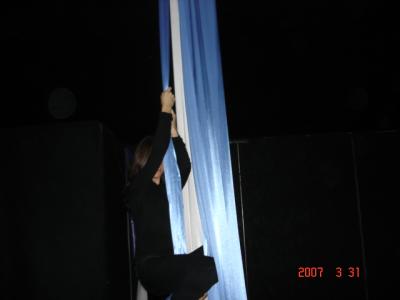
A subir al cielo
agarrado a la vida,
Subir, respirar, suplicar, seguir,
Bajar a la tierra,
El alma repleto de cielo,
Subir una y otra vez
Hasta alcanzar lo inalcanzable.
Hace tiempo camino
sobre la cara de la luna
gritando mi derecho
a soñar, soñar e inventar
universos nuevos
poblados de suspiros
verdes y negros,
como nuestros ojos;
caminar descalzo y juntar polvo,
pintar metáforas frescas
en el rostro plateado de la luna,
planificar la muerte de las sombras.
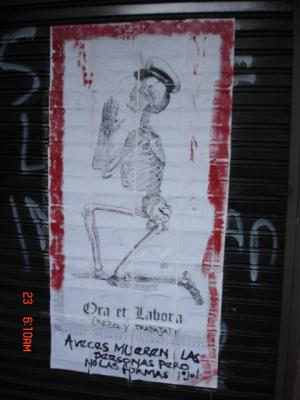
Lo encontré inclinado sobre una pared en la avenida 25 de Mayo, observando la marcha de protesta. Iba a apretar el botón de la camara digital cuando escuché una voz ronca:
--La mayor parte no tienen idea...
--¿Cómo?
--No saben...
--¿Qué dice usted?
--Es que estoy muerto. Los muertos ven cosas que los vivos no pueden ver.
--¿Usted fue testigo de los hechos del golpe del 24 de marzo...?
--Basta decir que yo he muerto y ustedes todavía buscan la justicia.
--¿Dónde está?
--¿Qué cosa?
--La justicia.
--Hay que buscarla.
--Entiendo...¿Siempre estás aquí?
--Aquí y en todas partes. Es la ventaja que los muertos tenemos.
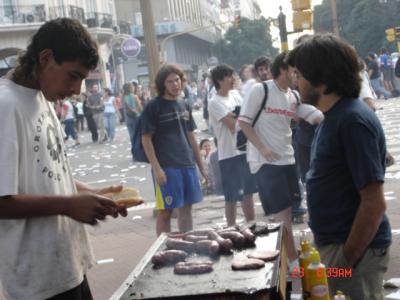 People get hungry after marching, singing, chanting and demanding justice. So they stop by a "chorizo" stand and ask for a still steaming sandwich. It's March 24th, a date full of shame for most Argentines: on that date in 1976 the military toppled the tottering government of Isabel Perón and put into motion the country's bloodiest dictatorship. Human rights organizations are still trying to locate infants--now adults--that military officers kidnapped and handed over in "adoption"
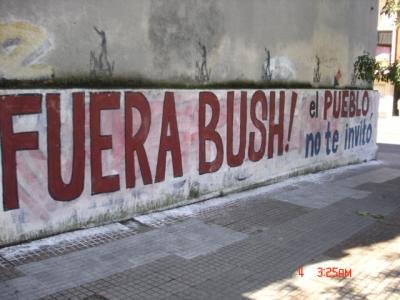
Es cierto: una frase puede decir tantas cosas. ¿Y una foto? Aparecen hombres y mujeres con pintura y de repente transforman una pared de Montevideo en un diario político. A ver. Las frases son de fácil comprensión. ¿Pero qué hay detrás de cada palabra? De repente pensamos en la escritora Alicia Steinberg, que alguna vez opinó que "Las posibilidades para decir algo en una sola frase son tantas...no me animaría a decir que son infinitas , pero son muchas..."
 You were discovering Montevide's rather run-down neighborhoods when your camera jolted and twitched as if to say: "click me please!" And this is what you clicked. Walls have their own language, don't they? U.S. President George Bush, escorted by who knows how many secret agents, probably never saw what your camera did.