Blogia

Buenos Aires Jaque Press, en inglés y español

The sun, the clouds and then a gasp

 It was Sunday morning, Spring, fresh but inviting, so she decided to carry out her usual routine: reading the paper at a neighborhood bar and then do a bit of shopping while trying to put the bits and pieces of her life together. Half asleep, she almost forgot her bag but then threw it over her shoulder and danced down the stairs. She was happy, without knowing why, she was happy. It was Spring. Life seemed to be returning.

     "What'll it be this morning?" asked the waiter with his usual half smile, half grimace.

     "Just a black coffee, no more!"

     She dug into her bag to find a pen. Why do certain people find it necessary to mark, underline and scribble on newspapers, magazines and books? Who knows. Perhaps it is a carry over from student days. That day, though, there was no pen. Just the digital camera and the tape recorder she had used the night before at the birthday party. That brings up another question: why can't people go to birthday parties without taking scads of photos?

       There are two wars in Iraq, she read, one involving the invading U.S. forces and the other an undercover one pitting mercenaries against...

         She stopped reading for a minute to gaze around the bar--the photographs of tango singers, an old Italian coffee maker, some very amusing old publicity posters. "What a strange world," she thought , "far-away wars that somehow seem to get closer and closer and these trappings of another epoch...when there probably were also wars."

         "Excuse me please," said a young man politely as he nudged behind to occupy a seat in back of her. She didn't even reply and hardly noticed the stranger. After all what had he to do with her life? She never talked to men in bars, well, unless she knew them or maybe she'd politely say no to those that invented typical questions such as: 'have a light?'

           It took her some time to get back to her reading. She was on the outs, having dumped her husband before he dumped her. That was the way she had understood the situation. Things were headed for an inevitable break-up so why not take the initiative? It's easier that way, isn't it? Isn't it? Besides, he was acting strange, aloof...maybe there was someone else, so the best remedy seemed to be...

           Suddenly, she sat up abruptly. A strange light feeling had overtaken her body. Instinctively, she looked for her bag. It was gone!

          "It was the kid," said a man at a nearby table, "he grabbed it an ran."

         "Oh shit!"

        Maybe the sociologists could explain the situation. Maybe the psychologists could. Maybe economists could. The guy was poor. On drugs. Had to get money somehow. He wasn't like those white glove thieves who occupy the last three floors of a skyscraper. No. But why did that kid have to take my bag, with my photographs, my recorder, my keys. "My keys!"

       Now she was close to paranoic. As she raced down the street towards her house, she imagined the worse: the youngster had gotten there before her, like the wolf in Little Red Riding Hood, had beaten up her eight-year-old son, kidnapped him, taken the cash she had stored away...

        There was a police car at the corner. Her heart leaped ahead, as if she had just finished the 100 yeard dash. A crowd of people were swarming around, shouting, crying, pushing.

         "Let me through! Let me through it's my son!"

        The body of a young boy splattered in blood greeted her eyes as soon as she pushed aside the last bystanders. "Carlos!"

          It wasn't Carlos. It was a young man his age, but not Carlos. The victim had gone to the cyber at the corner to send an e-mail to his girlfriend. A thief had entered, drugged to the hilt, and, disappointed at not finding any money worth grabbing, shot the youth in the head.

          "Free the area, now!" thundered the voice of the police officer, as he tried to move curious onlookers away from the body of the victim.

          The lady slumped over when she realized it was not her son, then straightened her back in a stroke of lightening and raced towards her apartment door. A foreboding feeling of apprehension invaded her as she turned the key in the lock, although she was saying to herself again and again: "it wasn't Carlos, Carlos is alright, calm down, get control of yourself..."

         Everything was in order inside the apartment, except for a brown envelop on her pillow, with her late husband's handwriting scribbled on it. She opened the envelop gingerly and took out a sheet of paper:

         "You were right to leave me. I have AIDS. I wanted to tell you, but I just couldn't get up the courage. It's better this way. I love you. Henri."

          A swallow came to rest outside her kitchen window and pecked at the bits of seed that the wind had deposited in the crevices. The young woman gasped for breath as a greyish cloud in the form of a mushroom momentarily blotted out the Spring sun. Then she tucked the letter to her breast as her lips repeated again and again: "My God! My God!"

Balbín Amable Aguaysol y la Fundación Amauta Escuela Cultural Ecco Museo

Balbín Amable Aguaysol y la Fundación Amauta Escuela Cultural Ecco Museo

El camino entre Amaicha y Los Zazos parece ir hacia un pasado remoto y misterioso, pero en realidad es un sendero que conduce el visitante hasta un museo que guarda el pasado y apunta al futuro. Allí conversamos con su director, Balbín Amable Aguaysol..

Amaicha es una comunidad única en la provincia de Tucumán, Argentina, pues cuenta con dos gobiernos: uno comunal, del estado nacional argentino, y el otro el gobierno indígena, donde se elige a una persona representativa, "El Cacique," quien cumple la función de administrar los bienes activos de la comunidad, a través de las decisiones en Asamblea de sus comuneros.

Los habitantes son del Pueblo Diaguita-Calchaquí. En el año 1716 la corona española a través de una Cédula Real entregó 120.000 ha de tierra para la población y sus descendientes. No obstante en el año 1994 el gobierno de la provincia de Tucumán reconoció las tierras de Amaicha, pero concediéndole solo 52.812 ha con título de propiedad colectiva.

Desde el centro del vecino poblado de Los Zazos un estrecho sendero sube en pendiente, luego se empareja y asoma a la vista un moderno edificio hecho al estilo antiguo. Es la Fundación Amauta, escuela cultural eco museo, y su director, Sr. Aguaysol, nos saluda con toda amabilidad. 

--Aquí la educación es para adentro y para afuera.

--Es un concepto interesante. ¿Podemos charlar un rato?

Hemos recorrido el museo, con sus planos de relieve, artefactos, cerámicas, herramientas y explicaciones científicas y antropológicas, y ahora estamos sentados a una hermosa mesa de madera de la zona. En una sala cercana media docena de chicos estudian con un profesor los secretos de la cibernética.

--¿Qué quiere decir Amauta?

--El nombre Amauta viene del quechua y significa maestro, guía, sabio en conocimientos. Señala algo más que enseñar a leer y escribir. Expresa sobre todo un sentimiento de arraigo y un compromiso con nuestros patrimonios olvidados, nuestras identidades negadas, nuestras historias no contadas. Es por eso que creemos necesario integrar el pasado a nuestro presente. Es una necesidad para el futuro. 

La idea es no perder de vista las importantes enseñanzas del pasado, los conocimientos y sabidurías de un pueblo rico en cultura y tradición, en fin, el estilo de vida de una comunidad integrada a su entorno natural; pero tampoco desaprovechar los avances tecnológicas que permiten conocer la ciencia moderna y las costumbres y formas de vida de personas de diversas razas y religiones alrededor del mundo.

--Esta es una escuela que ofrece algo diferente. Es un museo y una escuela y la enseñanza es individual y no basada en materias de estudio sino en el contexto. Los profesores no enseñan una sola y única cosa; transmiten al alumno la amplia gama de conocimientos que tienen sobre su técnica específica y sobre todos los demás conocimientos que han logrado a través de la experiencia. La meta es promover el arte y la cultura popular del pueblo aborigen de Amaicha del Valle, hacia un desarrollo sustentable, equitativo en un marco solidario, abierto y plural, en el marco de libertad, respeto y autodisciplina. Nuestra lema es: "Educar para la vida."

Los objetivos institucionales incluyen:

1) Insertar al niño en la sociedad en forma activa, creadora y responsable.
2) Elevar el nivel cultural de nuestra niñez y de las generaciones venideras.
3) Generar recursos genuinos, cuidando nuestra Pachamama y promoviendo su biodiversidad.
4) Tomar conciencia del patrimonio cultural-natural de nuestro pueblo.
5) Promover y desarrollar acciones comunitarias para el Desarrollo Sustentable.
La Fundación surgió a través de un grupo de amigos, interesados en revalorizar la cultura del Pueblo de Los Zazos, en Amaicha del Valle. Para ello, decidimos en 1995 señalizar las calles y callejones, con nombres de personas que hacían y hacen al acervo cultural y natural. Esa experiencia marcó el fortalecimiento de la identidad como pueblo originario. Para no tener que emigrar a los centros urbanos y poder ser un instrumento de bien para la comunidad de Amaicheña, nace la escuela.
La escuela trabaja con el establecimiento de Convenios que aseguren la mutua colaboración y cooperación entre las instituciones gubernamentales, ONGs y Empresas Socialmente Responsables.

--¿Mantiene contactos con otras instituciones?

Sí. La fundación trabaja con el establecimiento de Convenios que aseguren la mutua colaboración y cooperación, es decir, la retroalimentación-sinergia, entre las instituciones Gubernamentales, ONGs y Empresas Socialmente Responsables que garanticen implementar diversas acciones en procura del bien comunitario; equidad, participación, mejor nivel de vida, solidaridad y sostenibilidad.

--¿Es decir, la escuela realiza un tipo de educación alternativa.

--Claro. Como un medio educativo no formal, la escuela tiende a cubrir una amplia gama de funciones relacionadas con la educación permanente y con otras dimensiones del proceso educativo global, marginadas o deficientemente asumidas por la educación formal. Lo no formal toma en consideración las necesidades autóctonas e inmediatas para seleccionar los contenidos más idóneos.. Algunos miembros de la comunidad pueden prestar útil servicio dictando cursos en la rama del saber que son su especialidad, tanto a niños como a adultos. Además, la participación de la comunidad en las actividades educacionales ofrece la ventaja de brindar a sus miembros un conocimiento más cabal de los problemas que debe enfrentar el maestro, llevándolo a actuar con mayor comprensión.

--¿Cómo hace para responder a la actual crisis social?

--Nuestra comunidad ha sufrido durante las últimas décadas un fuerte proceso de desarraigo y migración de jóvenes, por no tener oportunidades de trabajo o estudio; es por eso que la Fundación propuso la creación de una escuela que brindara una educación alternativa, basada en la preservación del arte y la cultura, del medio ambiente y la identidad. El hecho de plantear la revalorización de las prácticas culturales nos llevo a pensar necesariamente en nuestros abuelos; ellos son los que nos transmitieron el amor por la tierra, el respeto, el valor de la palabra y la dignidad como seres humanos. Es por eso que este proyecto nos lleva al fortalecimiento de la identidad como herramienta de cambio, haciendo memoria de nuestro pasado común, preservando sus tradiciones y costumbres, para mejorar el presente y contribuir al enriquecimiento del futuro de nuestra comunidad.

--¿Es buena la repuesta del pueblo al proyecto?

--Sí, y las necesidades van creciendo también. Hoy nuestros alumnos demandan continuidad de los espacios de aprendizaje; es por eso que los integrantes de la Fundación, estamos buscando alianzas estratégicas con otros sectores que se involucren con la tarea para mejorar la calidad educativa. Además, apostamos a educar en el arte y el cuidado del medio ambiente a través de talleres específicos en co-relación con las propuestas de desarrollo sustentable. Invertir en esta forma de educación alternativa, favorece el proceso que pretendemos alcanzar y que es fundamentalmente: revalorizar nuestra cultura.

Al despedirnos del Sr. Aguaysol, describió las diferentes salas que actualmente funcionan en la Fundación:

° Sala de teatro y arte dramático "Juan Zorro," un espacio para desarrollar destrezas y habilidades y un pequeño escenario para títeres y obras de teatro para niños.

° Biblioteca "Luisa Haydeé Choquis," uno de los primeros espacios construidos para tal fin, con estanterías elaboradas rústicamente para exponer material bibliográfico, para realizar consultas, reuniones comunitarias, realizar charlas educativas, o dictar clases de agricultura e idioma.

° Salón Equidad: Centro Comunitario Digital, bien equipado para brindar confort para el alumnado de alfabetización informática.

° Eco Museo: Doctora Ayala, un espacio ambientado con recursos naturales, madera de algarrobo en el piso y de cardón y caña en el techo, que ofrece exposiciones permanentes o transitorias de revalorización del arte popular del valle, su patrimonio arqueológico y sus tradiciones folclóricas. Además brinda información turística al pueblo y al valle Calchaquí.

° Salón Lilí Segura, para el desarrollo de actividades tales como la alfarería, trabajos en cuero, hilado y tejido artesanal.

° Salón Amalia Lera, un espacio adecuado para desarrollar habilidades artísticas, mediante la expresión del cuerpo a través de la danza folclórica y el teatro.

° Conducción docente: Cacique Reimundo Silva, destinada para resguardar toda la documentación de la escuela. Su uso exclusivo para directivos y cuerpo docente, este lugar de trabajo es el centro de coordinación de toda las actividades educativas.

Contactos: Balbín Aguaysol y Aldo Ariel Aguaysol

Dirección: 
Los Zazos - Amaicha del Valle, Pcia. de Tucumán - C.P. 4137
Tel: 0054 - 03892 -421177, 03892-421177
Email: losamautas@hotmail.com , fuamauta@cosama.com.ar 
Web: http://www.turismoentucuman.com.ar/fundacionamauta , http://www10.brinkster.com/amauta

Entonces, crecen las flores entre los pedazos de vida dejados en el basural...

Entonces, crecen las flores entre los pedazos de vida dejados en el basural...

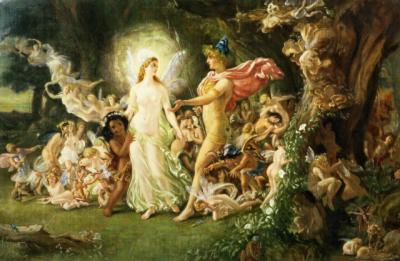
Pintura de Sir Joseph Paton (1849) "The quarrel of Oberon and Titania."

    Primavera impulsa energías

        hacia campos sembrados:

            semillas, brotes, memorias ocultas

               en las trincheras del tiempo;

                   suspiros, pensamientos llenos de aire y luz;

    el beso del sol sobre la piel de un amante:

      te amo, te quiero, te adoro, te deseo...te espero,

            paladares picantes plácidamente probados.

                 Primavera promueve pausas particulares,

                      Contemplaciones, poesías,

                           Conversaciones carnales...

                            entre besos infinitos

                               y ejercitaciones nocturas.


She called from distant valleys, lost in thought

She called from distant valleys, lost in thought

   She called from distant valleys,

          lost in thought, her lips smiling.

   Blind but seeing all, I whispered into her ear:

        "Darling, there is still time to charge our engines."

   Only silence pervailed on dry patches in distant valleys.

        Perhaps the rain will bring new life to mingle with old thoughts.

Cuarto encuentro internacional "Narradores de las Dos Orillas"

       En Punta del Este, Uruguay, se prepara el "Cuatro encuentro internacional 'narradores de las dos orillas' con participación de escritores de Argentina,Uruguay, Paraguay, Brasil, Perú, Bolivia, Chile, Venezuela, Colombia, Costa Rica, Nicaragua, México, República Dominicana, Panamá, Estados Unidos, España y Cuba. El encuentro se realizará el 22 y el 25 de noviembre en el Hotel Ámsterdam.
           
    Sylvia Lago dictará una de las conferencias principales: “Eduardo Acevedo Díaz: una narrativa fundadora” Otra importante conferencia estará a cargo de Ester de Izaguirre: “Narrativa Argentina Contemporánea”
    Escritores argentinos que participarán en el encuentro incluyen hasta la fecha Gladys Abilar Edith Albaini – Susana Boechat Alfonso Cebral - Elías Galati – Mariano Moreno Myriam Rozengurt – Emilce Strucchi - Daniel Tevini Silvia Vernengo Alfredo Mª. Villegas Oromí - Graciela Zolezzi
   De Uruguay: Mabel Altieri – Virginia Bintz Marta Bonilla – Rocío Cardoso -  Shirley Cotto – María Laura Dewaele – Graciela Genta – Alejandro Giménez – Lauro Marauda – Carlos Marenales – Marta Masares - Carlos Mazullo – Nybia Mazzullo – Rosana Molla – Pedro Ricciutti - Beatriz Suárez
    De Chile: Nuri Escorza.
    De Panamá: Enrique Jaramillo Levi.
    De México: Margarita García - Margarita Aizpiuru
    Los libros a presentarse:
“La noche más polar” (novela) de Daniel Tevini (Argentina)
“Andar ligero” (novela) de Emilce Strucchi (Argentina)
“Marta Lynch, pasión y política” (ensayo) de Susana Boechat (Argentina)
“Contar la realidad como ficción” (cuentos) de Elías Galati (Argentina)
“Vencí al derrumbe” (novela) Silvia Vernengo (Argentina)
“El viaje de Juan” (cuentos) Rocío Cardoso (Uruguay)
“Las aventuras de Terry” (infantil) Margarita García (México)
“Juguito de rimas” (infantil) Gladys Abilar (Argentina)
     Avanza la inscripción y quedan pocas plazas disponibles para integrar las Mesas de Lectura y Presentación de Libros. Las reservas deben confirmarse a la brevedad, con el envío de la Inscripción formal al Encuentro. Una vez cubiertos los cupos en las Mesas de Lectura, se podrá participar como asistentes y/o integrar la lista de espera, por si algún escritor no pudiera concurrir a último momento.
Para mayor información, dirigirse a la Comisión Organizadora del Encuentro: delasdosorillas@yahoo.com.ar
Carlos Mazullo     Rocío Cardoso   Alfredo Villegas Oromí
     Secretario               Vicepresidente                     Presidente

Asociación Cultural De las Dos Orillas
Ramón Masini 3328 - Of. 003 - Montevideo
Tel: (00598 - 2) 709.96.00
Celular: (00598) 94.314.683
e-mail: delasdosorillas@yahoo.com.ar

Segundo foro nacional contra toda forma de violencia y discriminación

      El próximo 20 y 21 de septiembre, Oscar R. Gómez (Osy) dará una conferencia a las 14hs. en la Universidad Tecnológica Nacional en el marco del segundo foro nacional contra toda forma de violencia y discriminación.
      Entre otros invitados se encuentran el Ministro Daniel Filmus, Juan Carr, Gastón Pauls e importantes personalidades del quehacer político y social.
      El evento será realizado en la Universidad Tecnológica Nacional, Medrano 951 y la intervención del Osy Gómez ha sido programado para el 21 y 22 de septiembre en el aula 527 de la universidad.
     Con entrada gratuita, el evento ha sido declarado de interés educativo por el Ministerio de Educación, Ciencias y Tecnología, como así también porla Facultad de Medicina de la Universidad de Buenos Aires, y de interés social por la legislatura de la Ciudad de Buenos Aires.
Más información sobre el foro en http://www.forocontralaviolencia.org

Iraq tells Blackwater mercenaries to pack their bags and go home...but they say no to their hosts.

    The decision of the Iraq government to expulse Blackwater mercenaries--following a confusing shoot-out with alleged insurgent forces during which ten civilians were killed and 13 wounded--reveals yet another sordid aspect of the U.S. war against Iraq.

   (The apparently hard-fisted measure lasted a wink and a half, long enough for foreign correspondents to spot the private soldiers on their usual routines.)

     However, the government's Interior Ministry spokesman, Brig. Gen. Abdul Kareem Khalaf, appeared to show no ambiguity when he declared on September 17: "We have revoked Blackwater's license to operate in Iraq. As of now they are not allowed to operate anywhere in the Republic of Iraq. The investigation is ongoing, and all those responsible for Sunday's killings will be referred to Iraqui justice." (According to CNN)

        Blackwater is yet one of several companies providing "security services" for U.S. diplomats, businessmen and others. Once only one of more than a hundred such private military firms operating in Iraq--according to the U.S. Government Accountability Office.

      On March 31, 2004, four Americans were ambushed and burned near their jeeps by an angry mob in the Sunni stronghold of Falluja. Their charred corpses were hung from a bridge over the Euphrates River. There ensued a bloody counterattack by U.S. troops which gave fuel to the fierce Iraqi resistance that haunts occupation forces to this day. But the four men killed were neither American military nor civilians. They were highly trained private soldiers sent to Iraq by a secretive mercenary company based in the wilderness of North Carolina.   

    Suggestively, Blackwater was founded by Erik Prince, a well-to-do Republican, former Navy officer and board member of the fundamentalist Christian Freedom International. Jeremy Scahill,  a Polk Award-winning investigative journalist who has recently published a book called Blackwater: The Rise of the World's Most Powerful Mercenary Army, says: "With its own military base, a fleet of twenty aircraft, and twenty-thousand troops at the ready, Blackwater is the elite Praetorian Guard for the "global war on terror"--yet most people have never heard of it."

       Joseph Wilson, former U.S. ambassador to Iraq, has asserted in a comment on Scahill's book that the writer's  "expose of the Blackwater mercenary firm forcefully demonstrates the grave dangers of outsourcing the government's monopoly on the use of force."

     The private armies recruit former militarymen from around the world, paying them salaries much greater than those received by the conventional occupation forces. The number of "private soldiers" operating in the country has been steadily increasing, although there are  few reliable figures available concerning their precise activities.

     According to the August 11, 2006 edition of "The Nation" private mercenaries operate in 27 countries around the world in contracts signed to protect U.S. officials, diplomats and businessmen.

     The fact that the government of Prime Minister Nouri al Maliki--which owes its existence to the U.S. invasion of Iraq--should order Blackwater to leave the country reveals the extent of contradictions surrounding the unending war against Iraq.

     Although Bagdad has been perfectly aware of the existence of private armies in the country, the incident on Monday and the government's rapid fire response would appear to suggest an up-scaling of the politically explosive presence of private soldiers in the country. 

     In apparent response to Democratic Party critics in Washington, the Bush Administration has been pressuring Maliki to carry out promised reforms the U.S. considers essential to stabalize the violence in the country. At the same time, Maliki has been walking on shaky political grounds and needs to gain popular support.

     Bagdad's demand that Blackwater's troops leave the country, raises some disconcerting questions concerning the role of  private armies in the country. How many incidents involving their activities have been pushed under the carpet? What connections, if any, do they maintain with conventional forces or with intelligence agencies such as the CIA?

    Will the expulsion of Blackwater be used as an excuse to send more U.S. troops to Iraq? What might happen should the U.S. aligned regime in Bagdad suddenly up the ante and ask U.S. conventional forces to leave the country? In the case of a U.S. withdrawal, would the private armies also be sent back home or would their number greatly increase?

           For more on his book reader may visit http://www.blackwaterbook.com


El tiempo, un presagio, apenas presente en los sueños

El tiempo, un presagio, apenas presente en los sueños

Folklore en San Telmo

Imagen

Conversations on a rainy weekend when the sun plays tag with the minister of economic affairs...

    "Get a load of this!" said the middle aged husband, fingering his out-moded wire rimmed glasses.

    "What's wrong now?" Maggie, his wife, was still half asleep.

    "Ever heard of a guy called Mike Davis?"

   "There must be thousands of guys with that name."

   "I know but this is the Mike Davis who just published a book on the slum planet."

   "Oh, really...is that something you read last night instead of paying attention to me?" Maggie's voice was tinged with irony.

   "Come on! It's a serious problem. The guy says 78% of people in poor countries live in slums."

  "Sounds a bit off key, if you ask me. Anyway, what does that have to do with us?"

   "Not much, I guess, but what if the stock market really does crash?"

  "Don't be silly. It'll never crash."

  "What makes you so sure about that?"

  "It just that, well, if what that guy says is right then there's a lot of market potential in the world. Those poor people need to be brought into the market, don't they?"

  "Maybe. But if they don't have money..."

  "Problems, problems...Oh, by the way, we've got to pay the mortgage on our house and..."

  "Don't worry. It's just a bubble. Bubbles pop and then new bubbles take their place...I'm sorry about last night. I couldn't sleep, thinking about the bubble popping, so I just wasn't up to it."

   "I've heard the same old story for years. Darling, I've had enough. I'm leaving you..."

  "What???????????"

Direcciones útiles para víctimas de violencia familiar

En Buenos Aires, como en todo el mundo, existen altos niveles de violencia contra las mujeres.  
Aquí anotamos algunas direcciones útiles para las víctimas de violencia familiar.  
 
º Dirección general de políticas de género: 0221-4293114. e-mail: pdegenero@mseg.gba.gov.ar  
 
º Burzaco. Andrade 98. Tel: 4238 9760.  
º Berazategui. Calle 160, entre 24 y 25. Tel: 4395-1283.  
º Monte Grande. Benavides 221. Tel: 4296-5650.  
º Tristán Suárez. Fariña 37. Tel: 423-3566.  
º Florencia Varela. Sto. Cabral y Alfonsina Storni. Tel: 4275-7185.  
º La Plata: Calle 1 entre 42 y 43. Nº 523. Tel: 0221-423-1826.  
º San Justo: Ombú 2370.  
º Grand Bourg. Ruta 8 y Ruta 197. Tel: 02320-423193.  
º La Matanza. Ombú 3720.  
º Mar del Plata. Independencia 2474. Tel: 0223-4949996.  
º Merlo. Juncal 363. Tel: 0220-483-6060.  
º Morón. García Silva 923. Tel: 4629-6150.  
º Don Bosco. Pilcomayo 68. Tel: 4252-0033.  
º San Isidro. Juncal 46. Tel: 4512-2345.  
º San Martín. Mitre 703. Tel: 4512-6712.

Gabriela Lombardo: “Brain Gymn is about exercising, sharpening and making the most of your brain power.”

Gabriela Lombardo: “Brain Gymn is about exercising, sharpening and making the most of your brain power.”

              “Who can be wise, amaz’d, temperate and furious, loyal and neutral, in a moment? No man.” Macbeth (Act II, Scene III)        

What a strange thing the mind is! How wonderful and at the same time how terrifying! But the mind is a muscle that needs to be exercised, trained, directed. Lot’s of people do push-ups, for example, others run around the block, still others go jogging and come home panting.       

Gabriela Lombardo, a woman with long experience in brain friendly language teaching technique, recently chatted with “Jaquematepress” about the exciting benefits which persons of all ages can obtain from brain exercise.     

 “That´s a powerful question !” she exclaimed, when asked what was on her mind.    

Then she added quickly: “You want to know what’s on my mind? Training and assisting teachers in  learning  these techniques as well as helping students learn with joy and ease while they make use of their full potential through brain gym. Also,working with people, with children and adults, to overcome ‘learning disabilities’ and assist them in fulfilling their dreams!”      

“O.K. But what exactly is brain gym?”     

“Brain Gym is about exercising,sharpening and making the most of  your brain power  It is an educational system created by Dr Paul Dennison that allows you to reeducate the mind – body system towards a desired goal. When you start using Brain Gym you stimulate the flow of information and processing within the brain and between the brain and body.”    

“And why is this so important?”    

 “Because as you exercise the brain, you restore your natural ability to learn and function at optimun efficiency. The body is the structure for learning . We need to make sure that our body is prepared for learning, that our eyes are teaming together, our ears open to listen and our coordination at its best.”    

 “I see. But wouldn’t you say that in the Western Judo-Christian tradition we tend to separate mind, body and spirit, get fat and forget our bodies or throw our guilt complexes around and then go to plastic surgeons...?” 

 “This is not so much about our physical appearance but, of course, we all know that when we are feeling good about ourselves, it also reflects on our faces and we sweat happiness, don´t we ? It´s about paying attention to our body in the learning process too since we are based on the principle that mind and body are interconnected. It´s about mind body integration, having coherence with what we think, what we feel and what we do!”

“How can doing brain gym help learning languages, improving professional life, etc.?”

Brain Gym can be experienced in different ways! It can be used while you are learning or practicing something in order to remember the information, become unstuck, concentrate,  accelerate the process of learning, in fact, to optimize teaching and learning. The other context in which brain gym is experienced is through balances- A balance is a process whereby the person is balanced towards that desired goal. Learning blocks in relation to the goals are identified and dealt with.”       “Could you tell us about some of your experiences in this and how you got involved?”

“Yes, of course I can.. It’ll be my pleasure! I got involved in Brain Gym because many years ago I went through a bad patch in my life and I had to stop working due to a prolonged stress. So, after a while, I started my search: first I found yoga, which has helped me a lot, and then Brain Gym. It was not until I became a certified instructor in 2002 that I fully realized the powerful tools I had learned. I use Brain Gym in my own personal and professional life as well. Many students around the world and my own students in particular do Brain Gym in my classes. It is one of my most important tools to optimize learning with children and adults as well The body has to be ready to learn as well as the mind and viceversa.

 I also give one on one individual sessions to overcome learning difficulties and improve in any area you might feel weak, stuck or not functioning at top efficiency.  Let me give you three examples of sessions I had , two of which were with children: a primary student , a high school student  and one with an adult.  Pablo, who was 11 years old, first  came for a session with his mum because of quite a lot of suffering at school. He could never finish copying from the board, he found it hard to read, had problems in math, among other things. It looks like an endless list and it really was! Let´s say school was equivalent to prison. Not only because things didn´t go well there but also because as soon as he was done with school, he had to do extra things to catch up after school. 

I noticed in our first session that  he could neither draw a lazy eight nor follow it with his eyes. This is the figure of a sleeping eight or the infinity symbol, whatever you want to call it. Among other things, at that point I could understand why he found it so hard to read. When we read our eyes should harmoniously team together and cross the midline but this is not always the case. He was hardly able to cross the midline!!! This is just one little and at the same time significant thing I noticed which after having worked for some time, it really  paid off.

 The other boy, who was 13,  had communication problems. He was very shy and had big difficulties to relate to people. A very important reflex which had not been integrated at the right time hugely affected him and so we worked on it . After some time, his relationships changed completely, even the relationship with himself who was then able to listen to his needs and after that, he also started building his self confidence. Needless to say , he also raised his marks at school. And last but not least, the case of an adult who wanted to obtain her  driver´s license  but didn´t dare to go through the testing process. After talking for a while, I asked her if she had had trouble at school or university every time she had to sit for an exam and she said she did.. So I balanced her for taking the driver´s license test easily and after two weeks she visited me again with tears in her eyes and the driver´s license in her hand!! It is very rewarding to see the wonderful transformations people experience when they go through balances.”    

“What requirements are needed to practice BG?”    

“There are no requirements to practice brain gym. Anybody can practice brain gym, from little children to adults,  within their own possibilities. Even people who cannot move. You can do the exercises for them while they are looking at you and in this way  they activate their mirror neurons. Certainly, it is always a good idea to ask the physician if you are allowed to do all the exercises if you have some physical discomfort or disease.”    “How can people contact you or get more info on the subject?”   

Gabriela’s contacts:  Web:      http://centrojoyful.com.ar   e-mail:   centrojoyful@fibertel.com.ar

  Phone:   (011) 4523-5261       Buenos Aires, Argentina. 


                                         Gabriela Lombardo

holds a degree as a Sworn Translator from Universidad del Salvador, Buenos Aires, Argentina. She has been working as a teacher of English  at all levels for 18 years now . She also gives in company training. In her classes she applies  humanistic as well as brain-friendly approaches in the teaching of the language so that students acquire it easily and with joy.  She  facilitates one to one sessions to help children and  adults in private sessions to defuse learning difficulties and stress related issues, thus enhancing performance, increasing self-esteem and reducing stress, returning the person to an awareness of CHOICE. She is a yoga practitioner and a certified Brain Gym â Consultant / Instructor, member of Brain Gym International (www.braingym.org)  She has also done diverse presentations at different congresses. She is at present studying psiconeuroeducation, teaching English in companies, doing Brain Gymâ and counseling parents, teachers, schools and any person interested in learning and applying these wonderful techniques. She can be reached at Joyful Learning Center, Centro Integral de Aprendizaje: http://centrojoyful.com.ar. Phone: (011) 4523-5261


Three September Elevens, two laments and a faint hope...

     Remember what George (Bush) said? That we'd all remember September 11. Perhaps. Perhaps things have not necessarily taken the road the U.S. president thought they would.

    He no doubt was not thinking about the military coup in Chile, which also took place on a September 11, nor had he in mind a third  September 11, teacher's day in Argentina. 

   Bush was trying to make Northamericans and people all over the world believe that something fundamental had changed, that the world would never be the same again, that good would win over evil and that God in the end would certainly be on his side.

     And then, as the ashes were still burning following the terrorist attack against the Twin Towers in New York City, a new version of an old concept was born: preventive warfare. That is, attack first and then hope for a fast K.O. Still, it is always convenient to drum up some sort of justification for a war.

    Danger! We were told Iraq had weapons of mass destruction (as if the United States did not, as if India did not, as if Pakistan did not, as if Israel did not, as if...as if Washington had not lent a hand to certain regimes in the fronteer areas considered friendly, some of which then became "unfriendly"...)

    So, in retaliation for the September 11 attack--still smoldering under convenient ambiguities and incomplete documentation concerning the real authors, the causes and purposes--what better than to find a victim. Iraq.

    With a dictator once silently backed up in view of Washington's fear of Iran. Can anyone seriously claim that the situation in Iraq is better than it was when the war began, that the world is less exposed to terrorist attacks? The war in Iraq and Afghanistan and who knows where else still wages wearily on. The daily toll of victims in Iraq: some 3,775 U.S. soldiers, nearly 25,000 wounded G.I's, and (no body seems to know the exact number) perhaps 600,000 Iraqui fatalities. And the torture of prisoners, the kidnapping of suspects, jailing them without trial...

    And there's certainly more to come. In spite of world and U.S. opinion, the Pentagon doesn't seem very eager to withdraw, maybe rotate a few troops, but ...withdraw? Will the Democrats really propose anything fundamentally different? After all, who would take care of those oil wells in one of the world's leading oil producers? Who would make sure Iran would not take advantage of the U.S. withdrawal? Who would bring the alleged benefits of capitalism and democracy to the war-torn middle east?

    Another September 11 took place in Chile, when General A. Pinochet grabbed power from Socialist  Salvador Allende, in an action openly applauded in Washington in view of its fear of a victory of socialist and anti-american forces. Leftists were rounded up, sent to concentration camps, according to recent newspaper accounts prisoners were abused and in some cases even tossed into the sea from airplanes. To save the country from the communist menace. The justification? If the ends are good, who cares what means are used to bring them about.

    Finally, the third September 11th is Argentina, teacher's day. A slim hope. The urgent need to re-educate a country also devastated by the rage of the 1976-82 Military Junta, which whisked away some 30,000 persons to death and oblivion, a coup that was also carried out in the context of the Cold War. Then the return to democracy, the selling off of State firms to the highest bidder and then...crash!Now underpaid teachers, over populated classrooms, and, well, if you're lucky enough to have struggled through the schools, what awaits you out there in today's lopsided world?

"Cien cebollas sin llorar:.." una obra de teatro protagonizada por la televisión.

"Cien cebollas sin llorar:.."  una obra de teatro protagonizada por la televisión.

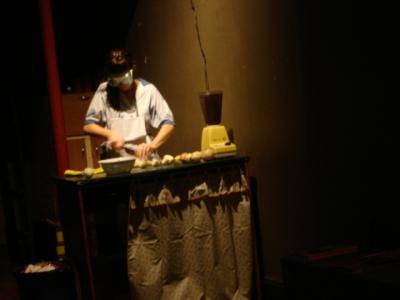
    La mujer ataca la cebolla como si fuera el peor vilano de Canal 13. Desde las primeras butacas se percibe apenas las piernas de ese famoso galán que literalmente se prepara para saltar a la conquista de la pobre esposa.

    La escena en el pequeño teatro-casa de la calle Medrano en Buenos Aires está por comenzar. ¿Qué vendrá? Según el programa: "Un espectáculo en que el teatro toma prestado el discurso de la tele para contar una historia avasallantemente cotidiano. "

    Es cierto, pero mejor guardar los detalles para los eventuales espectadores, cansados de aquellos  lúgubres ensayos de incomunicación, salas repletas de luces que al final nada dicen o textos bien aprendidos que tampoco conmueven.

   Aquí en cambio todo está a la vez creíble e increíble, real e irreal, serio e irónico, un juego de pasiones, estados, ritmos, re-cambios, sorpresas y variaciones sobre un tema archaíco y nuevo: la frontera entre ficción y realidad, entre las insoportables conflictos de la vida cotidiana y ese mundo kish del tubo bobo.

     Actúan Patricia Hurrahs, Francisco Ramírez y Sabrina Pérez, libro y muy acertada dirección: Pablo Lyonnet.

Medrano 536. Domingos a las 21 horas. Reservas 4865-4167. Web: http://ciencebollas.angelfire.com


"La Rueda," un espectáculo que explora, investiga y dramatiza un mundo fragmentado.

"La Rueda," un espectáculo que explora, investiga y dramatiza un mundo fragmentado.


            Ya se sabe: el mundo de hoy consiste en fragmentos, piezas que raras veces encuentran cómo fusionarse, guerras preventivas, oficinas en rascacielos que juegan la ruleta de la economía mundial, industrias que practican la rapiña de la naturaleza en nombre del progreso, parejas que se separan sin saber por qué, hijos para los cuales “el futuro” no es más que una nebulosa.


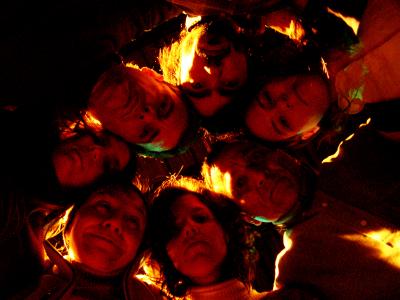
            De eso se trata, de alguna manera, “La Rueda,” un espectáculo dirigido por Pablo Tur que explora, investiga y dramatiza la soledad del mundo actual, dosificado con pequeñas gotas de fina ironía. Producto de propuestas de trabajo, improvisación, juego y el sudor de los actores: Facundo Aquinos, Jaime Mendoza, Flavio Miñana, Guadalupe Molteni, Julieta Prat, Orlando Ubieta y Alicia Vidal.


            “Para recorrer del punto A al B dispongo de 20 minutos,” advierte el programa, "dos minutos de juego, en un segundo podría se el nuevo yo. Suspendido de cada pérdida, camino los 18 restantes…”


            El dilema comienza desde la entrada del espectador a un espacio grande, apenas vestido con butacas casi encima del espacio escénico. Unos cubos, una estructura ambigua y, sobre una pared, un buje—pieza cilíndrica que se encaja en un eje para disminuir su rozamiento. Es la pieza que une las diversas historias aisladas y a la vez unidas que narra la obra. También es una mujer exótica que entra y sale de la acción, asumiendo el papel de hilo conductor. Todos los mundos tienen doble cara: quebrada, opuesta, dialécticas sin resolución.

             Ella, buje en carne y hueso, es el único personaje capaz de distanciarse de su propia situación con una dosis liberal de ironía:  “Soy lo que soy,” canta, “soy lo que quiero ser.” Sin embargo, el recurso de las pausas llenas de fuertes contenidos, la coordinación eficaz de acciones simultáneas en diferentes puntos del espacio y el juego constante entre estados de normalidad mundana y explosiones volcánicas combinan para desplegar una fina ironía que emana más allá de cada historia.  

Quienes buscan un relato tradicional no lo encuentran, pero pueden quedar con impactantes instantes de verdad. El relato, en realidad, es meramente una función de ese mundo quebrado que se rompe y vuelve a soldarse en el escenario.


            Si bien la iluminación apunta a acompañar el quebranto mediante sombras y luces tenues, es deficiente para el espectador que intenta ver en los rostros de los actores el sentido de las acciones.

             Es un buen espectáculo para ver un sábado a la noche en Buenos Aires y luego discutir—copa de vino mediante—nuestro  mundo actual, cruzado, quebrado y en constante ebullición…o ese otro mundo que alguna vez quisimos hacer nacer. 

Contactos:

Teatro Espacio Urbano: Acevedo 460 (Altura Av. Corrientes 5400)

Funciones: sábados 21 hs. Duración: 50 minutos.Entrada: $15, desc. Jubilados y estudiantes $12Promo 2x1, confirmar cupo limitado.

Reservas: 4854-2257

Prensa: Verónica Alegre e-mail: salallenaprensa@yahoo.com.ar  Cel: 1557692015  

Dirección: Pablo Tur

Mail: elojodelviento@yahoo.com 


El director:

Pablo Tur es actor, docente y director. Realizo estudios de actuación en el Teatro Payro, además con Javier Daulte-Alejandro Maci, Monica Cabrera, Alejandro Catalan y en el Teatro Payro. Y como director realizo seminarios con Guillermo Cacace. Participo como actor y director en varios espectáculos de teatro, y algo de cine. Su última obra como director fue “Spirto, la búsqueda”, una creación colectiva, del mismo grupo que ahora presenta “La rueda”.

"Espacio en blanco" en el Festival de Cine de La Plata

"Espacio en blanco" en el Festival de Cine de La Plata

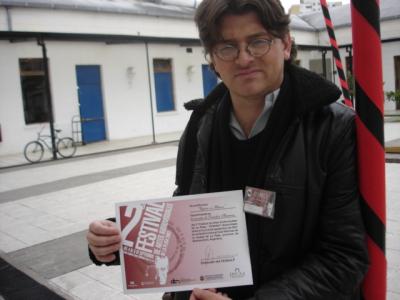
    Cristian Saenz dice: "fue una experiencia espectácular."

    Habla de su participación con el corto "Espacio en blanco" en el Segundo Festival de artes audiovisuales de La Plata 2007," del 4 al 9 de septiembre en el Centro Cultural Islas Malvinas. Películas cortas y largas, documentales, talleres, muestras....fue un evento muy importante para jovenes y experimentados directores de la ciudad y también del país y de otras naciones.

     "Espacio en blanco" narra la historia de un periodista extranjero que llega a Argentina durante la dictadura buscando la verdad...y a su amada, Zulma, que no encuentra.

    La dirección del festival: http://www.fesaalp.com.ar


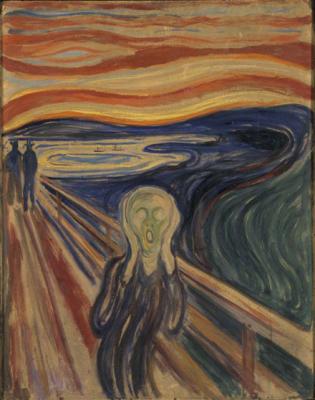
Homenaje al grito de Skrik

Homenaje al grito de Skrik

Grité

  lejos

   enamorado,

    inflamado.

     La lluvia

      seca

       me lastimó

        me enseñó.

         Luché

          aplastado

           encerrado

             castrado.

               La luz

                  ausente

                    oscurece,

                      endurece

                        Vencí

                          el tiempo.

                           miedos,

                             enredos.

                               Te nombré

                                 diós,

                                   padre,

                                     madre.

                                       Te saludé

                                         parco,

                                           pérdido,

                                              retaído.

                                               Rescaté

                                                 frecuencias,

                                                  memorias,

                                                     historias.

                                                       Mi tumba

                                                         vive

                                                           amando,

                                                             asombrando.

Espero

  eternamente

    la lluvia

     inflamada

        que llora,

           implora, eternamente.

              Vuelvo

                 cerca, siempre lejos,

                   cantando,

                      cantando,

                        cantando...

Theatre: "Breathing live into words, words into action, action into spirit."

Theatre: "Breathing live into words, words into action, action into spirit."

The Hopkins Creative Language Lab announces a series of four encounters on applied drama for actors, storytellers and students of English. The schedule is as follows: September 28: diction; October 12: storytelling; October 19: theatre technique and November 16: creating and staging short plays.

For more information write alfshopkins@yahoo.com.ar

                                                             Diction

The acquisition of language was a revolutionary event in the history of mankind: it enabled men and women to share their experiences and to pass them down from generation to generation by means of retelling, chanting songs and poems and—somewhat later on—acting out legends, heroic deeds or dramatic episodes. Greek chorus singers, Middle Ages troubadours and jugglers, and today’s storytellers and actors and, indeed, teachers and all those whose work depends on the spoken word, share in common a profound love for language and the urge to embellish it. 

Today’s teachers, lawyers, salesmen, politicians, business people and countless others in all walks of life use the spoken word as a key tool in their everyday dealings. From the moment the first word was uttered it has accompanied men and women in their work and play, in love and in war, in crisis and in celebration. It is therefore essential to develop the art of speaking clearly, with sharp and concise sounds, with conviction, with determination and with know-how.  

Nevertheless, countless persons suffer diverse maladies related to the abuse or incorrect use of their organs of speech. The day-to-day rat race, shouting in the classroom, at the soccer stadium, in the midst of traffic jams or even at home or in the office play havoc with our most precious tool of communication. Nerviousness oftens lead to thick raspy sounds which not only throw stumbling blocks onto communication’s path but discourage our listeners; our voices turn into depots for the underlying tension and stress that writhe within us like live wires. As a result  communication efforts become contraproductive. Instead of capturing the interest, sympathy or affection of listeners, the tense speaker provokes negative reactions or what we might describe as “the syndrome of relayed tension”. 

Trained teachers, public speakers, salespersons, actors, and storytellers capture our attention not only due to the discernible structure of the scripts they read or reproduce; additionally they embellish their deliveries with the timbre of their voices, with rhythm, flow, vivid imagery, change of tempo and denouement. Our attention is captured by the resilience and sonorousness of the speaker’s words, the ease with which he/she reproduces sounds and also by  the overriding state of relaxation, the honesty of the speaker’s gestures, the élan that exudes from every pore.

The listener’s imagination is awakened when he/she begins to “see,” “feel,” “associate” and “recreate” the places, characters, conflicts and events described.

                                                 Breathing Technique

Good speech is directly related to how we supply air to the vocal foils, the resonators, lips and the tongue. The development of breathing technique therefore provides vast potential vast possibilities for both native speaker and foreign language learner. As frequently as not, language learners sit before a recorder and try to mechanically reproduce the sounds of a native speaker. How often is attention placed on how we supply our vocal system with air to produce the infinite varieties of sound, to express emotion, conviction and excitement? In our view it is essential that teachers and learners develop their breathing capacities through simple and systematic drills so they can then take advantage of the unique opportunity to explore and enhance their vocal expression.

"Suit the action to the word, the word to the action," says Hamlet. Speakers must ask themselves may questions about their art. How can I develop my power of observation? What must I do to avoid getting nervious, gasping for breath when reading or speaking? How can I project my voice with feeling to the last row without strain or emotional stress? What can be done to bring dialogue to life?

                                         The Organs of Speech 

The production of sound involves three basic elements: 1) an exciter, or force making the sound production possible. The diaphragm, located at the base of the conical cage, is located in the abdominal area. It is a balloon like muscle capable of regulating the flow of air past the 2) vibrator, or vocal foils which resist the energy and chop it up into notes. The foils or chords open and close rhythmically in accordance to our inhaling and exhaling, cutting the air stream up into minute puffs, which we call notes. The air is then sent against the 3) resonators, which amplify the note. Although there are many different resonators, the most common are the hard palate, the nasal passage and the cranium.Any tension in the body will necessarily alter the quality of the sound produced. In extreme cases, when the tension affects the foils, it may produce irritation of the tissues and, eventually, nodules. It is therefore important to teach speakers to relax the area around the neck and shoulders. Often this stress is caused by chest breathing.

Very frequently we must re-educate the breathing process, lowering it to the rib or abdominal area. Pushing the air into the larynx from the chest not only creates tension: it prevents us from regulating and “aiming” the stream of air. An additional difficulty—especially in the production of English sounds—is failure to allow the jaw to open at the back. The jaw becomes stiff and defiant rather than agile and flexible. Instead of welcoming the sounds being produced our jaws turn us into tenth round boxers.

Speech then is the result of a whole chain of interrelated events. Its beauty, artistry or expressive potential are conditioned by the subtle harmony among the diverse elements involved in the process of sound production. If our breath is faulty, the tone may become weak or of a quality that impedes clarity. Inflamed vocal foils prevent them from vibrating at normal intensities and likewise seriously alter the quality of the words we pronounce. A bad choice of resonators may distort the sound or give it an unexpected dimension. Errors in articulation, in the use of the tongue, lips or soft palate may result in garbled vowels or unclear consonants.

                                         Some Practical Drills

1.      Breathe from the core. Try to imagine that the centre of your body is not your heart, but a “core” area just below your umbilical cord. Sit in an erect position on a chair. Drop and dangle your hands to your sides while you inhale and exhale imagining the core. Gradually allow your chin to fall upon your chest. Rest it there pushing all of your air in and out from the abdomen. Raise your arms slowly as you inhale, lower them when you exhale.

2.      Allow your body to flop over like a jelly fish, as you exhale. When all of your air is expended, slowly raise your body from the abdomen as you inhale. It is important to lift only with your abdominal muscles. Repeat using one or another vowel sound as you exhale.

3.      Place your hands against a wall, while maintaining your feet firmly on the floor, one in front of the other. Push against the wall, trying to do so from your abdomen, as you exhale all of your air. Repeat using one or another vowel sound. Then do the same but without touching the wall. The same drill may be done a companion, using his or her hands as the wall.

4.      Lie flat on the floor, trying to touch the small of your back against the floor. Take in air from your abdomen. Push it to your chest, then push it back to your abdomen and expulse it as you raise your neck. Do the same but push out the air in hefty bursts and stops, holding for a few seconds and then exhaling.

5.      Place your hands firmly on your lower rips. As you inhale try to feel your ribs pushing against your hands. A similar drill: standing with your feet at shoulder’s distance, allow your whole body to collapse inward as you expulse your air. Then raise your arms, ribs and neck outward as you inhale.

6.      Cup your fingers, maintaining your elbows at the height of your shoulders. Pull hard as you inhale. Then turn your hands around and place palm against palm as you exhale. Repeat saying vowels.

7.      Yawn and stretch as you inhale and exhale freely. Practice “popping” your ears as you do at high altitudes. In a standing position imagine you are at the bottom of the sea, being pushed to and fro by the waves. Allow you breathing to accompany the waves.

8.      Drop and relax your jaw, from the back. It is important that you do so from the back because it is that area which must drop to allow for a greater opening for the air stream. With your jaw dropped and relaxed, throw the air in bursts from your diaphragm against your hard palate.

9.      Walk about as if you were floating. Try to involve in relaxed movements all of your limbs, arms, shoulders, knees, ankles, etc. Allow the air to feely accompany these movements, allowing your arms to swing as if without control. Repeat, adding vocalized sounds such as vowels or onomatopoeic expressions.

10.   As you stand in place slightly shake your body to the rhythm of your inhaling and exhaling. Do the same but shaking only your shoulders, only your arms or only your torso.

11.   Stand with your feet at shoulder’s length. Raise your arms, spreading your fingers and pointing the left fingers at the right fingers, maintaining only a slight distance between them. Bend your knees slightly. Breathe in and out from the core. Pronounce “tho” as you expel the air.

12.  Run slowly in place as you inhale and exhale. Try to coordinate your intake and expulsion of air, with each step. Do the same as you count, as you say the vowels or as you hum or sing a song—beating the floor with your feet.

13.  As you walk or climb steps time and regulate your breathe to the speed of your steps. Remember breathing can be either a voluntary or an involuntary process. We can speed it up or slow it down. Retain your breath, then expel it in bursts.

14.  Clap your hands to any beat or to that made by a group of persons. Inhale and exhale with the beat.

15.  Say the vowels silently, making sure to open your mouth as wide as possible in accordance to the position required for each sound. Repeat imagining your whole body to be the sound. Repeat producing the sound. Retain the sound as long as your air permits. Repeat producing a choppy sound by bouncing the sounds against your hard palate, then holding your air for a few seconds before continuing.

16.  Stand at one end of a room. Call to someone at the other end bouncing the room, dividing his/her name into sound units and giving them different tone levels as you send them in a flowing arch first against the ceiling and then downward. Do the same with short sentences, phrases or improvised situations. A similar game is to imagine the phone is out of order.

17.  Describe everything you did this morning, with as many details as possible and as rapidly and clearly as possible. Do the same running, bending over or speaking to the floor or ceiling.

18.  Laugh, cry, stutter or speak with accents or clearly marked diction as you talk about an experience, event you are familiar with, or a passage you have memorized.

19.  Take a script of any sort. Whisper it, chant it, sing it, project your voice to the last row. Direct and bounce first your breath, then your voice, against a wall, the ceiling, to one side. Remember to open you mouth as widely as required for each sound. Relax your shoulders. Choose your resonators and bounce your air against them with the firmness required to produce the desired sound.

20.  Read or speak the script stressing first the vowel sounds, then the consonants, then both. Go through the text and mark the stress and accent. Try different possibilities rather than mechanically repeating only one.

21.  Tell a story or an experience as you perform some common task: brushing your hair, counting the dollar bills in your wallet (!), brushing your teeth, shaving, etc.



El aire tibio, el vino tinto y labios que buscan el encanto de noches paganas

El aire tibio, el vino tinto y labios que buscan el encanto de noches paganas

             El aire cálido, tibio,  contiene
               los cuatro labios encantados
                que buscan la botella de malbec,
                   plasmando un beso multi-color,
                     calmo, sin estridencias: agua de pradera;
                       el beso guardado bajo corcho,
                           esquivando balas pérdidas, pasiones sofocadas,
                             amores olvidados, abandonados, desnudos...
                                y el beso respira, simplemente,
                                   palpitando suavemente
                                      su razón de ser.


Fourth International Theatre Festival features an eight hour presentation of the Théâtredu Soleil

Fourth International Theatre Festival features an eight hour presentation of the Théâtredu Soleil

    The featured production of this year's theatre festival in Buenos Aires--from Sept. 5 to 23--proposes a turning back of the clock to the days when--without internet, television, radio or even electricity--the theatrical act was an all-day affair with food, family and fun mixed with dance, song, masks, costumes and dramatizations that did not necessarily fit into what we now call a plot.

    Ariane Mnouchkine's "Théâtre du Soleil" emerged from her student days in Paris, meshing theatre with social and historical events, circus and oriental arts. "Les Ephémères," her presentation at the B.A. Festival, lasts eight hours--with a break for the hungry--and features among other aspects the search of children for their past.

    The festival's ample program includes 16 Argentine independent theatre productions and an impressive closing with the "Kagemi" of Japan and the "Big in Bombay" of Germany.

     Tickets may be obtained at the San Martin theatre, Corrientes 1530; the President Alvear theatre, Corrientes 1659; the Regio theatre, avenida Córdoba 6056; andthe de la Ribera theatre, Pedro de Mendoza 1821.

Telephone booking: 0800-3335254.

More information is available at:  http://www.festivaldeteatroba.gov.ar