El amor, querida, es un pájaro en vuelo hacia el infinito

Hacia el año 420 China se encontraba en un constante estado de guerra y enfrentaba una gran inestabilidad social y política, con invasiones frecuentes de otras etnias.
Según la leyenda, en esa epoca nació una hermosa e inteligente niña, Hua Mulan, que practicaba artes marciales con su padre, un gran guerrero.
Un día llegaron a su casa mensajeros imperiales para avisar a su padre de que el emperador lo requería con urgencia para que se reincorporara al ejército a fin de combatir contra las invasiones en la frontera.
Sabiendo que su padre no soportaría las duras condiciones de la guerra, Mulan pidió permiso a sus padres para presentarse en su lugar, disfrazada de varón.
Tres años después y debido a que Mulan superaba a los otros oficiales en la pericia en artes marciales, se le dio el rango de coronel. Luego, Mulan y otro militar, Liu Yuandu, se disfrazaron con trajes enemigos e infiltraron las tropas enemigas.
En el camino Yuandu le confesó a Mulan que la admiraba, aunque no sabía que era mujer. Mulan también sentía atracción por él. Ella pudo conseguir los documentos e informes buscados pero el consejero militar imperial se burló de su apariencia de mujer y de su trabajo.
Sin embargo, en un fuerte ataque las fuerzas enemigas lograron poner fuera de combate al mariscal Chino, quien pidió que Mulan asumiera el mando del ejército. Luego de sangrientos enfrentamientos, logró por fin la victoria total.
Al regresar a la capital del imperio, el emperador quería premiarle con un cargo muy importante, pero Mulan no aceptó. Sólo pidió un caballo y el permiso de regresar de inmediato a su casa.
Los vecinos y familiares organizaron una gran fiesta y Mulan se quitó el traje militar, poniendo ropas femeninas, con la cabellera peinada como una dama.
La sorpresa fue grande, especialmente cuando Liu Yuandu vio que su compaño de batalla era una mujer y pidió ser su novio.
Hoy en memoria de Mulan existe un arte que se llama Mulan quan (boxeo de Mulan), un arte en el cual se combinan de manera equilibrada la dureza de las artes marciales tradicionales con la flexibilidad de la gimnasia moderna, un arte elegante, armonioso que conduce al mantenimiento de la salud, moldeando la personalidad.
Se fundamenta en el adiestramiento de la respiración, con ejercicios de qi gong, la danza folklórica china, el taijiquan y en la teoría filosófica y médica de yin yang, a través del recorrido de movimientos y posiciones estáticas.
Mediante su práctica continuada se previenen dolencias como problemas en las articulaciones, en la cintura, las piernas, el insomnio y mejora la función cardíaca.
Existen seis formas de Mulan quan: la primera y seguna sin armas, la tercera con un abanico, la cuarta con una espada, la quinta con dos abanicos y la sexta con dos espadas.
La Sociedad de Mulan Quan fue fundada en 1988 en Shanghai y el arte se practica en China, Hong Kong, Macao, Singapur, Australia, Japón, Estados Unidos, Canadá, Francia y Brasil. En Argentina la Sociedad está a cargo de Ana Wu. Quienes desean más información pueden llamarla al 15 62 75 7549.
The Hopkins Creative Language Lab will present the solo performance, "For God's Sake," written, directed and acted by Alfred Hopkins, in the Argentine colonial city of Salta at 7 p.m. on May 19, 2007.
The poor professor! He gets terribly muddled when trying to explain how to conjugate the verb to be and rushes headlong past the TV set, where an actor is struggling with Hamlet’s famous speech. Oh for God’s sake! Who is that barefoot being sitting in the front row talking about how lonely things are in the Heavens? Sorry. In order to find out you’ll have to come to Salta, Argentina and see the show on May 19th.
There will also be a tea party and presentation of the ELT reader "Tea for Two, a tale for you" by Mr. Hopkins and Alicia Ramasco, on Friday the 19th from 4 to 8 p.m. On Saturday participants will have a chance to tackle applied storytelling and drama at 9 to 12 p.m. and 3 to 6 p.m. respectively.
Tickets and information: cmoraga@arnet.com.ar / alfshopkins@yahoo.com.ar
http://jaquematepress.blogia.com / http://www.a-hopkins.com
The horse drawn buggy, filled with fresh watermellons, caused suspicion. You just don't see that very often these days in downtown Buenos Aires, do you? A sturdy brown horse with a tired languid look, the sagging wooden walls of the buggy, luckily having survived World War II, and the happy-go-lucky driver unaware of the lurking danger of...
Well, more or less because suddenly he was surrounded by pistol toting police on a side street in San Telmo, this city's colonial district, and a few passersby gathered around and scratched their brains, as I did, trying to imagine what horrible deed the baby-faced driver might have committed.
Could the crime have been the horse's droppings on the street? At least they are more pure than the scoffing cloud of carbon dioxide expulsed by the cars and buses.
Don't tell me! You think those juicy looking watermellons had been injected with drugs to beguile innocent bystanders into the habit of consuming crack?
Or was it the sweat of the poor animal, which no doubt had not been dabbed with spray on perfume to disguise its unmitigated
body oder.
Still worse, might there not have been some horrible conspiracy in the process?
Meanwhile time goes on. Street people still pick through garbage bags at night or approach prosperous tourists to beg for a coin. A record number of Argentines end their lives smashing their cars into other vehicles or bouncing to their death on narrow, bumpy and badily paved
highways...Lovers, who thought their love would last a century, grasp their hearts in dismay and beat their brains out trying to find the cause for what probably has none. And over here and over there former oil tycoons lick their chops at the prospect of producing ethanol...
And, just to be balanced, in the midst of this world of unending hlows and counter blows, terror and
counter-terror,children's gay laughter still rings out as fresh and uninhibited as the chirp of bird at sunset.
Oh. Frankly, we don't know what happened to the buggy driver at the police station. But with great sadness we conclude that never again will he venture to sell his juicy watermellons in downtown Buenos Aires.
Si poner flores en el inodoro,
Si decir que lo cierto es incierto,
Que matarse de risa es amar
Que morir es volver a vivir
Que amar es un acto solitario,
En fin, si ellas y todas las acciones
Más que meros gestos no son,
Entonces: ¿Por qué siempre recordamos,
al despertar del sueño nocturno,
El sueño que nunca tuvimos?
"Here's the smell of blood still:
all the perfumes of Arabia
will not sweeten this little hand. Oh, oh, oh!"
--Macbeth, Act V, Scene I
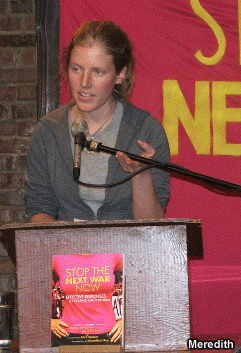
Meredith Dearborn was studying at Yale University in Connecticut on September 11th 2001, when the World Trade Center in New York City crumbled into a smoking heap of debris. Along with other women around the world she is now on the forefront of growing opposition to the U.S. war against Iraq. The Voz Journal asked Meredith to talk about her ideas and peace proposals.
"Our campus, which was very close to New York City, was silent for weeks in mourning," she recalls, but "despite my colleague's great sadnesss and astonishment, I also felt dismayed by the Bush Administration's reaction to the tragedy, which I felt to be misdirected and childish, based on grandstanding rather than on good foreign policy."
As a result she began a process of questioning.
"I wondered what would prompt someone to sacrifice their life to slap the face of a superpower, and felt there was a lesson to be learned here that the government and most of the country was intent on ignoring."
Then came the invasion of Iraq.
"When Iraq entered into the picture, and the press corps and government started beating the drums for war, I felt more than ever that this was the wrong answer to an exceptionally difficult question. I did not see any evidence that would indicate that Saddam Hussein had weapons of mass destruction, and felt that the skepticism of the United Nations on this front corroborated my opinion that the WMD's were just a piece of very effective rhetoric."
She also felt uneasy about Washington's claim about an alleged hook up between Al Queda, Saddam Hussein and the September 11th terrorist attack.
"Hussein was clearly a dictator of the worst order, but I fundamentally believe that the international community must engage these issues with foresight, diplomacy and reason, and that there are non-violent ways of influencing even the most gruesome leaders, if we work collaboratively."
"So this process of questioning led you to the peace movement..."
"Actually it was this difference of opinion with my government that led me to wonder about the business side of war-the so-called 'war machine.' War is fabulous business for politicians, who enjoy the relative malleability of public opinion during wartime-when disagreement and dissent can easily be labeled as unpatriotic. That is something we are now witnessing. War is immensely profitable for companies such as Halliburton, in the business of reconstructing blasted countries, and Lockheed Martin, which makes dramatically expensive weaponry. Should we be surprised then, when those in power make war and benefit from it?
"True indeed. Have you also worked in the peace effort outside the United States?"
"Yes. I lived in Nicaragua for four mounths, working with a local rural community. I have also spent a summer in Europe, mainly in Spain, and have done extensive research at the U.S.-Mexican border concerning the 'maquiladoras' and worked with women and men in the shantytowns across the border. I find it lovely and quite easy to speak with people from outside the U.S. and with persons whose background are different from mine."
"Do you consider working outside the U.S. to be an educational experience?"
"Oh certainluy. It's often like getting a year's education in the span of one conversation. In fact, my politics are usually more aligned with theirs than with my fellow (North) Americans. During the 2004 U.S. presidential elections I was in Managua, Nicaragua, and the first thing people would say to me was 'who are you voting for?' My answer was usually a grin and '¡Kerry, como no!' Then we'd all laugh. It's not hard to break that kind of ice, and people are generally really relieved to know that the caricatures are wrong, that alll Americans aren't gun-slinging Republicans. We all have a lot to learn from each other."
"How do you feel about the unending wars the U.S. has been involved in?"
"I'm only 23, so my memories of war are limited. My grandfather fought in World War II, though, and my uncle in Vietnam. Their stories involve great sadnesss and courage. War makes for good stories, but also tremendous pain and suffering: the experience of fighting has deeply affected both relatives. In terms of my own support for America's wars, it's hard for me to judge because our history has been written by the vistors and all I know of these conflicts has come from books I have been allowed to read. I don't feel that I'm in a position to judge the justness of a war on which I have such a limited perspective. However, as I understand it, the U.S. has continually demonstrated a tendency to enter into self-interested conflicts. The wars in the 80'' with Central America, in the 70'' with Korea, in the 60'' with Vietnam, in the 90'' with the first Gulf War...all were quite profitable for either the political or the economic capital of the U.S. That'' wrong of course: people'' lives are far more important than profits.""
"Why do U.S. citizens find it so difficult NOT to believe in and support their government's policies?"
"Well, it's a very effective political move to judge dissenters in terms of their love for their country. As an activists, I deal with this kind of vitriol all the time. Usually I quote the great patriots who have questioned their governments, such as Carl Schurz, who said in 1869: 'It is my country, right or wrong;when right, it is my duty to keep it right; when wrong, to set it right.' True patriotism, in the best of the American tradition, does not mean blind support but rather educated criticism and reform or revolution if morally necessary. Jefferson said this too."
"Would you say then that the Bush Administration utilized the supposed existence of weapons of mass destruction to gain support for the invasion of Iraq?"
"Unquestionably. It was a public relations blitz. I think the press was absolutely compromised in propagating the falsehoods that Bush used to convince the country and Congress to go to war. We in the anti-war movement at that time were baffled at how people could wholeheartedly believe that Iraq had weapons of mass destruction and ties to Al Queda, without a shred of evidence. What makes that kind of blind faith more plausible is that we weren't just hearing the pro-war messages from the president's mouth. We were reading it in the New York Times, in our local papers: we were seeing it paraded around as fact on TV news programs. For the press it was the truth and that made dissent difficult. No one was questioning it, except for demonstraters in the streets, who had no direct accesss to the big press and thus no real way to get our message into the mainstream."
"How did the movement against the war begin in the U.S.?"
"Well, going back to the Vietnam War, opposition grew slowly, becoming a popular groundswell by the end of the ten year war. In the case of Iraq, we had already built a huge movement even before the war began, culminating on February 15, 2003, when almost 40 million people around the world took to the streets to say no to war. But when we were unable to stop the war, people became disillusioned. Ever since then we have been trying to rebuild that lost momentum, and it wasn't until the summer of 2005, when Cindy Sheehan stood outside President Bush's Crawford, Texas, ranch for a month that we got our second wind."
"Do you see any hook up between the present anti-war movement and that against the Vietnam War?"
"Our present movement lacks the Vietnam era's great tangible domestic motivator: the draft. There is nothing like compulsory service to mobilize young people against a war. The U.S. government learned that lesson well during Vietnam, and even though the military is now having tremendous difficulty meeting its recruitment quotas, the government is loath to impose a new draft for fear of igniting a huge youth-based anti-war movement. What is interesting, however, is that the presence of military recruiters in schools has almost re-created the same kind of popular resistance as the draft did. When a mother faces the prospect of losing her child to a war that seems increasingly unjustified, she recoils at the idea of seeing recruiters on the high school playground demonstrating how to lob a hand granade. In contrast to Vietnam, now the peace movement recognized early-on that the soldiers and their families could be our best allies. Groups such as 'Military Families Speak Out,' 'Iraq Vets Against the War,' 'Veterans for Peace' and 'Gold Star Families for peace' often take the lead in our marches. The number of soldiers speaking out remains small, but their testimony is incredibly powerful, and brings a vital dose of reality to a war that is often either sanitized or ignored in the nightly news."
"Women seem to be strong protagonists in the movement. What do you attribute that to?"
"In any conflict women are disproportionately affected by warfare. In Iraq women trying to raise children and keep safe families in the war zone must cope with destruction of sanitation systems, the loss of electricity and clean water, a dearth of the social services upon which many women rely. Here in America a staggering proportion of our federal funds and tax dollars are being siphoned awar from public libraries, health care and education. Millions of American children are uninsured, yet our defense budget is bloated beyond reason, used to prop up a failing occupation and a seemingly endless conflict overseas. This imbalance in federal dollars affects women and children the most; so though it seems like the major players in war are men, war is actually very much a woman's issue. Because women bear the brunt of the cost of war, we should be the ones sto initiate the peacemaking process. In fact, the UN Security Council recently passed Resolution 1325, a document that essentially emphasizes this point, saying that women are uniquely situated to be peacemakers in a world dominated by men of war. In this spirit, CODEPINK: Women for Peace has launched this campaign, "Women Say No To War." We are gathering 100,000 signatures-mostly from women and decidedly from international women-before March 8, International Women's Day. The message of the campaign is very simple: women don't want warfare anymore; instead, we want to help create an alternative process by which countries can settle their differences."
"Do you reach out towards men too?"
"In CODEPINK we tend to mirror the kind of world we want to see in the way we work with each other. We have a more collaborative, less hierarchical approach to our organizing than some male-driven groups. We tend to be more open to new ways of thinking and new strategies. We relate viscerally to the pain of mothers in Iraq and here in the U:S. who have lost their children. It's the desire to stop more suffering that keeps us going at our frenetic pace. We juggle a million tasks at once organizing rallies, writing alerts, training newcomers, fundraising, building networks locally and globally amidst all the work and the constant barrage of bad news, we remain creative, joyful, playful and optimistic. I don't know many men who could juggle all that!"
"Has the women's peace movement been subject to harassment?"
"Well, the U.S. government has spied on us, to be sure. On Mother's Day last year a small group of women from CODEPINK and the Raging Grannies (a protest group of charming elders who sing clever songs about stopping war) held a rally in Sacramento, California, at which there were several spies from the National Guard. This has been well-documented and has raised quite a few eyebrows here when it was uncovered. The new PATRIOT Act contains clauses that could throw us in jail for disrupting political gatherings-a tactic CODEPINK has used to great effect in the past. One of our interns here is from Italy. She was absolutely blown away yesterday when there were more police than protesters at a demonstration in San Francisco. There were helicopters circling overhead, cops in riot gear standing by, and generally no noise from the crowd. It's a very effective intimidation tactic."
"Have you received support from Arab women? What has their reaction been to your programs?"
"It is certainly difficult to reach out to Arab women for a variety of reasons: language, cultural differences and political repression. But despite those obstacles, we have been pleasantly surprised by the support of Arab women and the interest they have in working together. We've been invited by women in Lebanon to come and meet with women from the region. We have a group of Iraqi women trying to come join us in Washington on March 8th (despite all the risks on their part) and we have many Arab-American organizations in the U.S. that are behind this effort."
"How might the increasing arrival of women to positions of power around the world affect the peace movement?"
"I absolutely believe that if we are to succeed in bringing about social and political change, we must build peace and equality from the ground up. We must, as Ghandi said, be the change we wish to see in the world. I see women are already doing this, all over the country and the world; we have connected with amazing women through this campaign who are heads of organizations, who sit on continental Parliaments, who are in the process of building peace in the most inhospitable of places. Women are assuming roles of power, it's true, but here are also many ways of being influential and making change. Some of the most inspiring and prominent women are acting in grassroots roles: they are the ones stepping to the plate, feeding their communities, building community centers, educating their local governments, founding charities to support women's rights overseas. CODEPINK has 230 local chapters throughout the U.S. and abroad. These women do incredible work in their communities. Some hold vigils every week. Others stage small gatherings of three women who want to educate themselves and their families about the realities of war. The grassroots are vital. I also belñieve that women in positions of power can also help shift the balance awar from war as foreign policy. But there are plenty of women politicians here in the U.S.-Senator Hillary Clinton and House Minority Leader Nancy Pelosi among them-who have continually supported the war in Iraq and continue to vote to fund it. Nevertheless, as I mentioned before women as a whole do support peace more than men do, so I see great potential in women taking on greater roles as leaders. But I also see a different model of social interaction taking hold, one that empowers women at the local level so we make systemic change from the ground up."
"What kinds of comments do you hear from the women you work with concerning the war and the peace movement?"
"Well, let me tell you about two Argentine women who have written me letters this week: Raquel Soprano de Witis and Miriam Mabel Medina. Both are mothers whose sons were killed in police violence over the past years. Miriam, whose son Sebastián Bordon, was killed in October of 1997, founded the Casita Sebastián in his honor; the Casita is a kindergarten for underprivileged children. Miriam has also organized a group called 'Madres de Lucha,' an organization of women who have lost children that is struggling to end violence against youth. Raquel lost her son, Mariano Witis, when he was just 23, on September 21, 2000, also in police violence. After that day she and her family have worked to ensure that her history is not repeated. It seems at first glance that these women are addressing different issues than we are. However, as I mentioned in the last question, peace begins at home, and if we are going to counter the war machine, we will do it from the ground up. What they are doing is vital to the peacemaking process. In fact, both women emphasize that they endorse the Call because they believe that peace is possible. The messages I received are peppered with words of hope and great love, of solidarity and understanding, a belief that violence of all institutional origins, whether in warfare or at the hands of the police, cause pain to women and so we should be the one to fight back. We couldn't agree more."
"What is your evaluation of the present situation in the world?"
"Wow! What a question! I believe the war makes profits for a few very wealthy men. I believe that the war in Iraq is a political tactic, and a way to secure the nation's oil requirements. I believe that it's geopolitical, that the Middle East is a very strategic location for the United States to maintain indefinite influence and military presence. In terms of the feasibility of ending this war, the war must end at some point and I believe that can happen while Bush is still in power. Public opinion is turning drastically against the war. There has been a real sea change in how Americans are thinking about the war in Iraq since the war's inception in 2003. Six out of ten Americans believe that going to war in the first place was a mistake. To some extent, we are exercising our democratic rights and rising up across borders to counter a war that has drained our resources and murdered our brothers and sons. We've had enough of it, and we believe that the faster and harder we work, the sooner this war will end. We have wonderful politicians who believe that this war needs to end. Here in California, Democrats Lynn Woolsey, Barbara Lee and Maxine Waters are working hard in Congress to pass legislation that will bring the troops home. To some extent, as the American people grow increasingly tired of war and increasingly involved in politics, those in power will have to start listening. Our movement and this campaign are emblematic of a significant shift in public opinion. We're just riding the wave."
Meredith Dearborn
http://www.womensaynotowar.org
http://www.womensaynotowar.org
Email: info@womensaynotowar.org
__________________________________________________________________________
THE CALL:
We, the women of the United States, Iraq and women worldwide, have had enough of the senseless war in Iraq and the cruel attacks on civilians around the world. We've buried too many of our loved ones. We've seen too many lives crippled forever by physical and mental wounds. We've watched in horror as our precious resources are poured into war while our families' basic needs of food, shelter, education and healthcare go unmet. We've had enough of living in constant fear of violence and seeing the growing cancer of hatred and intolerance seep into our homes and communities.
This is not the world we want for ourselves or our children. With fire in our bellies and love in our hearts, we women are rising up - across borders - to unite and demand an end to the bloodshed and the destruction.
We have seen how the foreign occupation of Iraq has fueled an armed movement against it, perpetuating an endless cycle of violence. We are convinced that it is time to shift from a military model to a conflict-resolution model that includes the following elements:
- The withdrawal of all foreign troops and foreign fighters from Iraq;
- Negotiations to reincorporate disenfranchised Iraqis into all aspects of Iraqi society;
- The full representation of women in the peacemaking process and a commitment to women's full equality in the post-war Iraq;
- A commitment to discard plans for any foreign bases in Iraq;
- Iraqi control of its oil and other resources;
- The nullification of privatization and deregulation laws imposed under occupation, allowing Iraqis to shape the trajectory of the post-war economy;
- A massive reconstruction effort that prioritizes Iraqi contractors, and draws upon financial resources of the countries responsible for the invasion and occupation of Iraq;
- Consideration of a temporary international peacekeeping force that is truly multilateral and is not composed of any troops from countries that participated in the occupation.
To move this peace process forward, we are creating a massive movement of women - crossing generations, races, ethnicities, religions, borders and political persuasions. Together, we will pressure our governments, the United Nations, the Arab League, Nobel Peace Prize winners, religious leaders and others in the international community to step forward to help negotiate a political settlement. And in this era of divisive fundamentalisms, we call upon world leaders to join us in spreading the fundamental values of love for the human family and for our precious planet.
THE CAMPAIGN:
In January of 2006, CODEPINK: Women for Peace announced its latest campaign, Women Say No To War. On that date, they launched a website, http://www.womensaynotowar.org / http://www.womensaynotowar.org where the group is gathering a hundred thousand signatures in support of their Women¹s Call for Peace. On International Women¹s Day, March 8, CODEPINK will deliver these signatures to the White House, and to U.S. embassies abroad.
At the beginning of this campaign CODEPINK made a concerted effort to reach out to the heads of organizations, prominent women, parliamentarians, and others across borders, and ask them if they would support this women's call for peace. The response was overwhelming, and the group received 250
signatures at the outset from prominent women across borders who are working both at a grassroots and at a governmental level for peace. At this point, six members of the European Parliament have signed on, as well as members of the UK Parliament and the German Bundestag. Women from grassroots groups in
Pakistan, Colombia, Fiji, Puerto Rico, Austria, Spain, Vieques, Poland, the UK, Kyrgyzstan, Thailand, Israel, Palestine, Japan, Argentina, Australia, Canada, Belgium, Panama, Serbia, Finland, the Netherlands, Bosnia, Greece, Mali, Burkina Faso, Morocco, Canada, the Philippines, Pakistan, Canada, Jordan, Italy, New Zealand and France have signed the call. The campaign has the support of Cindy Sheehan and other military families, conscientious objectors, and former diplomats.
More information about the campaign is available at www.womensaynotowar.org
http://www.womensaynotowar.org/ , or by email at info@womensaynotowar.org
"La Mazamorra, ¿sabes?, es el pan de los pobres,
la leche de las madres con los senos vacíos,
yo le beso las manos al Inca Viracocha
porque inventó el Maíz y enseñó su cultivo…"
-Antonio Esteban Agüero--
El sol se prepara para dormir entre las nubes blancas, grises y negras que bailan sobre los picos y cumbres de la sierra de Comechingones. Abajo, en Merlo, un pueblo de microclima en la provincia de San Luis, se está por iniciar el festejo conmemorando los 89 años del nacimiento de uno de los más grandes poetas argentinos: Antonio Esteban Agüero, ecologista, amante de los bosques, de los pájaros, de las hierbas, del agua de manantial, del sol y de la luna.
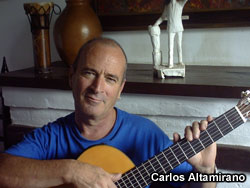
Jorge "Coco" Altamirano, el encargado de la "Casa del Poeta Agüero," un hombre alto, amable, de voz honda y modulada, cantante, conocedor y amante de los versos del poeta, invita a los visitantes que pasean admirando la arquitectura colonial del edificio, a una charla gratuita sobre la vida y la obra de Agüero, un escritor descendiente de españoles e indígenas, cuya voz resuena fuerte en la conciencia de los antiguos pobladores de Merlo.
--¡Adelante! ¡Adelante! Les invito a esta charla para conocer la casa del poeta y hablar sobre la vida de Antonio Esteban Agüero…
--¿Es una réplica o la misma casa del poeta?
--Es la misma que habitaba Antonio. La hemos arreglado un poco, el piso especialmente, y la hemos adornado con los muebles que usó el poeta. Dejó una obra maravillosa pero lamentablemente hasta ahora desconocida. Murió muy joven, a los 53 años, en la década de los '70. De haber vivido tendría hoy 89 años. Se han publicado apenas cuatro libros, que no llegaron nunca al gran público. De todos modos, dejó una obra inédita muy grande y exquisita. Por eso la gente de Merlo lo ha llegado a conocer como uno de los grandes de la poesía latinoamericana, sin que en el resto del país se haya conocido su obra.
--¿Nació aquí mismo?
--No. Nació en 1917, en Piedra Blanca, un pueblo a seis kilómetros de Merlo. Dos años después muere su padre y se viene a esta casa a los dos años.
En efecto, el poeta mismo, de magistrales pinceladas, explica:
"He nacido y me he criado entre montañas. Todos mis días han transcurrido en íntimo contacto con la madre naturaleza al amparo de los viejos árboles. Mi actitud hacia ellos fue siempre, desde mi primera infancia, una extraña clase de amor…Conozco los secretos del bosque, la soledad que fluye de los viejos troncos vegetales a la manera de una fragancia íntima, el silencio absoluto, bárbaro y delicado de la montaña donde el menor ruido, el más leve sonido, asume de pronto la importancia de un trueno terrible. Conozco cada hierba, cada florecilla silvestre, cada bestezuela, la época de celo y de nidificación de cada especie de pájaros, el canto diverso de cada corriente de agua, la forma y el color cambiante de las nubes, y toda música que hay en el aire…."
Tanto fue su amor por la naturaleza, que Antonio prácticamente no escribió poesías de amor. Su padre murió víctima de la epidemia de la gripe española que asoló al mundo en ese momento.
Jorge Altamirano respira profundamente, sus dedos recorren su guitarra, luego continúa relatando la historia:
--Esta casa era de los abuelos maternos. El abuelo tenía una biblioteca grande en esta misma habitación y aquí se comenzó a gestar el destino de Agüero. Era lector precoz. Se pasó su juventud leyendo y es en esta habitación donde adquiere el conocimiento, el manejo del idioma. Sus padres eran maestros y poetas. Desde muy jovencito iba por las calles de Merlo con total desenfadado diciendo y componiendo poesías. Y bueno, la gente del pueblo decía que el niño estaba medio loco. Pero el niño Agüero llegó a ser ministro de gobierno, constituyente, ministro de cultura y educación, era maestro y definitivamente no estaba loco. Era un hombre libre simplemente y sobre todas las cosas, poeta.
Luego, el encargado tomó la guitarra y cantó y encantó al público con una parte de una cantata de 25 minutos sobre "El abuelo," un árbol algarrobo de entre 800 y 1.200 años muy querido por su familia: .
--"La cantata al Abuelo Algarrobo" es una de sus obras maestras, un himno a la ecología no superado hasta el momento. Comienza así:
"Padre y Señor del Bosque,
Abuelo de barbas vegetales,
yo quisiera mi canto como torre
Para poder alzarla en tu homenaje;
no el canto pequeño de la flauta
dulce, delgada, suave,
la de cantar la rosa y la muchacha,
sino el canto del mar, un canto grave,
con olores de vida y con el pulso
musical y viviente de la sangre.
Algarrobo natal. Abuelo mío.
Hace mil años la paloma trajo
la menuda simiente por el aire
y la sembró donde Tú estás ahora
sosteniendo la Luz en tu ramaje
y la Sombra también cuando la noche
en larga lluvia de luceros cae.
Así naciste. Cuando tú crecías
la región era bosque impenetrable,
con oscuros guerreros que danzaban
junto a los fuegos al caer la tarde
y con nombres diaguitas en los ríos,
sobre todas la bestia y las aves,
una tierra sin mapas ni ciudades,
donde dioses sedientos presidían
al cortejo y el ritmo de la sangre
que vertían pintados hechiceros
para aplacar cóleras solares.
En tiempo aquél la arena numerosa
que festonea las playas litorales
ignoraba las máscaras de proa,
las amarras y el ancla de las naves,
sólo sabía de los pies desnudos
y de la huella digital del ave;
era cuando los ríos conducían
lentas piraguas sobre remos suaves
más no la ambición del maderero
que asesina al futuro en el obraje
y convierte en silencio de moneda
la rumorosa fiesta de los árboles;
por ese entonces, mientras Tú crecías,
Algarrobo natal, Señor y Padre,
la tierra nuestra en libertad vivía
hacia todos los rumbos cardinales,
desde el paraje que el Ceibo ruboriza
desde el país del Ona y la Ballena
hasta el infierno vegetal de Cáncer,
desde el paraje que el Ceibo ruboriza
a la región que señorea el Huarpe.
Sin conocer ejidos ni parcelas,
ni muro torpe o codicioso alambre,
donde el hombre y la bestia convivían
estrechados por lazos fraternales,
y la luna era Quilla y el Sol Inti,
el día joven y la noche grande.
Así creciste un día y otro día,
hacia abajo y arriba, penetrante,
con las raíces cada vez más hondas
y la copa más alta y dominante,
en crecimiento que fue dura guerra
sostenida y ganada a cada instante
contra el viento del sur y la sorpresa
del rayo azul y su puñal tajante,
contra el cierzo de julio que traía
los rebaños de nieve trashumantes,
contra la sed en el ardor de enero,
cuando gentes y plantas implorantes
alzan ojos y hojas a las nubes
por si las nubes sus entrañas abren
y la lluvia se vierte generosa
en licor de celestes manantiales.
Pero ya Tú eres lo que ahora miro
Algarrobo natal, Señor y Padre!
Con estos ojos que el amor habita
Y los otros secretos de la sangre:
Un árbol rey, un árbol solo, el Árbol
Sin edad en el tiempo y en el aire,
A cuya sombra hace doscientos años
A favor de un designio inescrutable
Se fundó mi casona solariega
Sobre honrada cimiento de linaje."
Luego de los aplausos, Jorge comentó:
-- Realmente Agüero tenía figuras poéticas y metáforas muy bellas. Era un pintor de la palabra. La cantata termina en una fiesta:
"…así yo quiero terminar la
Boda, asistido por
Ángeles del canto
Algarrobo mortal
Abuelo nuestro catedral de los pájaros."
Luego explicó que el padre de Antonio era Francisco Antonio Agüero, español de Castilla, que se casó con una princesa indígena de la zona. Y esa unión generó una genética muy fuerte de parte de la primera abuela india, pues Antonio estuvo muy orgulloso de sus marcados rasgos aborígenes.
Alguien pregunta sobre la poesía "La Mazamorra." Jorge contesta:
--Antonio dice que la mazamorra es el pan de los pobres porque no hay otra comida más barata. Se dice que es la leche de las madres de senos vacíos porque el jugo de la mazamorra substituye la lecha materna. Es un alimento muy potente. La gente del campo conoce muy bien sus propiedades. Dicen que si la quiere perfecta, hay que cocinarla en olla de barro, con amor, pues ninguna cosa importante se hace sin amor. ¿La magia? Cuando uno come la mazamorra uno debe sentir las mismas cosas que siente el abuelo cuando la come.
Agüero tenía preocupaciones políticas, pero desde la poesía. Esa más:
--"El Capitán de los pájaros," es la poesía más hermosa que he leído en mi vida y por esa obra estuvo preso en 1952. Alguna mente enferma leyó el poema e hizo la denuncia ante la Policía Federal, alegando que Agüero estaba reclutando un ejército para derrotar al Presidente Juan Domingo Perón. Y ese mismo poema fue utilizado en la campaña de un ex presidente, riojano, alto el hombre, rubio, de ojos celestes (dice con ironía) Carlos Saúl Menem, quien puso de moda la frase "el hambre de los niños pobres y la tristeza de los niños ricos."
El poema dice:
"Yo, Antonio Esteban Agüero,
Capitán de los pájaros,
General de livianas mariposas,
estoy en Buenos Aires,
la capital del Plata,
para ser presidente
y organizar la Patria.
Detrás he dejado
los pueblos que me siguen,
ejército de alondras
la división blindada de los cóndores
las águilas que saben del sabor de la piedra,
calandrias
chalchaleros,
chiriguas mañaneras
los secretos lechuzos que me pasan
la información del día y de la noche.
Tengo un millón de caballos
¿Escháis su relincho?
que rodean la urbe por
sus cuatro costados,
sus jinetes son muertos de Facundo,
son muertos de Ramírez
montoneros del Chacho,
sableadores de Pringles,
demaderes
remeseros,
rastreadores,
guitarreros,
espectrales jinetes
que cabalgan
mi millón de caballos.
Les ruego que se rindan
que depongan las armas,
que guarden los tanques,
y encierren sus cañones,
porque mañana a mediodía
quiero estar en la Plaza de Mayo
sobre viejos balcones del Cabildo
para ser presidente y prestar juramento:
Por los ríos de sangre derramada,
por los indios y los blancos muertos,
por el sol y la luna,
por la tierra y el cielo
por el padre Aconcagua,
y por todas las hierbas y los bosques,
y por el hambre de los niños pobres,
y la tristeza de los niños ricos
y el dolor de los jóvenes paridos,
y la agonía de los viejos.
Juro.
Yo juro.
Hacer de este país la Patria.
Ordeno que se rindan
porque mañana al mediodía
entraré en Buenos Aires.
Tengo un millón de caballos
(¿Escucháis su relincho?)
Nadie podrá atajarme.
--Jorge: es Usted músico, cantante, poeta, historiador…?
--Bueno, un poco de todo pero todo a pulmón. Soy músico, no soy historiador, pero sé un poco de la historia de San Luís por saber la obra de Agüero.
--¿Qué le llevó a Agüero?
--Yo estudiaba en la facultad de literatura y castellano en la Universidad de Villa Mercedes y tenía un profesor de literatura hispanoamericana que me llevó a la obra de Agüero.
--Es notable la cantidad de gente en el pueblo que escribe poesía…
--Se explica porque Antonio realmente convoca. Es un poeta muy grande. La obra de Antonio no tiene desperdicio y en este pueblo, que es chico y tranquilo, hay tiempo para el espíritu. Su gente escribe poesía porque es una actividad del espíritu y porque tiene tiempo para escribirla. Hay muchas personas que han venido aquí para vivir y que luego se transforman en poetas, o les sale el poeta que tienen adentro.
--¿Pero no es cierto que muchos de estos nuevos moradores han traído la ciudad en su hombros, el ruido, la obsesión por las conveniencias de la gran urbe…?
--Pues sí. Merlo ha crecido espectacularmente durante los últimos 15 años. Yo, por ejemplo, soy de Villa Mercedes y cuando llegué aquí había alrededor de 7.000 habitantes. En 10 años ya tiene más de 20.000. Y se puede imaginar el efecto que esta ola de nuevos habitantes ha tenido sobre la tranquilidad. Pero felizmente el crecimiento del pueblo se está haciendo en armonía. Hay normativas fuertes para los nuevos edificios y casas: no pueden tener más de dos pisos. Además en el pueblo hay una conciencia muy fuerte sobre la ecología, muy importante, incluso en las escuelas.
--Otra curiosidad es la cantidad de gente de raíz socialista…
--Es cierto. Yo creo que como en una época se dijo que el socialismo estaba acabado, ahora se está diciendo que el capitalismo está acabado. Tenemos que volver a hacer un poco más solidarios, a tener conciencia sobre lo que son loas prioridades. No puede ser que mil personas sean los dueños del mundo mientras al mismo tiempo hay tanta gente que pasan hambre.
--¿Qué dirán los abuelos originarios del mundo actual?
--¡Qué cosa! Los indios nuestros habían llegado a tal grado de cultura que no trabajaban. Vivían felices en sus rucas en la montaña, de lo que les daba la naturaleza. Sembraban poco y recolectaban lo que daba la naturaleza, cazaban algún bicho para un asado…
--Le parece que la obra poética de Agüero ha dejado algún mensaje para el mundo actual?
--Sí. Lo escribió Antonio y es lo que está en "La Cantata del Abuelo Algarrobo:" ¡Cuidado con el corte de los árboles en las Amazonas, el pulmón del mundo, y que seamos más solidarios."
Jorge "Coco" Altamirano, encargado de "La fundación casa del poeta",
Calle poeta Agüero 380 (588), Merlo, provincia de San Luís.
Email: cocomielprimero@hotmail.com , capitandpajaros@yahoo.com.ar
Tel: (02656) 476-545 / 476-698.
"Art thou in haste?
I'll not forsake thee;
Run'st thou ne're so fast,
I'll o'ertake thee:
O'er the dales, o're the downs,
Through the green meadows,
From the fields through the towns,
To the dim shadows.
-William Rowley (1585-1642)
Memory is such a frail thing, isn't it? Here today, gone tomorrow. You remember her face perfectly, maybe even that special perfume she used to dab on her neck, but what's her name? There used to be a small creek that criss-crossed your peach orchard but when you went back thirty years later it had vanished or been converted into a nameless suburban drain.
What is it that we actually remember? Times? Dates? Colors? Contours? Tastes? How something felt? A kiss? The blow that nearly sent you to Nirvana? How you chuckled with glee when Mama changed your diapers? And as for old man time, well, Henry David Thoreau's definition seems appropriate enough: "Time is but the stream I like to go fishing in."
So just imagine the difficulty a short-lived flesh and blood journalist might have in interviewing a subject of more than 1,000 years, born when who-knows-who was composing "Beowulf," when the Tiahuanaco culture in America had begun to spread over the Andes; or a bit later when Leif Ericson stepped on Nova Scotia or when Indian mathematician Sridhara recognized the existence of zero, when the Chinese were experimenting with gun powder, when men were inventing all sorts of flying contraptions in vain attempts to challenge the law of gravity, when an inspired Giovanni Boccaccio was writing about love, battle, cowardice, deception and courage or when multitudes of Christians were damned certain Judgment Day was right around the corner.
It was one of those splendid sunny days filled with resplendent sun rays. The scant clouds that arose from behind the mountain peaks formed ever-changing figures that magically transformed themselves as you stepped along the path, dodging bushes and admiring wild flowers of all colors. The air was sharp and charged with pure uncontaminated oxygen. The city and its thick layers of carbon dioxide were far behind. The only sounds were the flap-flap of bird's wings and their carefree chit-chat from the thickets and branches of the surrounding forest.
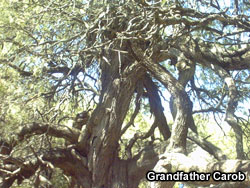
A slight opening of the dense vegetation led suggestively to a tiny meadow. There Grandfather Carob was waiting patiently for you to interview him. How amazingly sturdy erect and piliant he looked: his limbs stretching to the heavens and to the four winds, his torso firmly rooted on that very same plot of land that had served as his abode for so many centuries! Awe. That's the first sensation that swept over the visitor's entire being, then wonder, then an overwhelming and almost mystical calmness, the certainty of having tread upon a space of divine proportions, a temple, a cathedral, a mosque, an imposing santuary.
"Good afternoon," said the man of letters, fumbling with his pen nervously, "I've come to ask you a few impertinent questions....that is, if I may."
"Impertinent?" Grandfather Carob's voice sounded deep and clear and confident.
"Perhaps that's not the word...It's just...Is it true you're more than one thousand years old?"
"Ha! Ha! Ha! What can you do when you get past 100? You just stop counting."
"Really? I'm not even half that and yet for me time seems so precious."
"Time! What's that? But an invention of worried men like you."
There ensued a spirited silence, the kind of stillness that preludes the eruption of a strong emotion. How many men and women had become overcome momentarily by the same quietude decades ago, centuries ago? Grandfather Carob was beloved by all. Everyone defended, venerated and respected him. Long ago indigenous people used his fruit to make delicious and nutricious "añapa," "patay" bread or fermented drinks such as "chicha" and "aloja." (By the way, if you wander into remote interior areas in north western Argentina you can still see indigenous people eating patay and drinking chicha.) They also cured respiratory infections and consulted Grandfather on matters of love and resolved their conflicts in his presence.
"Please, Grandfather, tell me what the secret is!" The writer seemed strangely agitated, pressing the button on his recorder, then turning it off, scribbling illegible notes on his pad and looking as helpless as a lost sheep.
"First of all, patience. If you think of the end, come it will. It's better not to think of the end but to live in the present. The longer things take the better."
"You mean, for example, love making is better when done slowly?"
"Ha! Ha! Ha! Indeed you do ask impertinent questions young man! Everything worthwhile must be done without consideration for time but with energy, enthusiasm and dedication. How difficult it is for you modern men to understand! Forget about time! Time doesn't exist. It's the mere invention of worried men like you. What is eternal and timeless is Nature, the universe. It's your nervous mind that chops things up into separate units: time, light, darkness, death, love, hate, war, peace, birth, destruction. Can't you understand? Its all part of the one and only one. That's the only secret."
"It's not easy..."
"Look at me. That's right. Now what do you see?"
"Grandfather Carob."
"Yes. What else?"
"A certain roundness that seems to grow in every direction. Immensity which is nevertheless but a dot when compared to everything which surrounds you."
"Good. You're on the right track. What else?"
"A lung!"
"A lung? Indeed!"
"It is as if you were breathing with your entire body!"
"Of course, my dear fellow. We must respire through every pore, through every cell, from one extremity to the next. Only in that way can we realize we are one and part of one and since one is not divisible we also cannot be broken into pieces."
"Pardon me, Sir, I don't want to sound impertinent but I have seen so many of your friends and relatives smashed and broken and disintegrated and burned and turned into ashes..."
"Due to mankind's obstinate inability to recognize the notion of oneness. You chop and chop and dig and dig and pollute and inclose yourselves in plastic mirages; you dirty up the air, the land and the water and naively think you will find more out there in Nature to serve your selfish needs. You play with atomic power as if you were the masters of the universe and kill and rape and torture and slaughter each other in the name of lofty ideals that in the end represent nothing but your mad rush for power and money and separateness. You fail to see that you are planting the seeds of your own destruction."
"You've got a point there. But you haven't answered my question: how have you been able to survive without a scratch?"
"There is no way to put it into words. Words are beautiful but fail to understand the language of silence. Try it yourself! Go into the forest and say nothing. Just be. Feel. Open yourself up. Inhale, exhale. Listen. Listen to the oneness all around you."
"I will attempt that exercise, Sir, but I feel I lack preparation."
"Then listen to this poem by a dear friend of mine. Listen carefully, even though you do not understand Spanish. Close your eyes. Let your mind flow with every phrase.
"Yo, Antonio Esteban Agüero,
Capitán de los pájaros,
General por de liviana mariposa,
estoy en Buenos Aires,
la capital del Plata,
para ser presidente
y organizar la Patria.
Detrás he dejado
los pueblos que me siguen,
ejército de alondras
la división blindada de los cóndores
las águilas que saben del sabor de la piedra,
calandrias
chalchaleros,
chiriguas mañaneras
los secretos lechuzos que me pasan
la información del día y de la noche.
Tengo un millón de caballos
¿Escháis su relincho?
que rodean la urbe por
sus cuatro costados,
sus jinetes son muertos de Facundo,
son muertos de Ramírez
montoneros del Chacho,
sableadores de Pringues,
demaderes
remeseros,
rastreadores,
guitarreros,
espectrales jinetes
que cabalgan
mi millón de caballos.
Les ruego que se rindan
que dispongan las armas,
que guarden los tanques,
y encierren sus cañones,
porque mañana a mediodía
quiero estar en la Plaza de Mayo
sobre viejos balcones del Cabildo
para ser presidente y prestar juramento:
Por los ríos de sangre derramada,
por los indios y los blancos muertos,
por el sol y la luna,
por la tierra y el cielo
por el padre Aconcagua,
y por todas las hierbas y los bosques,
y por el hambre de los niños pobres,
y la tristeza de los niños ricos
y el dolor de los jóvenes paridos,
y la agonía de los viejos.
Juro.
Yo juro.
Hacer de este país la Patria.
Ordeno que se rindan
porque mañana al mediodía
entraré en Buenos Aires.
Tengo un millón de caballos
(¿Escháis su relincho?)
Nadie podrá atajarme."
There was nothing more to be said. The journalist bowed, clicked off his recorder, clipped his pen to his shirt pocket, and was on the point of leaving when Grandfather Carob said:
"Tell your friends to visit me at Piedra Blanca, San Luis province, Argentina, or drop by the La Fundación Casa del Poeta, calle Poeta Agüero 380 (588), Merlo.
Email: cocomielprimero@hotmail.com / capitandpajaros@yahoo.com.ar
Tel: (02656) 476-545 / 476-698.
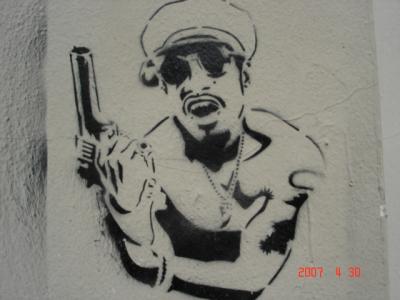
He was there staring at me out of nothingness.
I approached with trembling heart.
Did I know him? Did he know me?
That gun was pointing at me, wasn't it?
Or at you. Or at us.
I saw sadness in his face. Lonely chap.
Does the weapon make him feel loved? Powerful?
Motionless he was on a wall in Buedo,
"Buenos Aires, mi querida Buenos Aires..."
Gardel stuffed in a newly starched shirt
Time past, perhaps there on that street corner.
Guns, guns, blood and roses.
Justifications. Evasions. Smoke clouds.
The sewing ladies in Chicago
Gunned. The lesson of the boss.
May First, worker's day.
Everywhere except in Chicago.
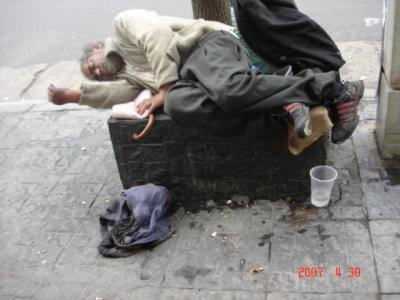
"Bajo el mismo techo,
--es Basho que habla--
durmieron las cortesanas,
la luna y el trébol."
También duerme un hombre olvidado:
¿Quién le robó aquel sueño largo,
lejano, bello y lleno de vida?

| If you live on those hamburgers, fried potatoes and dark gurgling bottles of coca cola you might well end up in jail for a crime. Perhaps that sounds a bit preposterous, but a recent study released by the U.S. National Health Institute reveals that lack of Omega-3 in your diet could make you more likely to commit an act of agression. A similar study carried out in England's Aylesbury jail showed that youths who consumed an adequate quantity of minerals, and fatty acids committed 37% fewer crimes. In fact, Lord Ramsbotham, the former United Kingdom jail inspector, said he was absolutely convinced of the direct relation between diet and anti-social behavior. The results of these studies should not surprise informed persons or scientists, concerned for some time about the negative effects of junk food diets. Lack of certain fatty acids (for example those obtained from fish oil) deprive the brain of the nutrients it needs to metabolize correctly, and may result in anything from extreme depression to acts of violence. Over the past century there have been rapid changes in the diets of the industrialized countries, with a significant replacement of the fatty acids of Omega-3 for those of commercialized oils taken from corn, soybeen or sunflowers. Although some exentrics have begun advocating go slow eating and working habits, most of the world's super capitalist countries are speeding along at an ever increasing rate and their inhabitants find it difficult to resist junk food marketing. So the next time you fall victim to an urge to gulp down a dish full of junk food, you might do well to take a deep breath and stroll down to the nearest fish market and enjoy a tuna fish salad. There is just a chance that that may mitigate your desire to slug your neighbor in the nose or rip off Tolstoy's "War and Peace "from your favorite book store. |
"There will always be someone who sees the splendor of beauty, the spirtuality
of pure ideals, although destiny obliges him to live surrounded by covetousness and mediocrity."
-- Marber--
"Music alone with sudden charms can bind the wand'ring sense, and calm the troubled mind.
-- William Congreve--
The absent-minded journalist glanced at his wrist watch, pursed his lips, gulped down the last lingering drop of coffee in his cup and rushed helter-skelter to the office where an accountant was waiting to be interviewed. Alas! In the downstairs lobby while biding his time for the arrival of the lift, an enchanting aria from "La Boheme"-in which poor Rudolfo once again confesses his love-seemed to pour out of the elevator shaft. "Can't be!" muttered the somewhat distracted reporter to himself, "I must be dreaming."
Still a bit taken aback by what must have been a fantasy, he knocked sheepishly on the door and introduced himself.
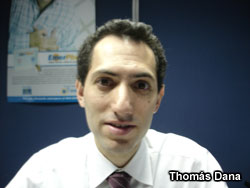
"Thomás Dana, the accountant? Pleased to meet you. I'm the reporter."
"Oh! Do come in."
"Well. I was wondering... Could I ask you a rather impertinent question?
"Go ahead."
"Ah...do you sing at work?"
"Ha! Ha! Ha! No, I'm afraid that's impossible. I mean I'm a sort of manager here and managers have to maintain an image in the public eye. But I sure would like to!"
"I see...ah...this question may sound a bit strange but...by any chance do you sing in the elevator? I mean I thought I heard..."
It was clear that the journalist had lost some of his usual aplomb, but Tomás just grinned and said:
"Could be. Sometimes when I take the elevator coming to my office or going home I tune up my voice. And you can imagine: in such a small place! There are people waiting and they wonder what's going on. They hear this strong tenor voice and seem dumbfounded. 'What's this? We must be at the Colon theatre but we aren't. We're at work.' And you know what? When I'm on the elevator with other people they don't pay any attention to me because I am so short. Anyway singing in the elevator is just a kind of joke I like to play on people."
"Ha! Ha! Indeed. I don't suppose there are many singing accountants..."
"I wouldn't say so. As far as I know I am the only one, at least in this office. "
"Would you say you are more accountant or more singer?"
"Singing came first but you must bear in mind that singing is an art and art is always in the process of development. It takes a long time to develop your voice and your artistic sensibilities-actually the process never ends. You have to advance step by step. As for accounting, well, I think it is easier. First you go to the university, you study, take exams and in five years or so you graduate, get your degree. become an accountant and get a job. But when you are involved with an art more than your intellect is involved: you put your whole soul into it. That takes a lot of effort."
"Would you say there is a conflict between singing and working as an accountant?"
"It has to do with time, lack of time. I work eight to ten hours a week, sometimes on weekends so that doesn't leave much time for singing. And since I live in a flat I can't practice late at night because the neighbors complain."
"I imagine they knock on your door saying they can't sleep..."
"Yea. But there seem to be two groups: those who think I'm disturbing and those who realize I am trying to better myself."
"Do you practice alone or do you accompanying your voice with the piano or some other instrument?"
"I did study piano but when I practice I do so alone because I have to work on each phrase and repeat it, develop it until it sounds right."
"What would you say is the most difficult aspect of the operistic style of singing?"
"Well, there are many difficult aspects but here in Argentine I believe that what is most difficult is to acquire good singing technique. We are in the midst of a crisis-perhaps the whole world is-in trying to find the best technique. Each teacher has his technique, so you have to choose. We singers use the whole body when we sing and the body suffers if you don't have good technique."
"You mean a singer uses more than his voice?"
"Certainly. There are many are many practical tools but the main one is vocalization and you must do each exercise correctly. That's why you need a teacher. You can't do it all by yourself. You need a teacher who knows the human body, psychology, someone who has a good knowledge of the stage."
"What about your own teacher."
"I've had a lot but now I am studying with an 80 year old Italian born teacher who sings very well, even at his age. In fact, he's a sort of Buddist in the way he teaches."
"You mean he uses oriental technique?"
"No. I refer rather to his attitude. You have to be introspective when working with the voice and that's what he teaches you. You have to control the body and sing without thinking about what you are doing."
"How do you bring emotion into your singing?"
"Well, for me the wonderful thing is when things begin to flow. There is emotion in the lyrics and in the music. But when you begin to feel the emotion of the composer, you are ready to add your own feeling. Take the opera "Carmen," for example. It makes me remember when I was young, when I felt rejected by women."
"Does the emotion come more from the lyrics or from the music?"
"It comes from both. You cannot divorce one from the other. It was Puccini who said the words have to fit perfectly with the music. He spent a lot of time choosing the right words for his arias. And if you improve your comprehension of the lyrics, you can then develop the music more masterfully."
"I suppose classical singing must be very demanding. Do you diet?"
"Well, I'm not a professional singer but you certainly must take care of your body if you have to go on stage night after night. Watch out for toxic dishes, fried potatoes, eat balanced meals, do light exercise, running or swiming but not the kind of gymn that demands a lot of stress."
"Getting back to your practicing at home: does your wife put up with your 'do-re-mi' drills?"
"Actually my wife loves to go to the opera. When she was young she told her mother she wanted to meet someone who liked opera and...maybe that's why we hit it off so well!"
"Bulls eye!"
"Yea. It was a sort of blind date. We struck it off fine because she likes music, especially instrumental music. When she was pregnant with my baby I would sing to her belly and now my young child shows she loves music because she tries to copy me when I sing. I like to think that music and opera could become a sort of legacy to her. If she wants to follow in my steps, fine, but I don't worry about that."
"In fact, some people say music has a therapeutic effect..."
"Yes, I believe so. Music is a sort of trip. It takes you to another world. And in opera you can pick the characters you want from Puccini or Verdi or...tragic or comic or romantic characters."
"Do you have a favorite aria?"
"There are lots but the character I like best is Rudolfo in "La Boheme." He describes himself as a poet, tries to live life from day to day till he finds his true love. He is a sort of bohemian until he finds true love. Unfortunately I don't think my voice is suited for the role but who knows, perhaps some day."
The journalist nodded and stood up, a quizzical expression momentarily spreading at the edges of his lips. He shook hands with the accountant-singer and headed towards the door, then turned and asked:
"Any advice for accountant-singers?"
"Yea. Those who work with numbers should try to find another discipline, especially in the arts, because that brings balance and harmony and makes you a better person."
Now, once again in the elevator, the journalist wondered whether his fantasy on the elevator an hour earlier about someone singing a Rudolfo aria had been real or not.
Tel:(5411) 4903-6963
Email: dant@longseller.com.ar
"Los impulsos preceden a las acciones físicas, siempre...es como la acción física, todavia invisible desde el exterior...si sabes eso, al preparar un papel, puedes trabajar a solas sobre las acciones físicas..."
--J. Grotowski--
Se ha dicho hasta el hartazo que el teatro es juego. Los niños saltan, intentan volar, se enojan, hacen muecas, gritan, lanzan insultos, ladran, se cubren de trapos, inventan discursos, arman trifulcas, matan a ladrones de a mil, planifican terribles batallas...A menudo los adultos se asombran de la inquebrantable convicción con la cual los pequeños reproducen sus fantasías. Y a veces los actores, directores y escritores vuelven a la infancia para nutrirse de materia prima.
Estamos en Montevideo, en el departamento del director teatral Amanecer Dotta, observando la plaza San Pedro, transportándonos hacia aquellos dorados días de la juventud cuando las acciones todavía no encontraban el freno de la conciencia.
--¿Pasó algo en su juventud que terminó despertando su interés en el teatro?
--Sí. Cuando éramos niños yo vivía en La Unión, en la calle Fray Bentos. Ëramos un grupo de muchachos de barrio. Un día se mudó junto a mi casa una persona que iba después a ser un amigo eterno, Alfredo Zitarrosa. Teníamos no sé si once años. Alfredo me introdujo la cultura a mi vida, con su biblioteca, sus libros. Un día nos pusimos a jugar y uno de los juegos era hacer una obra de teatro. Me acuerdo que la obra se llamaba ‘El niño que quiere ser perro.’”
--¡Jugoso título! ¿De qué se trataba?
--Había un niño que le iba mal en la escuela y veía sin embargo que los perros vivían sin grandes conflictos, hacían lo que querían. El drama de la obra era que el perro estaba atado a una silla. Yo era el director de la obra y Alfredo era el actor, el perro.
--¿Cantaba?
--Todavía no pero Alfredo era muy especial. Me acuerdo por ejemplo que una vez empezábamos a escribir una novela. El problema era saber dónde situar la acción. Entonces, abrimos un Atlas al azar y pusimos un dedo y el dedo cayó en el desierto del Sáhara. Alfredo puso la primera frase a la novela: “Con un sol que calcinaba la tierra, los dos amigos iban por el desierto…” La segunda frase la tenía que escribir yo. Y así sucesivamente. Puede usted imaginar el destino de aquella novela: tan corta como la enfermedad de Alfredo.
Hasta aquí llegó la entrevista con Amanecer, pues de regreso a Argentina, la mano de un ladrón hizo desaparecer la grabadora del periodista. No obstante, el robo permite algunas observaciones. Dotta trabajó luego en Cuba, organizando con gran éxito actividades culturales en los barrios y en las poblaciones que antes de la revolución casi no conocían el arte del actor. Ahora se empeña en una actividad similar en Montevideo y, en su tiempo libre, pone una palabra tras otra en una novela que ha de ser muy novedosa y en el cual el tango es protagonista.
¿Qué tiene que ver todo esto con el solitario ladrón que entró en un café en la avenida 9 de Julio y huyo con la velocidad de la luz, llevando como premio la conversación con Dotta? Es que quedan muy pocas personas como Amanecer, comprometidas hasta la medula con el teatro, consecuentes hasta los últimos detalles de su propio desarrollo artístico; personas que viven en y por el teatro. Pero su teatro es un “robo” en el sentido de representar un filtro alimentado por la vida de todos los días, transformado luego mágicamente en algo que la supera largamente. ¿Podemos imaginar al ladrón escuchando con atención a la grabación? ¿Habrá entendido que la verdad escénica es el premio del actor, que la transformación del actor en el personaje le permite “robar” una verdad al mundo real que le rodea…?
Contact: amanecer@netgate.com.uy
--
“Si el mundo está, como está, patas arriba ¿no habría que darlo
vuelta para que pueda pararse sobre sus pies?”
-Eduardo Galeano
Quizás la mejor forma de conocer un lugar es caminar, escuchar, mirar y conversar y luego conversar, mirar, escuchar y caminar. Es el caso de Merlo, un simpático pueblo orgulloso de su “microclima,” su tranquilidad, sus frondosos bosques de algarrobos, talas y molles y sus sabrosas parrilladas de chivito…
Pero se sabe que el dinero, la moda, la globalización y la “modernidad” no siempre son amigos eternos de la naturaleza. Entonces, los serruchos derrumban especies nativas, el agua se contamina o desaparece, el aire retumba con el ir y venir de los coches y la pureza de la atmósfera se altera y de pronto, incluso, cambia el tiempo…
Sobre la avenida Norte que une Merlo con Piedra Blanca, aparecen un cartel que anuncia: “Agrupación JuvennaT” y una flecha indicando que el curioso debe avanzar unos 150 metros más. Allí hay una casa con el mismo cartel. En los alrededores, árboles, arbustos y flores silvestres de todo tipo y adelante, las impresionantes sierras de Comechingones, que parecen hablar, cantar, rezar y reír según el momento del día. Dentro de la casa uno percibe las voces alegres de niños. Están mirando, entre sustos y risas, un video sobre los insectos peligrosos de la zona. Es un taller dictado por Carina Rives, de la comisión directiva de JuvennaT.
Ella explica después que JuvennaT significa juventud y naturaleza y que es una organización no gubernamental.
--Es una agrupación que desde hace 15 años está trabajando en la zona. Fue creada por un grupo de jóvenes. Ellos se daban cuenta luego de que necesitaban una comisión directiva y pronto empezó a llegar gente adulta y se tramitaron los papeles jurídicos correspondientes. Todavía siguen trabajando juntos adultos y jóvenes.
Uno de los últimos proyectos de JuvennaT fue un programa de reforestación de alrededor de 500 nuevos ejemplares de especies nativas en la zona de la reserva municipal de Rincón del Este. Se hizo de modo comunitario, con los chicos de las escuelas y con los participantes de los talleres de JuvennaT. La intención fue ayudar a la naturaleza a recuperar vegetación arbórea perdida debido al avance del desarrollo humano (sobrepastoreo, incendios, tala), para frenar la erosión en las zonas degradadas. Las especies de árboles que plantaron abarcaban talas, espinillos, duraznos de la sierra, manzanos de campo y talas falsos.
--El impacto ambiental del gran crecimiento de Merlo en los últimos 10 años debe haber sido fuerte...
--Sí, claro. Sucede que a menudo la gente subestima las plantas nativas. Dicen que son feas, que pinchan…Nosotros queremos que la gente redescubra todas las cualidades de la vegetación autóctona.
Algunos de los más conocidos son el algarrobo, cuya madera es dura y rojiza y se emplea tanto en la construcción de casas como en la fabricación de muebles. Con el fruto del agarrobo, los abuelos Comechingones hacían “añapa,” un rico jugo. Otra parte de las chauchas servía para fermentar y fabricar “aloja,” una bebida alcohólica. Lo que quedaba de las chauchas se secaba al sol para hacer harina y elaborar una rica comida: el “patay.” En la zona hay gran cantidad de plantas medicinales. Una de las más conocidas es el chañar, con cuya corteza se hace un té o un arrope, muy bueno para los resfríos e infecciones pulmonares. Las hojas del tala se usan también para afecciones del pecho y para diarreas….
--¿Con la urbanización de la zona se han ido cortando muchos árboles, verdad?
--La urbanización es uno de los peores males del lugar. Acá hay una zona protegida que es la del faldeo, pero la gente con más dinero siempre encuentra la forma de trasgredir y termina cortando molles. Por ejemplo, en el Mollar, lugar donde se delimitaron lotes de 400 metros cuadrados. Es una quebrada con una vegetación frondosa y muchos molles. La gente del lugar protestó contra el proyecto de urbanización y se logró pararlo. De lo contrario, se iban a sacar los molles con el correspondiente daño para el medioambiente.
--¿Quiénes son los dueños de la tierra que rodea la ciudad?
--Aquí todo es propiedad privada…¡incluso las montañas! Pero hace 20 años la tierra no valía nada. Uno podía comprar una montaña por $1.000 pesos. Ahora hay problemas vinculados con los límites de las propiedades, pues a menudo los papeles no estaban bien hechos.
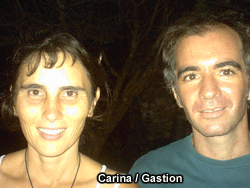
Gastón Peña llegó hace poco de Buenos Aires y comenzó a trabajar con Carina y la comisión de JuvennaT, diseñando un nuevo proyecto.
--¿Cómo es su proyecto?
--Se llama Vivero Educativo y es una idea que abarca varios aspectos, como senderos…
--¿Senderos?
--Sí. La idea es armar en este lugar senderos de interpretación sobre las plantas nativas y aspectos culturales relacionados con los Comechingones, el uso que daban los habitantes originarios a las plantas, las hierbas…
Carina explica que si bien no existe por el momento un peligro inminente para las plantas nativas, es algo que hay que observar atentamente.
--Es notable que los chalet y hoteles en Merlo usan con preferencia algarrobo en sus construcciones. ¿Se cortan los árboles en la zona o…?
--El otro día fui a una de esas casas de madera y me dijeron: ‘mañana viene el camión de Santiago del Estero.’ Se me pararon los pelos y salí corriendo. En general pienso que las maderas vienen de las provincias de Santiago del Estero y el Chaco.
--¿De aquí no?
--No, creo que no. Pero en las zonas de incendio recogen la madera y la venden como leña.
--¿Reciben el apoyo de la gente de Merlo para sus actividades?
--Bueno, hay un grupo bastante grande de gente que se inclina hacia nuestras ideas y nos apoyan. Pero en cambio, los comerciantes, el poder ejecutivo y los grandes terratenientes se sienten molestos por nuestras actividades.
--Por ejemplo, en el caso del agua.
--Le voy a dar mi opinión sobre el problema. Yo estuve en la comisión de emergencia hidráulica que se formó hace unos tres años durante una sequía muy grande. Para mí había que decir la verdad al turista: que ésta es una zona árida y por lo tanto hay que tener cuidado con el uso del agua, usándola lo menos posible. La mayoría de los comerciantes y dueños de hoteles decían que no, que cómo, que sería una vergüenza decir eso a los turistas. Pero yo insistí. Esta es una zona árida abastecida por el agua de los arroyos pero cuando no llueve, no hay agua…Ahora se ha hecho todo un estudio para ver si se puede traer agua de abajo, de pozos, pero claro, sería mucho más caro porque tendrían que subirla mediante bombas…De todos modos, a raíz de esta discusión se aprobó una ordenanza en la ciudad que establece que durante una emergencia hidráulica no se puede ni lavar autos ni llenar piletas. Entonces, hay más conciencia sobre el tema.
Carina mostró al periodista las diferentes plantas y árboles en el vivero y luego Gastón opinó que:
--A mí me parece que el proyecto de reforestación fue muy importante y el haberlo hecho con las escuelas y los chicos hace que ellos hablen con sus padres y de este modo se fomenta la conciencia sobre los problemas del medioambiente en la comunidad.
Por su parte Cecilia invitó a todos los interesados a acercarse al vivero y a hablar con los miembros de JuvennaT sobre el trabajo que se están realizando en la zona.
Carina Rives y Gastón Peña de la Agrupación JUVENNAT
Email: juvennat@merlo-sl.com.ar /
Sitio Web: http://www.juvennat.com.ar
Tel: 02656 -47287/ 474560
Dirección: Niña Mercedes S/N Barranca Colorada, Merlo, provincial de San Luís, Argentina. Horas de visita: de lunes a viernes de 9 a 13hs y de 14 a 18hs.
º "Busco las pequeñas cosas para emocionar al espectador para mostrar que mientras debatimos, e incluso mientras nuestros países se van a la ruina, la vida continua..."
--Adderrahmone Sissako, director cinematográfico
º "El teatro me saca de la soledad, porque es un trabajo que se hace en grupo..."
--Claudio Piñeiro--
º "Casi todos mis procesos de escritura surgen de la incertidumbre."
--Rafael Spregelburd--
º "Uno dice globalización y se piensa en algo que está fuera de todas las instituciones. Lo que sucede es que el estado se globaliza, especialmente el Poder Ejecutivo, pero la Legeslatura se domestica...Cuanto más se globaliza las empresas, más crecen sus funciones centrales de gestión en cantidad y complejidad."
--Saskia Sassen--
º "En realidad hay que salir un poco de si para no ser demasiado infeliz.
(I. de Charriere)
º "Las palabras de un hombre muerto se modifican en las entrañas de los vivos."
W.H. Auden.
º "¿Por qué necesariamente debo permanecer en un estado maltrecho, destruído, de sobreviviente lamentoso? ¿Acaso esto, este estado, es lo que él (el objeto) me ha dejado? ¿Por qué no podría estar, por ejemplo, contento de que haya vivido, de lo que me ha dado, y festejarlo, en consecuencia, al modo del homenaje?"
(Jacques Lacan)
º "Una gracia en las maneras, la chispa de nuestros ojos, el tono de voz, una viveza y una vibración generales expresan quienes somos mejor que las palabras."
(Alexander Lowen)
º "La respiración es vida y si respiras bien tendrás larga vida sobre la tierra."
(proverbio sánscrito)
º "Siento un poco de vértigo. No estoy acostrumbrado a la eternidad."
(J. L. Borges)
º "Pero hay que reconocer que tenemos problemas graves, profundos: una extraña enfermedad está erosionando nuestra ética y nuestros almas...sabemos que estamos entrando en una época de vorágine, pero aún no sabemos cómo será ni qué ocurrirá."
(Martín Scorsese)
º "El trabajo del escritor tiene mucho de embaucador, claro que sin una connotación moral."
(Antonio Benedetto)
º "Las posibilidades para decir algo en una sola frase son tantas...no me animaría a decir que son infínitas, pero son muchas."
(Alicia Steimberg)
º "Es cierto que hay una idea cuando me pongo a escribir, pero también tengo lacostumbre de dejar que la mano escriba sin pensar demasiado."
(Alicia Steimberg)
º "Para mí la música fue un hobby hasta que cumplí 15 años y me di cuenta de que ya viviía de la música pero que precisaba formarme como profesional."
(Dave Holland)
º "Creo que la improvisación ata un poco a la necesidad de una exposición y de una re-exposición...antes disfrutaba haciendo una música formalmente más abierta o incluso sin forma...trato de recrear ideas tradicionales, de hacer mi propia versión con la esperanza de que en ese proceso aparezca algo nuevo."
(Dave Holland)
º "Los idiomas tienen una franja que va de lo lunfardo a lo académico, y no hay nada en el medio para hacernos sentir más cómodos. La sociedad reprime el lenguaje en las zonas de actividades fundamentales de la vida, como la sexualidad."
(Ivónne Bordelois)
º "Los hombres están solos en la tierra, ésta es su tragedia."
( Dostoyevski)
º "Cuando trabajamos sobre los impulsos, todo queda enraizado en el cuerpo."
(Jerzy Grotowski)
º "Los impulsos preceden a las acciones físicas, siempre...es como la acción física, todavia invisible desde el exterior...si sabes eso, al preparar un papel, puedes trabajar a solas sobre las acciones físicas..."
(J. Grotowski)
º "Antes de una pequeña acción física, hay el impulso. Allí reside el secreto de algo muy difícil de aprender, porque el impulso es una reacción que empieza detrás de la piel y que es visible sólo cuando se ha convertido ya en una pequeña acción. El impulso es algo tan complejo que no se puede decir que sea sólo del dominio de lo corporal."
(J. Grotowski)
Let's face it: you know nothing. You go to work, pay your taxes, kiss your sweetheart, if you have one, go to the shrink before, after or during divorce, and wonder if what you read in the newspapers or on the web is really true, then go to bed and dream of delicious would-be worlds of peace, love and understanding.
For example: Maybe you browsed around the media until you found a scoop in "Le Monde," in which you learned about how French secret service agents had their eye on Osama bin Laden as far back as 1995, even infiltrating his organization, and--take note--the French spies sent the U.S. CIA information indicating plans in October of 2000 to kidnap airplanes and...so, using a bit of deduction, U.S. spies must have had a pretty good hunch that something big was going to happen. What did the U.S. spies do with that information?
A bit unsettled, you then hook into the British newspaper, "The Independent" and discover that the Iraq national inteligence service is totally financed by the CIA, at a cost of 3 billion dollars since 2004. You aren't a politician. You aren't a spy. You just work in an office, have frequent headaches and barely earn enough to make ends meet, but you think: who really upholds the government in Iraq?
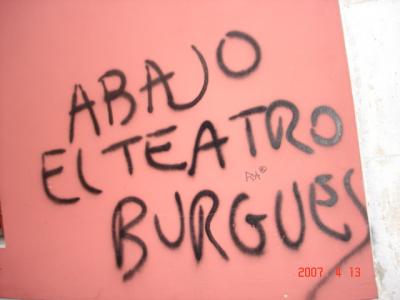
¿Será cierto eso que dicen, eso que dijo algún bardo barbudo, que todo el mundo es el escenario, que no hace falta más que un sólo espectador para producir ese milago que se llama teatro? Que no hace falta tener luces, ni decorados, ni cortinas, ni altoparlantes, ni muebles, ni críticos teatrales. Con un actor y una idea dramática basta y sobra, con una actriz que sepa transformar palabras y/o acciones en eventos transcendentales, basta y sobra.
Estas ideas primitivas van dando calor a tu conciencia, mientras vas caminando por la calle Humberto Primo, en San Telmo, Buenos Aires, y súbitamente tus ojos descansan sobre una pintada con las expresión "teatro burgués." ¿Qué será? ¿Es posible hablar de un teatro burgués, un teatro proletario, un teatro negro, un teatro homosexual, un teatro...es decir, un tipo de teatro que no pone el sudor y el sufrimiento del actor en el escenario como finalidad única? Está bien, cambalache, hoy día todo tiene su precio, todo se vende, paquetes de colores variados, contenidos sellados, encerrados...nada es lo que parece ser, mentiras, robos, torturas, normal, la vida de Susana Giménez, las reglas del juego...
¡Pero por favor! ¿No te das cuenta? Pensá en esas obras que hablan de la soledad, del individualismo, que sé yo, "La muerte de un viajante," "My Fair Lady," ¡ah! "El conventillo de la paloma..." esta obsesión con la dicción, con los valores de "occidente..." ¡Basta! Ya tengo la cabeza llena de hormigas. ¿No es que el actor debe tomar distancia, comprender sus personajes desde un punto alejado de la realidad? ¡Vamos payaso! ¡No sabés que en Roma a menudo mataban a los esclavos que "actuaban" en los escenarios? ¡Que la mayor parte de los espectadores son actores, estudiantes de actuación, madres, padres, primos, esposos, amantes de actores! ¿Que eso es precisamente el teatro burgués? ¿Y el proletario? Es un excluído de las bondades del capitalismo. No tiene ni tiempo ni medios económicos para estudiar teatro.
De repente, desde los bordes de la pintada saltan a la calle unas figuras que podrían haber sido hechos de papel descartado, de cartones, cajas, botellas de plástico, y con las manos extendidos y cruzadas, casi como el Buda, murmuran: "una moneda...una ayudita...¡por favor!" Tenés unas monedas en tus bolsillos pero igual apurás tu paso, pues estás pensando en esa frase pintada en la pared...teatro burgués...¿qué será?
Nobody knows who ventured first into the fascinating world of short-short-stories, sometimes known with a more academic term: micro-fiction.But probably the best known is this six worder by Ernest Hemingway: “For sale: baby shoes, never worn.” That leaves a lot up to the reader’s imagination, don’t you think? That’s precisely the idea of the super short tales. Here are some more (thanks to “Wired” magazine:º “He read his obituary with confusion.” Steven Meretzky.º “It cost too much staying human.” Bruce Sterling.º “To save human-kind he died again.” Ben Bova.º “Corpse parts missing. Doctor buys yatch.” Margaret Atwood.
º “When he woke up the dinosaur was still there.” (Cuando despertó el dinosaurio todavía seguía allí) Augusto Monterroso.
º “The last mano n Herat sat in a room. There was a knock on the door.” Thomas Bailey Aldrich. And then, more daring writers, have tried for less:º “How nice.(Que bueno), Luisa Valenzuela. (However the title was a bit longer: “El sabor de una medialuna a las nueve de la mañana en un viejo café de barrio donde a los 97 años Rodolfo Mondolfo todavía se reúne con sus amigos los miércoles por la tarde.)
º “Yo” (I) by Aloé Azid, with the title “Autografía” (Autograph) probably has no competitor for shortness. The idea of the super short stories is to provoke the active participation of the reader and for that reason there are as many versions as there are readers. Taking the classic by Hemingway, you might ask yourself questions such as: who is selling the shoes? What do they look like? Why? Why have they not been used? Has something happened to the baby? Who has placed the sign to sell the shoes? Although all of this sounds simple, once you sit down to write a short-short short story you might well come to the conclusion that nothing worthwhile is easy.