Blogia
Buenos Aires Jaque Press, en inglés y español

Revista (Magazine)

El viejo y el río, una saga de agua, tierra y luz...

El viejo y el río, una saga de agua, tierra y luz...

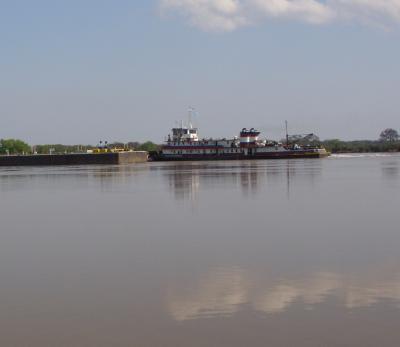
    A lo lejos, un barco cargado de granos avanza hacia Buenos Aires. Es una lástima, dice uno de los pescadores, pues la soja ha traído mucha plata a algunos productores pero se están desmontando bosques naturales para plantar más...

El viejo y el río, una saga de agua, tierra y luz...

El viejo y el río, una saga de agua, tierra y luz...

El viejo y el río, una saga de agua, tierra y luz...

El viejo y el río, una saga de agua, tierra y luz...

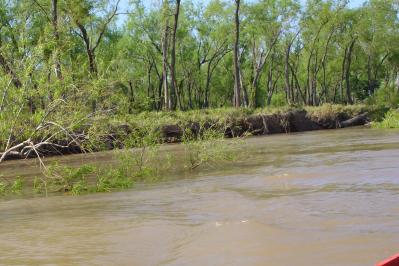
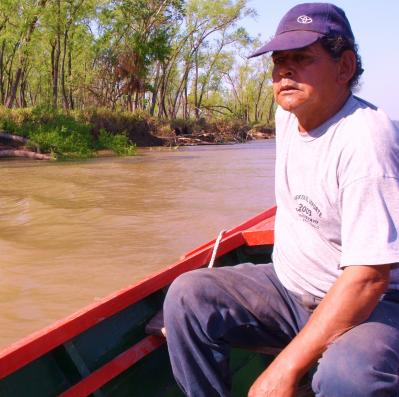
     Ramón mira al horizonte, firme al timón, pues hoy el río no guarda sorpresas; mañana es un incógnito. El agua fluye sin cesar, buscando su destino, ahora con tranquilidad, pero cuando las inhundaciones río arriba tiran torrentes de agua al Paraná todo se agita y se torna impredictible. La naturaleza es así: tiene su lógica pero la furia de las tempestades constituyen parte de todo un sistema increíblemente complejo de relaciones.

     Por precaución el huesped ha pasado al bote de Ramón, pues el otro bote está muy cargado y el agua ha comenzado a invadir el fondo. No hay pelígro, pero los pescadores saben que la cautela es la reina.

     "Falta un poco más. El rancho del viejo Gómez queda allá cerca del claro en el bosque."

El viejo y el río, una saga de agua, tierra y luz...

El viejo y el río, una saga de agua, tierra y luz...

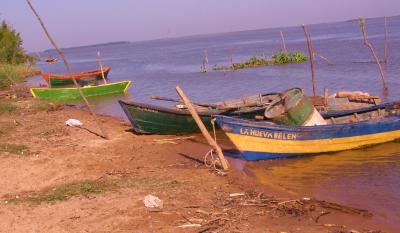
        El río Paraná espera, paciente, como siempre. En la sombra de esa construcción dantesca que escupe soja a los barcos, juegan chancos y perros. Llega el chico, tiene apenas 14 pero puede pasar por 20, y todos los hombres ahora entran en acción, cargando el bote con bebidas, algo útil para pasar un rato en la isla. Lejos se escuchan algunos sonidos urbanos, de la ciudad, de La Paz, la iglesia, algún moto corriendo por las calles, un chico gritando su gol. Hay agua en el fondo del bote. El chico se encarga de sacarla con una lata.

        "No hay problema," explica al huesped, "el agua se va cuando el bote se marcha."

      El agua es turbia, pero limpia. Los pescadores no tienen miedo al agua, ni a las corrientes en el medio; no, pero se escucha alguna carcajada inspirada en un relato sobre un pobre que no sabía nadar. Cruzando el río siempre hay tiempo para reirse de la muerte...de todos modos el chillido incesante de los motores no permite conversar más que sobre los temas rutinarias. Habrá tiempo después, mate en mano, pues aquí el tiempo transcurre con otro rítmo.

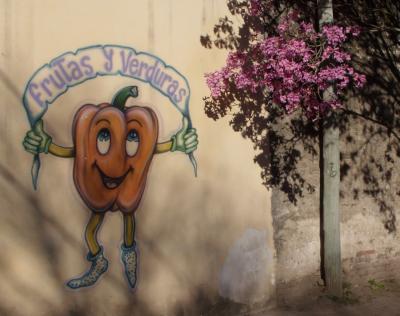
Frutas y verduras, una vida sana y un negocio alegre

Frutas y verduras, una vida sana y un negocio alegre

La poesía de Juan Huallparrimachi, descendiente de los incas

   Hay algo entre romántico y ecológico en la poesía de Juan Huallparrimachi, músico, poeta y descendiente de los incas. Aquí publicamos versos del poeta que llevan el títuo de...
"Luz que me despiertas en cada mañana:"


"Luz que me despiertas en cada mañana,

con la sonrisa rosada de otra aurora que llega,

y, muy despacio, va dorando el cielo,

mientras un sol madrugador, entibia

del aire la caricia...

Mañanera, suave brisa,

si está mi amada despierta,

llévale este hato de besos,

que en mi boca tengo presos.

En cuanto llegas, amigo sol,

lo que la noche esfuma con su oscuridad,

se llena de vida, luz y calor.

¡Buen día, Apu-Inti! ¡Buen día, mi Dios-Sol!

No te vuelvas ardiente,

no la hieras quemante.

Torna tu luz tan suave,

que hasta su rostro llegue,

cuál tímida caricia, como ese beso leve,

¡qué mis labios ansiosos,

a darle no se atreven!

¡Apu-Inti, del mundo todas las maravillas

con ti despiertan y ellas son mis amigas!

¡Buenos días, aurora clara!

¡Buenos días, quieta montaña!

¡Al sol, toda de oro, y en la noche, de plata!

Buen día, cielo limpio con sol recién nacido,

Pasto flor, río calmo, arroyo cristalino...

A ti arroyo, te hablo:

Corriente de agua clara, tú que copias su imagen

y la llenas de besos, cuando la baña tu agua.

¿No te das cuenta cuan feliz eres?

Hoy otro día nace, donde todo está riente,

y como todo es un sueño dichoso y transparente,

mi alma enamorada le envía su saludo.

Se ha dormido mi pena. Se la llevó la noche.

Al arribo del día mi dolor queda mudo"

  
(Juan Huallparrimachi)

What's in a name?

"Good morning! I would like to speak to Prapawdee Jaroenrattanatarakoonon."

"Sorry, could you repeat that?"

"It isn’t too easy to pronounce."

"Well you’ve got to give me something to go on. All I can make out is a bunch of consonants with a handful of vowels, but if that’s a name it must be the longest in history"

"I don’t know about that, but she has just lifted 126 pounds and that’s a lot but probably not the record. Anyway, her name is long but not heavy. Jaroenrattanatarakoonon won first place for the category of up to 53 kilograms in the Olympic Games in China."

"That 'sher! That’s the person I want to talk to!"

"Sorry, she is helping a friend take her bags to the hotel room."

"Oh. Well, I’ll call back later...Ah...How do you pronounce her name?"

"Just as it is written."

"That’s my problem. Ah...doesn’t she have a nick name?"

"I’ll ask her and then call you back."

"Thanks a million! By the way, my name is John."

"Just John?"

"John Jones."

"Short and sweet."

"Yea. But I didn’t choose it. They give you names and you have to live with them the rest of your life."

"True."


Shakespeare's insults were a bit more polished than modern-day verbal floggings...

Shakespeare's insults were a bit more polished than modern-day verbal floggings...

Today’s insults tend to be of one or two syllables and they tend to come out as snorts or gasps, but lack the fluency and grace of the magestic insults William Shakespeare conjured up, for example in this extract from "King Lear:"

"You are a knave, a rascal, an eater of broken meats; a base, proud, shallow, beggarly, three-suited, hundred-hound, filthy worsted-stocking knave; a lily-livered, action-taking, whoreson, glass-gazing, super-serviceable, finical rogue; one-trunk-inheriting slave; one that wouldst be a bawd in a way of good service, and art nothing but the composition of a knave, beggar, coward, pander, and the son and heir of a mongret bitch: one whom I qill beat into clamorous whining if thou deni’st the least syllable of thy addition." (2.213-23.)

On second thought, an insult is an insult, so why talk about the grace or fluency of the phrase you are bombarded with? What counts is the intention...and you don’t even have to understand the words to realize that you are being insulted. Still, it might be useful to introduce a bit more variety and colour into our insults. Better yet: put the insults into a box, lock it, and throw away the key! Well, a good old-fashioned insult does come in handy at time, to get across your feeling with no ambiguity! The problem is that the person you insult will certainly return your verbal whipping by upping the ante...

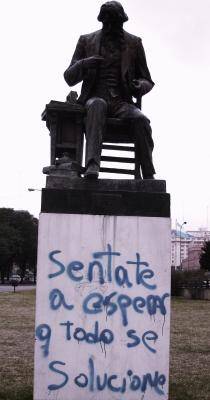
Sentáte ahí, que todo se soluciona

Sentáte ahí, que todo se soluciona

En realidad, la solución está ahí,

detrás de tu silla, a la espera,

oculta, paciente,

siempre a la espera de los acontecimientos,

dócil, tierna, sincera, clara, evidente,

como el amante de tu amante.

(Pero vale la pena aclarar que la solución no es la que estabas esperando tan trabajosamente...)

Caminando camino por los caminos

Caminando camino por los caminos,

caminando.

Sin rumbo camino los caminos

bolsillos livianos,

corazón palpitando

caminando camino por los caminos.


Camino hacia la música

Camino hacia la canción

Camino hacia el amor perdido

caminando camino por los caminos.


Corazón palpitando

las balas de la guerra

golpean y rebotan alrededor

Caminando camino por los caminos.


¡Ay! piernas duras,

Ay! piernas sangrando,

¡Ay! ojos cansados de ver

Caminando camino por los caminos

Caminando,

Caminando,

Caminando.


y aunque me pida perdón

llevo la paz en el corazón

Caminando por los caminos

manos agarrando yerbas salvajes

camino caminando por los caminos

On what happens when a poster makes you stop and think

On what happens when a poster makes you stop and think

Let’s call him Johnnie. Forget his last name, his age, his nationality, his religion, his sexual preferences, his ideology, his social class. Just Johnnie, yet another homo sapiens.

With nothing better to do one Sunday, he wanders into a museum and mumbles to himself as he passes by posters and paintings and drawings, and illustrated books and a vast array of gadgets of all sizes, colours and states of preservation. A musuem doesn't talk, usually, but the visitor can carry on enchanting monologues before each object.

"Hmm. Women workers."

He said that loud enough for at least one person to hear his words--a clearly female voice retorted:

"So? What’s so strange about that? Women have always worked, haven’t they?

Johnnie didn't have time to answer that, didn't have time to see the face that spoke those words. The woman's question was still rebounding in the air when a band of musicians, dressed in the colours of the rainbow,  marched into the exhibition room, playing the most exotic instruments, some using long feathers to strike chords on stretched out pieces of what appeared to be leather,fastened tightly to a gourd. The melodic but quite nostalgic sounds sent Johnnie into a state of joy mixed with profound sadness...

The woman leaning on the shield of the "National Federation of Women Workers" had managed to slip out of the poster and now had her hands on her hips, right in back of Johnnie. He didn't know that, though, because he was now so enthralled with the band that he had forgotten about the woman's voice.

"So," she repeated. "What's so strange about that?"

Now the man did turn around, his eyes fairly popping out of their sockets. Never had he seen a lady of such rare beauty, and a worker! He found it difficult to organize his thoughts because his body was moving adroitly to the catchy melody the musicians were plucking out on their instruments, while his mind was groping for an answer to the lady whose loveliness was now in open conflict with his usually indolent thinking patterns.

"Aren't you supposed to be in that poster?"

"You gotta be kidding, or didn't you hear about the gogglepath?

"The what?"

"The gogglepath. Not only have we freed ourselves of male chauvinist consumer society sexism. We have achieved the ability to appear and disappear, returning to posters or leaving them to pass on the word to those poor souls still under the thumb of the market."

"You mean you left the poster to talk to me?"

"Look at the poster. The woman has left. I have left."

In fact, there was an empty space where the woman had been in the poster, and the lady talking to him was wearing exactly the same clothes.

"I'm terrible sorry, it just that, well, this can't be, things like this only happen in the movies..."

"It's a question of consciousness. People like you have become so brutalized by the urge to buy the latest gadgets that you've lost your imagination. It is imagination and not technology that's going to decide the fate of the human race."

"But doesn't it help to have a good computer at hand?"

"Ha! Ha! I knew you were going to say that. That's what unenlightened men like you always say..."

Just at that moment there was a fire alarm and firemen began swarming all over the place. The band had disappeared as if into thin air. Johnnie looked towards the poster: there she was, holding on to her women worker's flag, in the poster, calm and confident. Johnnie squinted towards the setting sun and set off towards his rooming house. Tomorrow would be another day. Was it true what the lady had said? Had he become a slave of gadget society? It didn't seem likely. His only gadget was a talking watch. It kept him company in the dreary hours when he was not working and woke him up when it was time to get dressed and rush to arrive before the boss did. 

Un niño sufre hambre en un país productor de comida...

 Cansado de ver la tele, cansado de oír la radio, cansado de los discursos políticos, impaciente, perturbado, el personaje se levanta y se dirige hacia la calle, compra un diario, lo tira al piso, dobla su cintura para leer nuevamente un título, deja endurecer sus piernas y continúa su marcha.


Ese mismo día los técnicos en la fundación Arcor y la Universidad Católica terminaban de sacar el barómetro de la Deuda Social argentina: más de cuatro de cada diez chicos entre 0 y 17 años viven en hogares que no pueden acceder a una adecuada alimentación...


El personaje es esposo, trabaja desde hace13 años en una empresa de seguros de vida, ya no piensa en nada especial, es fanático de Racing Club, conversa muy poco con su mujer, su panza se agranda todos los años, sus ojos brillan cuando maneja su nuevo teléfono móvil de última generación, y a veces, muy pocas veces, habla con el vecino. El tema: la seguridad, la calle, el caso del jubilado de 89 años muerto a tiros hace seis meses.


Sin embargo, ahora dice algo diferente:


--No puede ser, no puede ser...


--¿Qué cosa?


--Que exportamos trigo y soja y maíz y carne y frutas y leche y tenemos niños hambrientos. No puede ser. Estamos en Argentina de las vacas y los granos. No puede ser. Ya no entiendo nada.


--Y bueno...¿qué podemos hacer?


Muy buena la pregunta. ¿Qué podemos hacer? ¿Qué puede hacer un país, conocido productor agrícola, para que sus niños no sufran hambre?


Love with all its reverses

Love with all its reverses

Love with all its verses,

Love with all its curses,

Love with all its reverses,

Love with its empty purses,

Love, my dear, needs too many nurses.


Water, water everywhere, nor a drop to drink...

Water, water everywhere, nor a drop to drink...

Who has not read that poem in school? But are schools and universities and politicians and scientists paying enough attention to something many of us take for granted?

Water is essential for existence (our bodies are full of it) but also for industry: according to theStockholm International Water Institute, and others concerned about the problem, each person on earth needs at least 1,000 cubic meters (m2) of water per year for everything from drinking, hygiene or growing food.

However, as usual the poor are those who suffer most from water shortages.Although we lack the precise figure, it is clear that most of the world's nearly 900 million souls who suffer from hunger also encounter serious difficulties in obtaining the water they need. While middle and upper income groups enjoy taking several baths a week, the world’s slum dwellers must often draw water from wells or other community sources and transport it to their homes.

Not a few experts foresee not only a growing energy crisis, but difficulties, conflicts and even wars over water or its distribution or availability. According to data collected by Peter Rogers in "Scientific American" an estimated one billion people, oneout of six, suffer inadequate access to safe freshwater. The United Nations predicts that by 2025 there willl be water stress in nearly half of the world’s countries.

Part of the problem has to do with the increased usage by middle and upper income groups--who are lucky enough to take a bath ever day or so, wash their cars, water their gardens and fill their swimming pools. Another aspect has to do with the climaticchanges produced by contamination--with zig-zag effects, from flooding to severe dry spells around the world.

Analysts such as those at BoozAllen Hamilton claim that a great increase in investment in water usage will be needed between now and 2030 to prevent a major world crisis. One figure mentioned: $1 trillion a year on applying erxisting technologies for conserving water, maintaining or replacing infrastructures, constructing sanitation systems.

Countries such as China and India will need to greatly increase their supply of water, in view of their rapid entrance into the consumer society. Decisions will have to be made concerning how much of the valuable water supply should be derived to the cities and how much used to produce food in the countryside.

Techniques for converting salt water to drinking water may help, and innovative conservation methods will also have to be developed. One example: the use of drip irrigation for plants, providing the exact amount for each plant., 

Oda a la yerba mate de Marta Stella de Gasparini

Hemos recibido otra poesía de Marta Stella de Gasparini sobre la yerba mate, que "hace fluir la amistad...entre hermanos."

Oda a la yerba mate:

La yerba mate sabe a vida

tiene el gusto de esta tierra

de su gente laboriosa

de su lucha cotidiana.


Es tibieza en el invierno

que me abriga y me repara.

Es frescura en el verano

que me humedece y me sacia.


La yerba mate matiza

las charlas de cada jornada,

ayuda a filosofar,  

a ver la vida más clara.

Es fluir de la amistad

que tejemos entre hermanos:

argentinos, uruguayos, brasileños, paraguayos;

elixir mercosureño de esta fuerte Patria Grande.


La yerba mate matiza

el devenir de mi gente.

Sin ella no concibo

su diario vivir, su calma.


Y allí está la bella Apóstoles,

ciudad-jardín entrañable,

que la festeja y le canta

a la noble yerba mate.
 

¡Una flor en cierne, la amistad, la vida, la renovación: feliz día del amigo!

¡Una flor en cierne, la amistad, la vida, la renovación: feliz día del amigo!

Of dogs and cats and rats and bats

Of dogs and cats and rats and bats

Toil and chat: 
Dog and cat,  
Ball and bat...  
The rat  
Morphed the cat,  
The cat,  
The bat  
So cats and rats and bats  
Make dog-gone fat cats!  

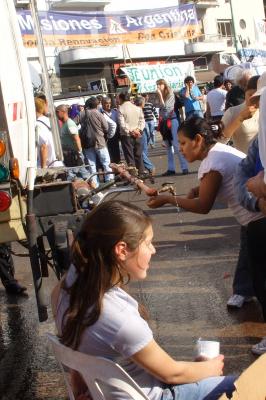
Un pausa para tomar un poco de agua, pues

Un pausa para tomar un poco de agua, pues

Campesinos en la plaza...la democracia en la calle

Campesinos en la plaza...la democracia en la calle

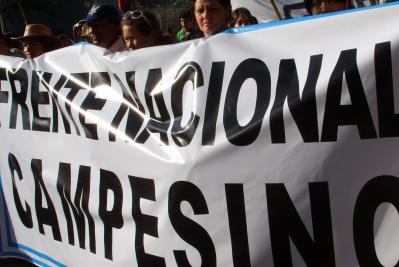
La cuestión agraria. Podría ser el título de un ensayo sociológico. No. Son un grupo de campesinos que ayer marcharon a la Plaza de Congreso para expresar su apoyo a las retenciones móviles, un impuesto a la exportación de soja y otros granos--fuertemente rechazado por las entidades rurales.

Poesía de Marta Stella de Gasarini: "Acróstico sobre la yerba mate"

Poesía de Marta Stella de Gasarini: "Acróstico sobre la yerba mate"

Ya está. Las banderas, los cantitos, los discursos. Los argentinos en favor y en contra de las retenciones a los cereales, propuesta por el gobierno, han salido a la calle, a la espera de la votación de una propuesta de ley sobre el tema, hoy en manos del Senado de la nación.

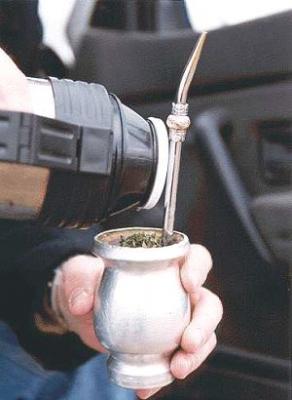
En las dos marchas el mate, la bebida nacional...Entonces, aquí publicamos "Acróstico sobre la yerba mate," un poema de Marta Stella de Gasparini:

Yerba mate te siento tan profundo

En mis ávidas entrañas

Revivo con cada sorbo

Bebiendo tu tibieza mansa

Amargo sabor que peregrina


Mutando en dulzura, savia que

Alimentas los espíritus y sus cuerpos castigados

Transportas más que un mero confortar

Exaltas las eternas esperanzas


Animas y das templanza  al

Pueblo mío que aún canta, contra

Oprobios e insultos ¡cuántos!

Sostienes mi yerba mate a

Tantos pobres en su transcurrir errante

Otorgándoles consuelo, insuflándoles

Las ganas de seguir luchando inermes

En pos de una existencia digna

Sueño que no defecciona, al contrario se agiganta.