Blogia
Buenos Aires Jaque Press, en inglés y español

Noticias (News)

"El horror y la crueldad se apoderaron de nuestro pueblo..."

"El horror y la crueldad se apoderaron de nuestro pueblo..."

     Una extraña sensación de horror y alegría se apoderó del público, al entrar en la ex-Escuela de Mecánica de la Armada Argentina (ESMA) 32 años después del "comienzo de la noche más negra de la historia argentina, donde el horror y la crueldad se apoderaron de nuestro pueblo cuando las Fuerzas Armadas y sectores civiles representantes del gran capital asaltaron las instituciones de la República aniquilando a millares de seres para disci`linar al conjunto de la sociedad a sangre y fuego e imponer así la destrucción del Estado, la concentración de la riqueza, la exclusión y la marginación social de las mayorías," en las palabras de Eduardo Luis Duhalde, secretario de Derechos Humanos del gobierno argentino, al iniciar una ceremonia ecuménica en la ESMA. Ahora el temido centro de detención de la dictadura está siendo preparado para convertirse en un "Espacio de la Memoria."

The Bill of Rights in the context of the "war" against terrorism

In the context of public discussiones concerning alleged abusive practices against prisoners in the "war" against terrorism, and questioned information gathering practices likewise carried out or advocated by the Bush Administration, such as the retention of suspects without trial outside the territorial limits of the U.S., the first and the sixth amendments to the constitution are appropriate to bear in mind. 

      It should also be pointed out that these amendments were approved in the wake of the struggle of the U.S. colonies against what were considered abusive practices carried out by British colonial authorities.

     "Amendment I: Congress shall make no law respecting an establishment of religion, or prohibiting the free exercise thereof, or abridging the freedom of speech, or of the press, or the right of the people peaceably to assemble, and to petition the Government for a redress of grievances."

      "Amendment VI: In all criminal prosecutions, the accused shall enjoy the right to a speedy and public trial, by an impartial jury of the State and district wherein the crime shall have been committed;which district shall have been previously ascertained by law, and to be informed of the nature and cause of the accusation;to be confronted with the witnesses against him;to have compulsory process for obtaining witnesses in his favor, and to have the assistance of counsel for his defense."


Is the world advancing towards globalization or will regionalization stake its claim ?

Is the world advancing towards globalization or will regionalization stake its claim ?


Recent events in Latin America suggest that instead of the greatly marketed idea of "golobalization," the world may actually be advancing towards division into blocks or regions which come together more out of mutual interest than any coherent plan.

      Globalization from the point of view of the multi-national corporations which dominate the U.S. and Europe is actually an euphenism for the expansion of business around the world in such a way that the so-called "invisible" market factors can become predictible components in a re-shaping of economic, social, cultural and political life in accordance with the needs and necessities of corporate society.

       One component of this disguised expansionism is the notion of "preventive wars" developed by the Bush Administration to deal with what Washington has described as "the axisis of evil," that is nations with political, cultural or economic structures that resist the globalization and the attempt to organize the world's economic resources in accordance with the demands of the corporate vision. In effect, the "preventive wars" in Iraq and Afghanistan are attempts not only to bring "democracy" to those countries but also to incorporate them into the system of globalization. However, the process has remained stalemated in those two countries and has not advanced to others included in the axis--Syria, Iran and North Korea, the most mentioned.

       The wars in Iraq and Afghanistan have been super costly and have not yet produced any clear results in terms of achieving docile governments willing to impose Western style democracy, and open up their territories to the exploitation of natural resources--especially oil--needed to feed the globalized economy.

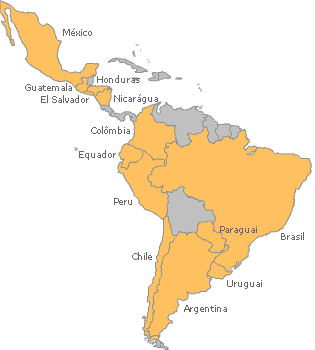
       One result appears to be a shift of attention to from the Middle East to Latin America. The relative absence of U.S. presence in the area, due to involvement in the war in Iraq and against terrorism, has facilitated the arrival of center left governments in a growing number of Latin American countries: Chile, Argentina, Uruguay, Brazil, Bolivia, Venezuela, Ecuador, Nicaragua...

        For years U.S. policy had concentrated on Colombia, due to the presence there of several key factors: drugs, the continent's oldest armed guerrilla movement and the geo-political importance of the country. It has received more military aid than any other Latin American country, in spite of the existence of para-military gangs and flagrant rights abuse.

          It was therefore less than a surprise when Colombia recently bombarded a FARC guerrilla camp inside the Ecuadorian border, without advising the Ecuadorian government. The action constituted a de facto rehearsal of the notion of "preventive warfare" in the area, in this case carried out not by U.S. forces but by the Colombian military (although according to press accounts with U.S. advisorship)

          What few observers expected--either those favorable to U.S. policy or those opposed to it--was the rapid rejection of the action taken by the vast majority of the region's governments. Even Peru, which via Allan Garcia, has been strongly courting the possibility of signing free trade agreements with Washington, took a critical position with respect to the allegations of violation of Ecuador's sovereignty.

           In view of the long history of U.S. interventionism in Latin America, and the increasing air of independence in the area, it would have been extremely difficult for Colombia's action to go unheeded.

           But even before the recent action against Ecuador, there had been movements in favor of regional economic and political groupings. For a decade the Merco-Sur had been hibernating but over the past five years has assumed a more dynamic and political stance, favoring regional relations over those with the United States. Venezuela has not only contributed to the de facto slicing of the U.S. imposed embargo against Cuba; it has made possible the replacement of oil which Cuba previousl imported from the ex-Soviet Union and has facilitated economic and cultural contacts between Cubans, Venezuelans and other countries in the area.

            The ALB, a grouping more radically opposed to trade alliances with the U.S., seems to have perked up after a slumber to get the enthusiastic support of countries such as Cuba, Venezuela, the Dominican Republic and even previously staunchly pro U.S. countries such as the Granadas, Barbados and San Vicente.

              Perhaps a bit less ostentaciously, Brazil and Argentina have signed a number of significant agreements, including one on exchange of know-how on atomic energy, the joint manufacture of military vehicles and a space satellite.

              The latest move is Unasur, a multilateral organization of South American nations bringing together the Merco-Sur and the Andian Community. Furthermore, Brazil has proposed the creation of a Southamerican Security Council, clearly stimulated in part due to concern of Colombia's violation of Ecuador's sovereignty.

              In other parts of the world also regional groupings are growing in strength simply because they give their members more negotiating power than they would have in a uniform "globalized world." Where this process is headed is anyone's guess. However, it very likely will take a course not too clearly envisionaged on the computers of the global planners. 

            What remains to be seen is whether the next president of the U.S. will continue Washington's approach to globalization or seek a way to disentangle itself from it unilateral policy.

Alicia Bonet: "¿Quién dio la orden, y por qué, de fusilar dos veces a mi marido?"

              En una carta abierta a los responsables de la masacre de presos políticos el 22 de agosto en el penal de Trelew, Argentina, Alicia Bonet, viuda de Rubén Bonet, uno de los fusilados, pregunta:

         "¿Quién dio la orden, y por qué, de fusilar dos veces a mi marido?"

        La carta, publicada el 12 de marzo en el diario Página 12, se dirige a "los que programaron, decidieron, ejecutaron, fueron actores directos o cómplices de la masacre de Trelew."

        Continúa:

        "Los presos de Rawson, cuando organizaron la fuga del penal, estaban con las armas que fueron recuperando a medida que iban tomando el penal. Con esas armas, el grupo de 19 que queda en el aeropuerto de Trelew hizo un acuerdo con ustedes para rendirse...Ellos depositan sus armas y ustedes los traicionan con sus órdenes: en vez de reintegrarlos al Penal de Rawson, los llevan a la Base Almirante Zar.

         "Cuando nosotros los familiares fuimos a Rawson y a Trelew, el 15, 16 y 17 de agosto de 1972 tocando todas las puertas para que nos permitieran llevarles comida, ropa, medicamentos, usted dieron la orden de apresarnos. Llovieron las amenazas y meses o años después ustedes mataron a gran parte de los familiares y los abogados de Trelew."

          El uso de "ustedes" se refiere al aparato militar-represivo de aquel entonces, que luego tomó más fuerza con el golpe de 1976, que dejo aproximadamente 30.000 personas desaparecidas.

         "Nosotros sabíamos, el 22 de agosto, que era imposible fugarse de la Base, en medio del desierto patagónico, rodeado de cientos de usteds con todo tipo de armamentos. Por ese convencimiento fue que inmediatamente exigí que abrieran el cajón para reconocer si era Rubén, y su cuerpo con cada detalle de lo que vi me acompaña como una fotografía que no se puso amarailla con los años. Era mi esposo, tenía balas y hematomas en diferentes partes del cuerpo, pero además, y sobre todo, tenía la cabeza destrozada."

        Una semana después en Capital Federal el juez ordenó la autopsia: las heridas de bala en el cuerpo no eran mortrales, pero el tiro de la cabeza es dado en posición horizontal a poca distancia, con arma de fuerte calibre que entró por la oreja y salió por la cebeza. Fue el tiro mortal.

       Los tres sobrevivientes, Haidar, Camps y Berger, hicieron una declaración sobre el caso ante familiares, jueces y abogados, alegando que:

         "Cambiaron la guardia ese día, nos levantaron a las 3 de la madrugada entre gritos e insultos, nos hicieron salir de las pequeñas celdas enfrentadas y desde el frente del pasillo comenzaron a ametrallarnos, los que estaban en las primeras celdas murieron en el acto, los que estábamos lmás lejos nos tiramos al suelo y esperamos, conteniendo la respiración, escuchamos el cese de los tiros y después pasaron celda por celda y nos tiraron con el arma que tenían en sus cinturones a quemarropa. Nunca pensaron que podía quedar alguno vivo."

           Según Alicia "ustedes mataron e hicieron desaparecer a los tres sobrevivientes de la masacre de Trelew, unos años después, cuestión de borrar cualquier intento de que la verdad de sus actos trascendiera."

          De todos modos, el caso ahora está en manos de la justicia argentina.

          Alicia concluye: "Morir moriremos todos, pero nos diferencia el orgullo que tenemos y que continuamos transmitiendo de generación en generación por haber tenido un familiar al que ustedes mataron por querer un país más justo y libre y solidario."

Este sábado es el día del Consumidor, menos mal que sale una ley en nuestra defensa...

Este sábado es el día del Consumidor, menos mal que sale una ley en nuestra defensa...

      A veces uno se pone a pensar, verdad, si uno es una persona o simplemente un eslabón en la cadena de producción. Los sabios economistas tipo tinto o blanco nos dicen que la única forma de salir de la pobreza y avanzar hacia la modernidad, (una especie de cielo en la tierra, nos dicen) es....producir, producir, producir.

      Eso supone además que uno tiene que comprar, comprar, comprar....

     Bueno, ya se sabe que a veces lo que uno compra es un producto con una falla, que no es lo que se dice que es, que dura menos que un soplo....Pero, no hay que ponerse triste: en Argentina desde el 12 de marzo rige una modificación de la Ley de Defensa del Consumidor, a nuestro favor, se supone, así podemos gritar (bueno, con buenas modalidades, claro, no tan sacado como el personaje en la pintura, que encontramos en una pared de Buenos Aires...

     La ley establece:

     1) Cuando el consumidor se sienta dañado puede efectuar una denuncia en cualquier oficina de Defensa del Consumidor en todo el país sin pagar un sólo peso.

      2)  La ley señala el derecho de los consumidores a acceder a indemnizaciones inmediatas de hasta 3.000 pesos.

      3)   Las empresas prestadoras de servicios públicas deben garantizar la atención personalizada a los usuarios y habilitar un registro de reclamos.

      4)   Se establece la figura del "daño punitivo," que abarcaría incluso si alguien tiene un accidente en un centro comercial o shopping, aunque no haya comprado nada, en cuyo caso el comercio debe hacerse cargo del daño físico.

       5)   La ley también condena la discriminación, que apunta específicamente a los precios sobrefacturados en moneda extranjera para los turistas que provienen de otros países.


The theory of "preventive warfare" comes under fire in Ecuadorean-Colombian border dispute

What appeared to be a carefully planned but badly executed attempt to take President George Bush’s notion of “preventive warfare” to Latin America has run up against a stumbling block: the vast majority of countries in the area refuse to accept the notion that military intrusions across national borders can be justified in view of the so-called war against terrorism.


Colombian President Alvaro Uribe, chosen by Washington as a strategic ally and receptor of multi-million dollar aid in weapons and financial air, sent planes, helicopters and soldiers into Ecuador in a recent sensationalist manoeuvre that took the life of Raúl Reyes, the FARC guerrilla leader in charge of negotiations to exchange political hostages for militants held in Colombian jails.


Along with the guerrilla leader more than 20 others were killed in the attack. Uribe failed to announce his intention to Ecuadorian President Rafael Correa and subsequently attempted to justify the attack by describing the victims as terrorists who had escaped into the border area. However, news reports showed that the guerrillas were asleep at the time of the attack. Reports from Colombia subsequently attempted to add wood to the already blazing fire by accusing Ecuador and Venezuela—whose governments are left leaning and critical of the U.S.—of protecting the guerrillas. On the basis of information allegedly found in Reyes' computer, Venezuela was accused of giving financial aid to the FARC and there were allegations that the guerrillas were attempting deal in uranium.


The similarity with the Bush Administration’s attack against Iraq is clear. Following the terrorist attack against the Twin Towers, Washington declared war against terrorism (which has never been very clearly defined) and invaded Afghanistan and Iraq after unsuccessful attempts to get Europe and the United Nations to condone the action. The invasion of Iraq was justified on the theory that the regime of Saddam Hussein was a dictatorship which had weapons of mass destruction and maintained ties with terrorist groups. Neither charge has to date been verified.


The war against terrorism declared by Washington supposes a number of ambiguous notions. Firstly, the military action is theoretically not directed against nations but against groups which operate in diverse countries. Secondly, punitive actions are justified in view of what the United States considers to be defence of its national security. There has also been an attempt to describe various insurgent groups around the world as terrorists.


The FARC began as an ideologically leftist organization in the 1960’s and were confronted by rightwing “self defence” or para-military groups. Both have subsequently been accused of financing their operations with the sale of drugs. Colombia has placed the FARC in the category of “terrorists,” something which has been resisted by Ecuador, Venezuela and many other Latin American countries. The fear is that should such groups be termed “terrorists,” the possibility of strikes such as that of Colombia against Ecuador could compromise national sovereignty.


Correa insisted that Colombia’s action was a gross violation of its sovereignty and obtained the backing of the majority of the hemisphere’s countries. Finally, in an seven hour debate in Santo Domingo, and in spite of his strong defence of the action against Reyes, Uribe ended up signing a document in which he asks forgiveness for his action. In the final document of the heads of State meeting to peacefully resolve the issue, their was a clear rejection of one of the basic principals of preventive warfare:


“We reject this violation of Ecuador’s territorial integrity and reaffirm the principle that the territory of a State is inviolable and must not be infringed by military occupation or other acts of force taken by another State.”

There of course remain many questions. One of the most obvious: why did Colombia decide to take the life of the man who, according to press accounts, was in charge of the negotions to free Colombian-French citizen Ingrid Betancourt and other kidnap victims?

Will U.S. soldiers be replaced by robots in Iraq?

Will U.S. soldiers be replaced by robots in Iraq?

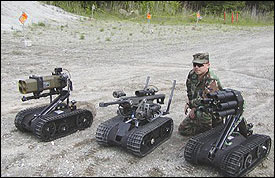
       The Pentagon may have found an imaginative solution to drastically reduce the number of U.S. soldiers killed in "preventive wars."

       Some 1,678 U.S. military personnel have been killed in Iraq and Afghanistan since July of 2003, according to the Georgia based Iraq Coalition Casualty Count, but the count would have been much higher without the help of some 5,000 IED detecting robots.

      In view of the unpopularity of the war in the U.S. and around the world, the next step--short of a traditional withdrawal--might be the evolution of those robots from saving to taking lives.

     The U.S. Army soon plans to deploy armed robots with firepower into the wars in Iraq and Afghanistan. Designed by Foster-Miller, robots of this sort, known as SWORDS (Special Weapons Observation Reconnaissance Detections Systems) might soon begin replacing soldiers: they would be operated and fired by remote control and outfitted with M240 or M249 machine guns or Barrett .50 caliber rifles.

     SWORDS first came to light in 2005, when the Associated Press reported, “Military officials like to compare the roughly three-foot-high robots favorably to human soldiers: They don’t need to be trained, fed or clothed. They can be boxed up and warehoused between wars. They never complain. And there are no letters to write home if they meet their demise in battle.”

      Swords are not alone in the market. On Oct. 21, 2007 CBS reported that iRobot, founded in 1990 by MIT roboticists, and one of several robotic companies contracting with the military, would be ready to launch its iRobot’s Warrior in Iraq by 2009. Warrior, like SWORDS, is currently being designed to have human operators, but why not have the robots "think for themselves?"

     In that case any "collateral damage," now attributed to human "error," would be the robot's fault and that would certainly have clear political implications. The public mood is a necessary conditioning factor for carrying on wars. 

    Oh. The U.S. budget for research and development for military technology is around $71 billion, although only a fraction of the hefty  $500 billion U.S. defense budget.  According to DefenseLink, the Pentagon plans to spend $2 billion on robots.

    This may not mean robots will be taking over the task of the Pentagon's soldiers. However, it does imply another step in the "privatization" of conflicts and an attempt to make them more acceptable to the U.S. taxpayer. Seeing soldiers brought home wrapped in flags is a politically explosive issue. Who would bother to protest the death of a robot?

¿Dónde está la justicia? Los hombres condenados por la violación y muerte de María Soledad Morales salen en libertad.

¿Dónde está la justicia? Los hombres condenados por la violación y muerte de María Soledad Morales salen en libertad.

    Hace diez años, el 27 de febrero de 1998, luego de un juicio que duró 2.726 días y durante los cuales hubo 91 marchas de silencio, la justicia de la provincia argentina de Catamarca condenó a Guillermo Luque y a Luis Tula por la violación y muerte de María Soledad Morales. 

    No obstante, muy pronto, cuando cumpla los dos tercios de su sentencia de 21 años, Luque podrá gozar de "libertad condicional." Tula ya cumplió la totalidad de su condena y estudia abogacía.

     La madre de la víctima, Ada Morales, declaró a Clarín: "Para nosotros la causa de María Soledad Morales no está resuelta. La policía encubrió. Fue un tremendo encubrimiento que se dio desde distintos niveles y esto nos duele. Esto no terminó." 


Una jornada por los pueblos originarios

“En realidad el problema es al revés,” escribe el Diario Norte del Chaco Argentina el 8 de febrero con respecto a la situación de los pueblos originarios: “son estos quinientos años de avance del sistema que desprecia la naturaleza y las mayorías los que han llevado a este presente. El no retroceso de la voracidad capitalista es el responsable de la miseria chaqueña. Ese es el avance que hay que detener, la marcha asesina de una sociedad manejada por y para muy pocos.

Pues como ya es una tradición desde 1992, cada cuatro años tienen lugar las Jornadas de Paz y Dignidad de los pueblos originarios para hablar de sus problemas y unir criterios en la carrera ceremonial por el reencuentro con nuestros hermanos originarios de todo el continente.

 El 6 de abril de este año comenzará en la ciudad de Ushuaia en el extremo Sur de Argentina, la 5° edición de nuestra carrera continental con destino en Panamá donde nos reuniremos con todos los demás corredores de nuestro continente. Según los organizadores, será “un  día de júbilo en homenaje a nuestros antepasados, portando los bastones de mando de nuestro continente, acompañando y apoyando a nuestros corredores en su tarea de reunirnos nuevamente como una Gran Familia.” Además, “Sin distinción de credo, raza o ideología alguna, vos podés ser parte de nuestra organización como Coordinador de Apoyo. Desde tu casa, escuela u organización, tu participación puede ser de mucha importancia. Para eso corremos, para ir hacia tu encuentro y el de nuestros hermanos. Porque todos somos hijos de esta tierra independientemente del color de piel que tengamos.”Por su parte Francisco Melo, fundador de Jornadas de Paz y Dignidad, hizo conocer el siguiente mensaje:“Los pueblos indígenas han mantenido esta lucha, no por que se sientan dueños o propietarios de la tierra, sino porque simple y sencillamente nos están entregando a todos, instrucciones sobre lo que vivieron y comprendieron que por miles de años ha sido el apropiado uso de ella.La obligación es cuidar de este nuestro paraíso, por que aquí es donde se nos da la vida y aquí es donde interactuamos con todas las demás formas de vida. Todos estos seres vivientes, sea cual fuera la forma que tengan, son también  nuestros hermanos y junto con ellos somos parte de esta gran familia. El ser humano se ha alejado por ignorancia de la relación que tiene con todas estas formas de vidaDe eso se trata la lucha, de recuperar el entendimiento de esta relación con este ser querido que es la tierra,  que nos está haciendo un llamado bien urgente de volver a mirar hacia ella, de volver a cuidarla. La mayoría de nuestros ríos están sucios, las montañas están peladas por la tala de árboles, como así también esto que llaman agricultura, han sido algunas de las situaciones por las que se ha ido perdiendo este entendimiento, y con él algunos miembros de esta familia que ya no regresarán jamás.”Coordinación de enlace Argentina:    e-mail: jornadasdepazarg@yahoo.com.ar

Budgets, wars and some clues on how things work...

Budgets, wars and some clues on how things work...

    There you are visiting a quaker church in Pennsylvania and, after the usual coffee and cookies, this red and white sheet of paper catches your eye. It says 21% is for past military spending, 31% for present military spending, 33% for human resources, 12% for general government and a mere 5% for physical resources.

     Well, if you add 21 and 31 you get 52, that is, more than half of the budget goes for some form of military spending!

     For a minute we might wonder about the precision of the data presented, but the general idea is clear enough. What is lacking are the millions spent on the "preventive" wars against Iraq and Afghanistan, the millions spent in paying off loans--many from foreign governments or banking institutions--in part to pay off the loans to cover the expense involved in reducing taxes...especially those paid by industrial giants... 

     And then you read about the threat of recession, how the sale of homes in the United States fell by 40.7% over the past year, how untold numbers of home buyers are pulling their hair out trying to figure out how to pay their mortgage payments, and you hear Republican presidential candidates advocate even more tax reductions for big business, about the $600 dollar checks the government is going to send tax payers so they "buy more" and beef up the economy...

    That leads you to ponder what people are really talking about when they glibly chat about "globalization." Then you learn that an unending string of corporations are leaving the country to exploit cheap wages and natural resources abroad, and in the midst of those meditations you stop by a store in Princeton, New Jersey, selling clothes and other objects to university students.

    You're looking a some key chains. A group of Chinese tourists approach. One of them picks up a key chain, turns it over, reads "made in China," smiles and nudges his companion in the ribs. They both smile. "Made in China."

Would Socrates have asked: "Is the U.S. economy being 'latinamericanized?"

    Sometimes innocent sounding questions may elicit surprising and revealing responses. Maybe Socrates got it right in his question-answer philosophy.  Let’s try one: is the U.S. becoming ‘Thirdworldized?” Or, closer to home base: ‘Latinamericanized?”
    
    By now even the least informed inhabitant south of the Rio Grande knows that for decades foreign firms have been gobbling up businesses and land from Mexico to Tierra del Fuego. It is also almost folklore that every country in the area is trapped in an unending cycle of astronomical and un-payable debts, for which more debt is created in the vain attempt to pay them off.

      So what should we conclude when we read in the January 20 New York Times that last year foreign investors got a record $414 billion in securities stock in U.S. factories and properties?  

    Good old-fashioned financial giants, such as Merrill Lynch, the Citigroup or Morgan Stanley have sold multi-million dollar stakes to entities in Germany, Asia or the Mid East.
    The so-called Sovereign Wealth Funds (SWF) have put some $70 billion on the U.S. market over the past few weeks, according to Bloomberg.com. The SWF are giant pools of capital controlled by governments, which invest in private markets.
    None other than Frederick Kempe, president of the Atlantic Council, wrote quite optimistically in a recent Bloomberg column that:
 “Our economic problems will multiply without foreign investment and our continued openness toward it. International purchases of Treasuries not only help finance our national debt, but foreign-owned businesses employ some 5 percent of the U.S. workforce and account for almost 6 percent of output, 20 percent of U.S. exports, and 10 percent of all U.S. investment in plant and equipment. Beyond that, overseas companies pay wages 30 percent higher on average than their U.S. counterparts.”
    Suggesting that the present financial crisis somehow has its roots in the globalization of the world’s economy, he added: “SWFs are another sign of the dramatic structural shift sweeping the global economy that we can shape but not reverse. The U.S. share of world output will continue to decline, as will its portion of annual global growth. And that's for the best as billions of people embrace capitalism and global markets. If we can keep attracting foreign capital and access global markets, we'll continue to lead.”
    His conclusion sounded like a gentle chide with respect to Washington’s present policies:
“We still must press for global policy responses to avoid abuse. Unilateral action won't work, whether by us or our European friends. We should push for voluntary multilateral agreements that already are in the works.”
    So there you have the voice of an authorized financial pundit. But let’s get back to the dizzy  question at hand. According to Brian Williams of the NBC Nightly News, Citigroup and Merrill Lynch had to go shopping abroad for some $20 billion to stay afloat and ward of the surging mortgage crisis in the U.S.
       Who might some of the saviors be? Well, there’s the Saudi Prince, Awaleed bin Talal. His offer to boost New York Mayor Rudolph Giullani’s reconstruction efforts after the September 11 attack were turned down. But if you’ve seen Michael Moore’s movie, or watched the news, you realize that Saudi Arabia is on President Bush’s list of friendly nations. And then there’s Kuwait—which raises some other questions concerning why the U.S. invaded Iraq…Perhaps China should also be put on the list: despite its communist politics it has used its economic surpluses to bolster the Uncle Sam’s deficit ridden economy.
     Five million Americans now work for foreign companies, according to Deputy Treasury Secretary Robert Kimmitt, and since 2001 the U.S. has lost three million manufacturing jobs. Does that sound familiar? I mean if you live south of the Texan border?
    Then there’s the downhill spin of the stock market, as the U.S. eases into what is likely to be a hard-hitting struggle for the White House in next November’s presidential elections.
The financial outlook appears to be something like this:
    --A good part of the international financial community looks with tilted eyes towards President Bush’s tax rebate stimulus program, putting around $800 dollars in the hands of taxpayers in the hope that they will go on a spending spree capable of boosting the country’s sinking economy.
    --Even Wall Street is a buzz with talk about the possibility of getting financial help from abroad.    
    --Today’s interest rate reduction may be but the first of a series, aimed at there attracting foreign investment and making it easier to get credits (to pay off debts).

    Thus, we come back to the initial question: is the U.S. becoming latinamericanized, or is this but another process in the globalization of the world’s economy?

Who is going to be calling the cards from now on?

As capital goes bananas or seeks gorgeous profits will it concern itself with where the whole process is headed? Is this a rational process?

Will political and social organizations be able to put a reign on the appetite of profiteering financial institutions?

Is there no economic or social alternative to a system that ends up not only filling its own pockets but marginalizing the majority of the world’s population?

In view of the present industrial system’s roots in petroleum and its devastating effects on the environment, what will be the end result for the well being of the world’s ever growing population?

Iraq: pretty much like a graveyard for journalists

      Some figures say more than a thousand words: of the 124 journalists and photographers killed in Iraq since the U.S. invasion, 102 were Iraqis.

      The Iraqis are badly needed by the New York Times, the Washington Post...and the numerous other international media that report from Iraq. They rely heavily on local journalists for information and contacts but the Iraqis pay a high price for their collaboration.

      An equally alarming figure: U.S. military authorities have held more than eight Iraqi journalists at detention centers for from weeks to months on suspicion of alleged collaboration with insurgent groups, according to the Committee to Protect Journalists.

    One of the arrested journalists is Bilal Hussein, who won the Associated Press's 2005 Pulitzer Prize for photography. He was held for approximately 20 months at Abu Ghraib, according to the New York Times, and now his fate hinges on the decision of just one man, an Iraqi magistrate who will act as a one man jury to decide if there is evidence linking him to the insurgency.

    If the occupation of a journalist is to collect duly verified information so the reader can come to an intelligent conclusion concerning a social or political conflict, detention on mere suspicion is a clear violation not only of the journalist's obligation to inform but of the public's right to receive objective and reliable information.

Oh Gosh! What a Mess!

      You mean the National Intelligence Estimate in Washington is not certain whether Iran is busy as a bee building atomic weapons? Oh really? So what are we supposed to conclude? The Administration in Washington appears to be alarmed about the prospect of an Iranian atomic bomb, but Washington's own intelligence has put the damper on that doom's day like prospect.

Does that mean public opinion has had the wool pulled over its eyes once again--after being told, for example, that the "preventive invasion" of Iraq was to prevent that country's use of weapons of mass destruction? Weapons which curiously enough were never found...

Or perhaps you are worried about the political implications of a world in which spy agencies with shadowy budgets can beguile public opinion so easily--true, with the wink of politicians in the top nitches of power...and a good part of the mass media.

You might even dare to wonder at the implications of leaks to the press that somehow end up changing the course of political events--helping to bring about wars or putting and end to them.In this case, for example, how convenient is this information is for Moscow, which has long questioned Washington's disaster view concerning Iran's alleged intention to join the exclusive atomic bomb club (U.S., France, Russia, Israel...Pakistan...)

Here is what Mark Mazzetti wrote about the problem in the December 3 issue of the New York Times:

"A new assessment by American intelligence agencies released Monday concludes that Iran halted its nuclear weapons program in 2003 and that the program remains frozen, contradicting a judgment two years ago that Tehran was working relentlessly toward building a nuclear bomb.

The conclusions of the new assessment are likely to reshape the final year of the Bush administration, which has made halting Iran’s nuclear program a cornerstone of its foreign policy.

The assessment, a National Intelligence Estimate that represents the consensus view of all 16 American spy agencies, states that Tehran is likely to keep its options open with respect to building a weapon, but that intelligence agencies “do not know whether it currently intends to develop nuclear weapons.”

Iran is continuing to produce enriched uranium, a program that the Tehran government has said is intended for civilian purposes. The new estimate says that the enrichment program could still provide Iran with enough raw material to produce a nuclear weapon sometime by the middle of next decade, a timetable essentially unchanged from previous estimates.

But the new report essentially disavows a judgment that the intelligence agencies issued in 2005, which concluded that Iran had an active secret arms program intended to transform the raw material into a nuclear weapon. The new estimate declares instead with “high confidence” that the military-run program was shut in 2003, and it concludes with “moderate confidence” that the program remains frozen. The report judges that the halt was imposed by Iran “primarily in response to increasing international scrutiny and pressure.”

It was not clear what prompted the reversal. Administration officials said the new estimate reflected conclusions that the intelligence agencies had agreed on only in the past several weeks. The report’s agnosticism about Iran’s nuclear intentions represents a very different tone than had been struck by President Bush, and by Vice President Dick Cheney, who warned in a speech in October that if Iran “stays on its present course, the international community is prepared to impose serious consequences.”

The estimate does not say when intelligence agencies learned that the arms program had been halted, but officials said new information obtained from covert sources over the summer had led to a reassessment of the state of Iran’s nuclear program and a decision to delay preparation of the estimate, which had been scheduled to be delivered to Congress in the spring.

The new report came out just over five years after a 2002 intelligence estimate on Iraq concluded that it possessed chemical and biological weapons programs and was determined to restart its nuclear program. That estimate was instrumental in winning the Congressional authorization for a military invasion of Iraq, but it proved to be deeply flawed, and most of its conclusions turned out to be wrong.

Intelligence officials said the specter of the 2002 estimate on Iraq hung over their deliberations on Iran even more than it had in 2005, when the lessons from the intelligence failure on Iraq were just beginning to prompt spy agencies to adapt a more rigorous approach to their findings.

The 2007 report on Iran had been requested by members of Congress, underscoring that any conclusions could affect American policy toward Iran at a delicate time. The new estimate brought American assessments more in line with the judgments of international arms inspectors.

Last month, Mohamed ElBaradei, director general of the International Atomic Energy Agency, reported that Iran was operating 3,000 uranium-enriching centrifuges capable of producing fissile material for nuclear weapons, but he said inspectors had been unable to determine whether the Iranian program sought only to generate electricity or to also to build weapons.

Senator Harry Reid, Democrat of Nevada and the Senate majority leader, portrayed the assessment as “directly challenging some of this administration’s alarming rhetoric about the threat posed by Iran” and called for enhanced diplomatic efforts toward Tehran. Democratic presidential candidates mostly echoed Senator Reid, but also emphasized that Iran’s long-term ambitions were still a great concern to the United States.

In interviews on Monday, some administration officials expressed skepticism about the conclusions reached in the new report, saying they doubted that American intelligence agencies had a firm grasp of the Iranian government’s intentions.

The administration officials also said the intelligence findings would not lessen the White House’s concern about the prospect of a nuclear-armed Iran. The fact that Iran continues to refine its abilities to enrich uranium, they said, means that any decision in the future to restart a nuclear weapons program could lead Iran to a bomb in relatively short order. While the new report does not contrast sharply with earlier assessments about Iran’s capabilities, it does make new judgments about the intentions of its government.

Rather than portraying Iran as a rogue, irrational country determined to join the club of nations that possess a nuclear bomb, the estimate says Iran’s “decisions are guided by a cost-benefit approach rather than a rush to a weapon irrespective of the political, economic and military costs.”

The administration called new attention to the threat posed by Iran this year when Mr. Bush suggested in October that a nuclear-armed Iran could lead to “World War III.” Mr. Cheney also said that month that as Iran continued to enrich uranium, “the end of that process will be the development of nuclear weapons.”

Yet even as Mr. Bush and Mr. Cheney were making those statements, analysts at the Central Intelligence Agency were well under way toward revising the earlier assessment about Iran’s nuclear arms program. Administration officials said the White House had known at the time that the conclusions about Iran were under review but had not been informed until more recently that intelligence agencies had reversed their 2005 conclusion.

In September, officials said, Gen. Michael V. Hayden, the C.I.A. director, and his deputy, Stephen R. Kappes, met with Iran analysts to take a hard look at past conclusions about Iran’s nuclear program in light of new information obtained since 2005.

“We felt that we needed to scrub all the assessments and sources to make sure we weren’t misleading ourselves,” said one senior intelligence official, speaking on condition of anonymity.

The estimate concludes that if Iran were to restart its arms program, it would still be at least two years before it would have enough highly enriched uranium to produce a nuclear bomb. But it says it is still “very unlikely” Iran could produce enough of the material by then.

Instead, the report released on Monday concludes that it is more likely that Iran could have a bomb by the early part to the middle of the next decade. The report states that the State Department’s Bureau of Intelligence and Research judges that Iran is unlikely to achieve this goal before 2013, “because of foreseeable technical and programmatic problems.”

The estimate concludes that it would be difficult to persuade Iran’s leaders to abandon all efforts to get nuclear weapons, given the importance of getting the bomb to Iran’s strategic goals in the Middle East.

Intelligence officials presented the outlines of the intelligence estimate two weeks ago to several cabinet members, along with Mr. Cheney. During the meeting, officials said, policy makers challenged and debated the conclusions. The final draft of the estimate was presented to Mr. Bush and Mr. Cheney last Wednesday.

Officials said they now planned to give extensive briefings to American allies like Israel, Britain and France. Israel intelligence officials for years have put forward more urgent warnings about Iran’s nuclear abilities than their American counterparts, positing that Iran could get a nuclear bomb this decade.

Intelligence officials had said just weeks ago they were ending the practice of declassifying parts of intelligence estimates, citing concerns that analysts might alter their judgments if they knew the reports would be widely publicized.

But in a statement on Monday, Donald M. Kerr, the principal deputy director of national intelligence, said that since the new estimate was at odds with the 2005 assessment — and thus at odds with public statements by top officials about Iran — “we felt it was important to release this information to ensure that an accurate presentation is available.”

Boomerang Politics or the way the world might look upside down...

Boomerang Politics or the way the world might look upside down...


    There is a well-known weapon which pre-industrial tribes used to use in Australia which can either hit a desired object or come back towards the thrower. A verbal example of that was recently used by Ecuador's president, Rafael Correa, referring to the U.S. military base at Manta, whose lease expires in less than two years.


    Correa said he would accept renewal of the base "on one condition: that they let us put a base in Miami--an Ecuadorian base. If there is no problem having foreign soldiers on a country's soil, surely they'll let us have an Ecuadorean base in the United States."


     It doesn't seem very likely that President George Bush or whoever follows him would say: "O.K. That's fine! Tit-for-tat. Why not come to Florida and set up your own military base here?"


     The base at Manta is theoretically a staging area for the "war on drugs," but as everyone knows U.S. bases are used for many purposes not mentioned in public: for example, in neighboring Colombia there is a multi-million dollar military aid program which is supposed to be aimed at curbing illegal drug traffiking but likewise is aimed at the continent's longest living guerrilla organization, the FRAC.    

     During the decade of the 1970's, that is, during the "Cold War" between the U.S. and the Soviet Union, the continent was caught in the net of an international struggle that had little to do with its own particular interests. For the past thirty-five years economist Milton Friedman's ideas--tax cuts, free trade privatized services, cuts to social spending and deregulation, etc. became the rule of the day. They were imposed to a great extent by military regimes such as that of Chilean dictator Gen. Augusto Pinochet, nudged into power with help from Washington. Other dictatorships in Argentina, Uruguay, Brazil, Bolivia and Central America followed the same pattern of "economic shock treatment."


     In an article entitled "Latin America's Shock Resistance, Naoimi Klein adds: "These economic shock therapy programs were facilitated by far less metaphorical shocks--performed in the region's many torture cells, often by US-trained soldiers in Latin America."


      Friedman has maintained that "only a crisis--actual or perceived--produces real change. When that crisis occurs, the actions that are taken depend on the ideas that are lying around." Translation: sometimes it becomes necessary to invent a crisis in order to facilitate the imposition of economic policies on the menu of international corporations.

    A glance around the continent shows towards the 1980's the replacement of military regimes with very fragile democracies, most of which continued to apply the essence of Friedman's notions. In Argentina, for example, President Carlos Menem proudly proclaimed "carnal" relations with the United States and proceeded to privitise right and left.

    The problem of shock treatment is to determine the direction to be taken following recovery. Following the 2001 debt crisis in Argentina, the country evolved towards economic policies strongly questioning the previous no-holds-barred market economics....and it has been growing over the past few years by around 8%. In Venezuela President Hugo Chavez went much further: he proclaimed his own version of socialism. 

      In November 2006, Ecuador's presidential elections turned into an ideological battleground between Rafael Correa, a 43-year-old left-wing economist and Álvaro Noboa, a banana tycoon and one of the richest men in the country. Correa called for the country "to overcome all the fallacies of neoliberalism" and won. By the time he took office Bolivian President Evo Morales, of indigenous extraction, was already approaching the end of his first year in office and advanced towards recuperating oil and mineral resources for the State.

      There are many other examples of boomerang politics--and there will certainly be more in the future.


Is racism disappearing or changing faces?

    She has very lively blue-green eyes, sandy blond hair and her skin is sparkling white. You might even mistake her for Snow White.   

“There’s one thing I just cannot understand,” she tells a fellow English teacher in Buenos Aires, while waiting for a student to appear.  

“What’s that?”  

 “I’m from Brazil.”  

 “Really? 

 “Yea. I learned English on an exchange program. They sent me to live with a family in Texas.”  

“Texas, the land of the cowboys…and Bush…”  

“Look, my father is black, well, dark, mulatto, but I never even stopped to think that he was Negro until I arrived in Dallas.” 

“What happened?” 

“Well, I was looking at some photographs of my father and the mother of the family I was staying with asked me who the man in the photograph was. When I said he was my father and the woman’s face wrinkled up and she said: ‘you mean your father is a Negro?’ Until then I had never even thought of my father as Negro. That made me realize what it means to live in a racist society.”   

The teacher's comment raises the question: Is the united States still a racist society—in spite of  some dark cream colored politicians who have lately appeared in some important government offices? That depends to a great extent on the measuring stick used to determine what is “racism.”  

According to Gary Kamiya in the Salon news letter, more than a third of black Americans no longer believe that blacks are a single race.

There would appear to be a sort of de-emphasis of racial issues as the never-ending “war against terrorism” drags on and on.

“It’s hard to believe, “ writes Kamiya, “that just a few years ago, issues of black vs white dominated the national discourse. The Rodney King riots and the O.J. Simpson case inspired endless discussions and reams of editorial soul-searching.  Affirmative action and racial preferences, multiculturalism, and political correctness were fraught topics. The  twin towers fell, and suddenly we had a completely new enemy to worry about.”  

True. The U.S. has had a long history of enemies and the wounds of its own Civil War are but patches of a protracted process of social struggle and change.  

And the country’s wars inevitably end up influencing race and social structures on the home front. During the Second World War blacks went north to man the factories short of manpower…and when high technology began to shelf manual labor slums began to haunt northern cities.   During the Vietnam War blacks occupied the front lines in a blatantly outrageous proportion to whites. The present war against Iraq and Afghanistan, on the other hand, shows a great percentage of soldiers of Latin American origin.  

Getting back to the blue eyed daughter of a Brazilian mulatto: It certainly isn’t that race discrimination does not exist in Brazil. Discrimination still appears deeply engrained in Brazil and throughout most of the world. But, according to the English teacher, in multi-racial countries such as Brazil people don’t deal with each other on the basis of their color.      

Botnia, Smoke Stacks, Progress and...

Botnia, Smoke Stacks, Progress and...


Produce! Produce! Produce! And consume! consume! consume! That appears to be the formula for today's ever more hungry consumer society. To do so axes chop down forests, mineral rich mountains are lambasted, oil rigs suck "black gold" from its hiding place under the surface of the earth....Mother Nature is stripped to provide the raw materials necessary to produce those glimmering gadgets that excite the whims of avid purchasers from New York or Paris to impoverished slums in the world's under-bellies. In a word, progress at any cost.

     True. Some of the gadgets represent significant and even revolutionary advances: computers and internet, high tech medical equipment, digital photography...tons and tons of sun-shine white paper...What is also true is that this head-on production frenzy also inevitably contaminates the environment and threatens world society with irreversible climatic change.

     Highly developed capitalistic economies in the United States and Europe need more and more raw materials to satisfy the spiral of demand for industrial gadetry and therefore search the globe for oil, gas, iron...even water. Not a few wars and "preventive invasions" (presented as conflicts in defense of democracy and Western values) are at least in part motivated by the need to secure the supply of raw materials needed to feed factories and cars, etc. in the "First World."  Many typically "dirty" factories have begun re-locating in outlying areas not only due to market considerations; popular pressure at home has led them to set up in "Third World" countries where controls are more lax.

     In this connection, does anyone really doubt that the new multi-million dollar Botnia paper mill in Fray Bentos will fill the Río de la Plata river with contamination? Let's be frank: the cost of "modernization" is contamination. That means slow but steady destruction of Nature in order to feed the ever-growing demand for raw materials. True, indigenous trees and plants are replaced by fast growing species but that affects the delicate balnce of nature and leads to the destruction of many animal species.

   Furthermore, this super-exploitation of natural resources also implies significant cultural and social alterations. For example, the massive planting of soy bean in Argentina--at the expense of native forests--has deprived indigenous tribes of land and the basic ingredients of their diet.  Since the industrialization process is dominated by super capitalistic multinational corporations, globalized production has led to by-products such as fast food and imported life styles which have begun to replace traditional habits and customs.

     (By the way, even before the multi-million dollar mill went into operation in Uruguay 11 of the firm's workers suffered diverse physical ailments due to over-exposure to chemicals used at the plant, according to the Nov. 13, issue of Página 12. The workers have initiated law suits against the company, but most of the mass media has completely ignored their situation).

     Botnia and the Uruguayan government have promised that the latest anti-contamination technology has been incorporated at the plant in Fray Bentos, but the mere size of the operation assures a yet to be determined degree of contamination in the area. Furthermore, if the firm manages to survive political and legal pressures from those who fear the effects of contamination, other similar ventures will certainly pop up in other nearby areas, including Argentina. Operations of this sort are based on long term planning by multi-national interests bent on organizing their operations on a world scale.

      In considering the kind of development the consumer society has designed it is important to bear in mind a number of other aspects which have been scantly discussed in the mass media:

     º Computers certainly have made offices more efficient. But if you thought they would reduced the amount of paper used, you were way off the track.

    º  The multinational character of production operates on a big scale and therefore when a decision is made to set up a paper mill in Uruguay, for example, it is merely the first step to a re-edition of the kind of mono-production typical of underdeveloped areas a century or two ago.

     º  Mass production of industrialized products demands an enormous and ever growing supply of raw materials. In the case of the Finnish Botnia plant, that constitutes an enormous potential threat to native vegetation in the area.

    º  The vast majority of the products elaborated at Botnia, and those manufactured at similar multinational ventures, are aimed at export to the developed world. The products which multi-national corporations sell domestically inevitably end up with increased price tags for the local population.

     º  The argument that such ambitious enterprizes provide jobs and income to workers and their families is quite misleading: the ultra-modern technology used is aimed at maximum efficiency and therefore provides employment only to a limited number of hightly skilled workers...

     We welcome any comments readers may have on this subject.

En un país con resabios machistas, dos mujeres asoman como contrincantes...

Es cierto. No causó sorpresa la victoria de Cristina Kirchner en las elecciones presidenciales del domingo pasado. Hace meses las agencias de publicidad anunciaban la victoria de la esposa del presidente argentino, Néstor Kirchner, y adelantaban la probable aparición de Elsa Carrió como cara visible de la oposición.            

Más allá de las acusaciones de “robo de boletas” por casi todos los candidatos opuestos al gobierno peronista, quejas de algunos votantes asegurando que no encontraban en el cuarto oscuro las boletas correspondientes a los candidatos de su preferencia, y la evidente ventaja del gobierno que convirtió actos de gobierno en eventos de campaña, la victoria oficialista fue clara y contundente.            

También fue clara el escaso interés que el voto despertó en la mayoría de la población, tal vez por el actual “boom” económico o por la falta de una opción política-económica capaz de convocar el debate de los ciudadanos.             

La elección hizo trizas de la izquierda y la derecha y premió posturas eclécticas abarcando algo de los dos límites tradicionales de la oferta ideológica.            

Es más, la campaña se caracterizó por la falta de debate y la mayoría de los principales presidenciales no proponían nada muy diferenciado del menú oficialista.            

Cristina sacó  alrededor de 45% de los votos, mayormente entre las provincias y entre las capas de inferiores ingresos que históricamente votan al peronismo y  empleó  como estandarte la reducción en la pobreza—cercano a tres dígitos hace cuatro años y ahora un dígito y medio—y las figuras “chinas” de crecimiento.              

Elisa Carrió, voz rebelde que salió del viejo partido Radical (Unión Cívica Radical) en las tempestades que acompañaban el crash de 2001, juntó voluntades de izquierda y derecha y basó su campaña en una crítica de la forma de construir el poder del gobierno peronista, emerge ahora como la cara más visible de la oposición a Cristina. Su Coalición Cívica sacó el segundo lugar y se hizo fuerte en lugares urbanos, especialmente en Buenos Aires y Santa Fé.            

Pero tendría que medirse en Buenos Aires con Mauricio Macri, un millonario empresario y presidente del Club de futbal Boca Juniors, elegido meses atrás como nuevo intendente de la ciudad. Su orientación está claramente a la derecha de Cristina y Carrió.             Cristina tendría mayoría en las dos cámaras del Congreso, aunque las divisiones y deserciones políticas común en Argentina seguramente modificaría el plano político con el transcurso de los años y los futuros desafíos nacionales.             

Algunos de los temas que pueden llegar a enfrentar Cristina y Carrió incluyen qué hacer con la deuda externa—a pesar del pago que Kirschner hizo para al Fondo Monetario Internacional al iniciar su presidencia, la deuda sigue aumentándose astronómicamente; la galopante inflación; la manipulación oficial de los datos de INDEC (estadísticas y censo); la urgente necesidad de invertir en infraestructura energética; el fuerte desequilibrio en la distribución de ingresos; el espiral de violencia en las calles; los juicios vinculados a la violación de derechos humanos durante la dictadura; las relaciones con el MERCOSUR y con la presión de los Estados Unidos; las discusiones sobre qué hacer con la violencia doméstica y una posible ley de aborto.             

Cabe pregunta en fin si la presencia de dos mujeres en posición de poder—una en la presidencia, la otra en la oposición—significaría algún cambio con respecto a la manera de ejercer el poder en un país que sigue siendo profundamente machista. ¿Puede una mujer ejercer el poder de un modo diferente que un hombre? ¿Puede ella resistir la presión de las infraestructuras de poder, que casi siempre terminan tragando entero hasta las personas de mejores intenciones reformistas?

A votar se ha dicho...

     En las elecciones presidenciales del próximo Domingo los Argentinos tendrán que elegir entre 14 boletas, aunque en realidad el asunto parece ser una cuestión de mujeres: las encuestas aseguran mayormente que la Senadora Cristina Fernandez de Kirschner, la actual esposa del Presidente Néstor Kirchner, entrará en la Casa Blanca, pero no se descarta una segunda vuelta con Elsa Carrió de la Coalición Cívica.

    Carrió ha intentado durante los últimos cuatro años edificar una oposición tibiamente progresista, concentrando en una campaña anti-corrupción y contraria a lo que considera un exceso de autoridad pesidencial en el actual esquema de poder. Cristina debe cosechar al menos el 45% de los votos, pues de lo contrario habrá ballottage; Si logra obtener el 40% y 10% más que la segunda formula, será elegida.

     Las dos mujeres buscan votantes en el mar de lo que queda del peronismo, en el siempre vacilante clase media, entre los marginados y en una franja de voluntades ubicadas en algún punto a la izquierda del centro...

    Por su parte, la derecha parece muy dispersa y la izquieda se encuentra dividido entre varios grupos muy lejos del poder--la Nueva Izquierda de Vilma Ripoll, el Partido Obrero de Néstor Pitrola, Luís Alberto Ammann del Partido Humanista y Partido Comunista, José Alberto Montes del Frente de Izquierda, Raúl Anibal Castells, del Movimiento Independiente de Jubilados y Desocupados, y el director de cine, Fernando Pino Solanas, del Partido Socialista Auténtico (es quien mejor anda en la cosecha de votos entre los grupos de izquierda).

    Una novedad de esta elección es el derecho de votar por primera vez en la historia del país de las personas que se encuentren privadas de la libertad pero sin condena. Son aproximadamente 20.148 presos en 176 unidades de detención de todo el país. En 2002 la Corte Suprema de Justicia de la Nación declaró inconstitucional el artículo 3º de la Ley 19.945, que prohibía el voto de los detenidos con prisión preventiva y en septiembre de 2006 el Poder Ejecutivo reglamentó el decreto 1.291 por el cual los procesados pueden votar.

    Otro aspecto de la elección que llama poderosamente la atención es la gran cantidad de personas que no han decidido su voto--entre el 10 y el 17% según las encuestas, y el número de personas que han dejado de militar en los partidos políticos: La proporción de personas que se declaran afiliadas a algún partido político se sitúa actualmente en alrededor de 11% de los potenciales votantes.

     La prensa y los especialistas en asuntos económicos y financieros han ubicado los siguientes problemas como los principales desafíos para el próximo gobierno: el incremento de los precios, el pago de la deuda, la situación de los sectores todavía marginados de la sociedad, las tarifas de los servicios públicos, la provisión de energía para las industrías y los domicilios y la suerte de las relaciones con el Mercosur y el próximo gobierno de los Estados Unidos de Norteamérica.

Washington's antidrug efforts look a bit groggy abroad, while marihuana plants are having a hey-day in the United States...

      For years Washington has been promoting expensive antidrug programs directed at cultivation of drugs in foreign countries. In Latin America it has been estimated that some $6 billion has been earmarked to put an end to a multi-million dollar business, with half of that total dedicated to Colombia.

      Yet for even the least informed observer, the problem of drugs is one of market economics and market economics is supposed to be the golden rule of economics. Supply and demand. Where there are buyers, a seller will find a way to sell. And the buyers are mostly in the United States and Europe, the sellers mostly in the "marginal" areas of the world.

      And so U.S. financed programs are theoretically aimed at reducing supply and thus driving up prices in order to discourage consumption in the U.S. In the form of Plan Colombia, that has meant military aid, combat helicopters, light weapons, intelligence technology, advisers...and resort to fumigation of coca fields--questioned by many critics as having negative effects on the environment as well as on peasants.

      Meanwhile, and in line with the rules of the market, there has been a marked increase in the U.S. of drugs such as marihuana in what appears to be an effort to get around the import restrictions. A study by Jon Gettman, as reported in Clarín, Oct. 15, 2007, indicates that the marihuana harvest in the U.S. brings in some $35 billion dollars. That's more than the combined income from corn and wheat: $30.8 billion.

      Gettman estimated that there are about 56.4 million marihuana plants growing in the sunlight on U.S. fields, and around 11.7 million in people's houses and apartments.

      What would happen if authorities were to use the kind of dangerous sprays used in Colombia and elsewhere to destroy those crops?

¿Qué pasó con el mito de un Argentina para Argentinos?

      Son datos y un dato representa tan sólo una parte de la verdad. Además, los datos del Indec--con la salida forzada de directores y la entrada de otros a meses de las elecciones presidenciales en Argentina--pueden no ser del todo confiables...

     Pero...según una encuesta nacional de grandes empresas realizadas por la recolectora de datos, de las 500 compañías líderes en el país 360, es decir, el 72 por ciento, es de capital extranjero.

     ¿Pensó usted que con el gobierno de Néstor Kirschner los pequeños y medianos empresarios nacionales iban a prosperar a expensas de o a pesar de las empresas multinacionales?

      En 1993, en pleno gobierno Menemista, del Presidente Carlos Menem, y de las relaciones "carnales" con los Estados Unidos de Norteamérica, el porcentaje de empresas extranjeras llegó a 44%; en el año 2000, 62%.

       Actualmente, de las diez compañías industriales con mayor facturación, tan sólo dos pertenecen a empresas argentinas.

       Entonces, cabe preguntar: ¿puede un país llevar a cabo un proceso genuino de desarrollo basado únicamente en empresas multinacionales? Y: ¿qué sucede al empresariado nacional que por lo visto prefiere vender sus activos a empresas de afuera que luchar para seguir adelante?

       Los datos de este proceso de externalización de la economía argentina aparecen como rutinas diarias en las revistas y diarios del país--Alparagatas, Edival, Grafa, Unisol, Fargo, Milkaut, Quilmes, Loma Negra...