Israeli troops conveniently pulled out of Gaza just as president elect Barack Hussein Obama was being sworn in as the 44th U.S. president, leaving behind more than 1,300 persons killed, more than half of them civilians--children, women and aged--25% of the houses in the Gaza strip distroyed, numerous schools, mosques and government buildings in complete ruins, medical installations, ambulances and even doctors attacked... Israel claimed the right to invade Gaza in response to home-made rocket attacks launched by Palestinians enraged by Israeli occupation of land to which Palestinians claim ownership.
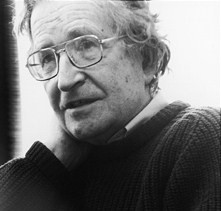
On the eve of Obama's inauguration,Israel declared a unilateral cease fire and began sending its troops home, saying that the objectives of the invasion had been met.The same day the first Afro-american president took charge of the White House, Noam Chomsky published an article in the web magazine ZSpace, dissecting the conflict in great detail. In view of the precision which characterizes Chomsky's views on social issues, we feel his opinions deserve close attention.
Here are some of the main points made by the reknown linguist:
"On Saturday December 27, the latest US-Israeli attack on helpless Palestinians was launched. The attack had been meticulously planned, for over 6 months according to the Israeli press. The planning had two components: military and propaganda. It was based on the lessons of Israel's 2006 invasion of Lebanon, which was considered to be poorly planned and badly advertised. We may, therefore, be fairly confident that most of what has been done and said was pre-planned and intended.
That surely includes the timing of the assault: shortly before noon, when children were returning from school and crowds were milling in the streets of densely populated Gaza City. It took only a few minutes to kill over 225 people and wound 700, an auspicious opening to the mass slaughter of defenseless civilians trapped in a tiny cage with nowhere to flee.
In his retrospective "Parsing Gains of Gaza War," New York Times correspondent Ethan Bronner cited this achievement as one of the most significant of the gains. Israel calculated that it would be advantageous to appear to "go crazy," causing vastly disproportionate terror, a doctrine that traces back to the 1950s. "The Palestinians in Gaza got the message on the first day," Bronner wrote, "when Israeli warplanes struck numerous targets simultaneously in the middle of a Saturday morning. Some 200 were killed instantly, shocking Hamas and indeed all of Gaza." The tactic of "going crazy" appears to have been successful, Bronner concluded: there are "limited indications that the people of Gaza felt such pain from this war that they will seek to rein in Hamas," the elected government. That is another long-standing doctrine of state terror. I don't, incidentally, recall the Times retrospective "Parsing Gains of Chechnya War," though the gains were great.
The meticulous planning also presumably included the termination of the assault, carefully timed to be just before the inauguration, so as to minimize the (remote) threat that Obama might have to say some words critical of these vicious US-supported crimes.
Two weeks after the Sabbath opening of the assault, with much of Gaza already pounded to rubble and the death toll approaching 1000, the UN Agency UNRWA, on which most Gazans depend for survival, announced that the Israeli military refused to allow aid shipments to Gaza, saying that the crossings were closed for the Sabbath. To honor the holy day, Palestinians at the edge of survival must be denied food and medicine, while hundreds can be slaughtered by US jet bombers and helicopters.
The rigorous observance of the Sabbath in this dual fashion attracted little if any notice. That makes sense. In the annals of US-Israeli criminality, such cruelty and cynicism scarcely merit more than a footnote. They are too familiar. To cite one relevant parallel, in June 1982 the US-backed Israeli invasion of Lebanon opened with the bombing of the Palestinian refugee camps of Sabra and Shatila, later to become famous as the site of terrible massacres supervised by the IDF (Israeli "Defense" Forces). The bombing hit the local hospital - the Gaza hospital -- and killed over 200 people, according to the eyewitness account of an American Middle East academic specialist. The massacre was the opening act in an invasion that slaughtered some 15-20,000 people and destroyed much of southern Lebanon and Beirut, proceeding with crucial US military and diplomatic support. That included vetoes of Security Council resolutions seeking to halt the criminal aggression that was undertaken, as scarcely concealed, to defend Israel from the threat of peaceful political settlement, contrary to many convenient fabrications about Israelis suffering under intense rocketing, a fantasy of apologists.
All of this is normal, and quite openly discussed by high Israeli officials. Thirty years ago Chief of Staff Mordechai Gur observed that since 1948, "we have been fighting against a population that lives in villages and cities." As Israel's most prominent military analyst, Zeev Schiff, summarized his remarks, "the Israeli Army has always struck civilian populations, purposely and consciously...the Army, he said, has never distinguished civilian [from military] targets...[but] purposely attacked civilian targets." The reasons were explained by the distinguished statesman Abba Eban: "there was a rational prospect, ultimately fulfilled, that affected populations would exert pressure for the cessation of hostilities." The effect, as Eban well understood, would be to allow Israel to implement, undisturbed, its programs of illegal expansion and harsh repression. Eban was commenting on a review of Labor government attacks against civilians by Prime Minister Begin, presenting a picture, Eban said, "of an Israel wantonly inflicting every possible measure of death and anguish on civilian populations in a mood reminiscent of regimes which neither Mr.Begin nor I would dare to mention by name." Eban did not contest the facts that Begin reviewed, but criticized him for stating them publicly. Nor did it concern Eban, or his admirers, that his advocacy of massive state terror is also reminiscent of regimes he would not dare to mention by name.
Eban's justification for state terror is regarded as persuasive by respected authorities. As the current US-Israel assault raged, Times columnist Thomas Friedman explained that Israel's tactics both in the current attack and in its invasion of Lebanon in 2006 are based on the sound principle of "trying to `educate' Hamas, by inflicting a heavy death toll on Hamas militants and heavy pain on the Gaza population." That makes sense on pragmatic grounds, as it did in Lebanon, where "the only long-term source of deterrence was to exact enough pain on the civilians -- the families and employers of the militants -- to restrain Hezbollah in the future." And by similar logic, bin Laden's effort to "educate" Americans on 9/11 was highly praiseworthy, as were the Nazi attacks on Lidice and Oradour, Putin's destruction of Grozny, and other notable attempts at "education."
Israel has taken pains to make clear its dedication to these guiding principles. NYT correspondent Stephen Erlanger reports that Israeli human rights groups are "troubled by Israel's strikes on buildings they believe should be classified as civilian, like the parliament, police stations and the presidential palace" - and, we may add, villages, homes, densely populated refugee camps, water and sewage systems, hospitals, schools and universities, mosques, UN relief facilities, ambulances, and indeed anything that might relieve the pain of the unworthy victims. A senior Israeli intelligence officer explained that the IDF attacked "both aspects of Hamas -- its resistance or military wing and its dawa, or social wing," the latter a euphemism for the civilian society. "He argued that Hamas was all of a piece," Erlanger continues, "and in a war, its instruments of political and social control were as legitimate a target as its rocket caches." Erlanger and his editors add no comment about the open advocacy, and practice, of massive terrorism targeting civilians, though correspondents and columnists signal their tolerance or even explicit advocacy of war crimes, as noted. But keeping to the norm, Erlanger does not fail to stress that Hamas rocketing is "an obvious violation of the principle of discrimination and fits the classic definition of terrorism."
Like others familiar with the region, Middle East specialist Fawwaz Gerges observes that "What Israeli officials and their American allies do not appreciate is that Hamas is not merely an armed militia but a social movement with a large popular base that is deeply entrenched in society." Hence when they carry out their plans to destroy Hamas's "social wing," they are aiming to destroy Palestinian society.
Gerges may be too kind. It is highly unlikely that Israeli and American officials - or the media and other commentators - do not appreciate these facts. Rather, they implicitly adopt the traditional perspective of those who monopolize means of violence: our mailed fist can crush any opposition, and if our furious assault has a heavy civilian toll, that's all to the good: perhaps the remnants will be properly educated.
IDF officers clearly understand that they are crushing the civilian society. Ethan Bronner quotes an Israeli Colonel who says that he and his men are not much "impressed with the Hamas fighters." "They are villagers with guns," said a gunner on an armored personnel carrier. They resemble the victims of the murderous IDF "iron fist" operations in occupied southern Lebanon in 1985, directed by Shimon Peres, one of the great terrorist commanders of the era of Reagan's "War on Terror." During these operations, Israeli commanders and strategic analysts explained that the victims were "terrorist villagers," difficult to eradicate because "these terrorists operate with the support of most of the local population." An Israeli commander complained that "the terrorist...has many eyes here, because he lives here," while the military correspondent of the Jerusalem Post described the problems Israeli forces faced in combating the "terrorist mercenary," "fanatics, all of whom are sufficiently dedicated to their causes to go on running the risk of being killed while operating against the IDF," which must "maintain order and security" in occupied southern Lebanon despite "the price the inhabitants will have to pay." The problem has been familiar to Americans in South Vietnam, Russians in Afghanistan, Germans in occupied Europe, and other aggressors that find themselves implementing the Gur-Eban-Friedman doctrine.
Gerges believes that US-Israeli state terror will fail: Hamas, he writes, "cannot be wiped out without massacring half a million Palestinians. If Israel succeeds in killing Hamas's senior leaders, a new generation, more radical than the present, will swiftly replace them. Hamas is a fact of life. It is not going away, and it will not raise the white flag regardless of how many casualties it suffers."
Perhaps, but there is often a tendency to underestimate the efficacy of violence. It is particularly odd that such a belief should be held in the United States. Why are we here?
Hamas is regularly described as "Iranian-backed Hamas, which is dedicated to the destruction of Israel." One will be hard put to find something like "democratically elected Hamas, which has long been calling for a two-state settlement in accord with the international consensus" -- blocked for over 30 years by the US and Israel, which flatly and explicitly reject the right of Palestinians to self-determination. All true, but not a useful contribution to the Party Line, hence dispensable.
Such details as those mentioned earlier, though minor, nevertheless teach us something about ourselves and our clients. So do others. To mention another one, as the latest US-Israeli assault on Gaza began, a small boat, the Dignity, was on its way from Cyprus to Gaza. The doctors and human rights activists aboard intended to violate Israel's criminal blockade and to bring medical supplies to the trapped population. The ship was intercepted in international waters by Israeli naval vessels, which rammed it severely, almost sinking it, though it managed to limp to Lebanon. Israel issued the routine lies, refuted by the journalists and passengers aboard, including CNN correspondent Karl Penhaul and former US representative and Green Party presidential candidate Cynthia McKinney. That is a serious crime -- much worse, for example, than hijacking boats off the coast of Somalia. It passed with little notice. The tacit acceptance of such crimes reflects the understanding that Gaza is occupied territory, and that Israel is entitled to maintain its siege, even authorized by the guardians of international order to carry out crimes on the high seas to implement its programs of punishing the civilian population for disobedience to its commands - under pretexts to which we return, almost universally accepted but clearly untenable.
The lack of attention again makes sense. For decades, Israel had been hijacking boats in international waters between Cyprus and Lebanon, killing or kidnapping passengers, sometimes bringing them to prisons in Israel, including secret prison/torture chambers, to hold as hostages for many years. Since the practices are routine, why treat the new crime with more than a yawn? Cyprus and Lebanon reacted quite differently, but who are they in the scheme of things?
Who cares, for example, if the editors of Lebanon's Daily Star, generally pro-Western, write that "Some 1.5 million people in Gaza are being subjected to the murderous ministrations of one of the world's most technologically advanced but morally regressive military machines. It is often suggested that the Palestinians have become to the Arab world what the Jews were to pre-World War II Europe, and there is some truth to this interpretation. How sickeningly appropriate, then, that just as Europeans and North Americans looked the other way when the Nazis were perpetrating the Holocaust, the Arabs are finding a way to do nothing as the Israelis slaughter Palestinian children." Perhaps the most shameful of the Arab regimes is the brutal Egyptian dictatorship, the beneficiary of most US military aid, apart from Israel.
According to the Lebanese press, Israel still "routinely abducts Lebanese civilians from the Lebanese side of the Blue Line [the international border], most recently in December 2008." And of course "Israeli planes violate Lebanese airspace on a daily basis in violation of UN Resolution 1701" (Lebanese scholar Amal Saad-Ghorayeb, Daily Star, Jan. 13). That too has been happening for a long time. In condemning Israel's invasion of Lebanon in 2006, the prominent Israeli strategic analyst Zeev Maoz wrote in the Israeli press that "Israel has violated Lebanese airspace by carrying out aerial reconnaissance missions virtually every day since its withdrawal from Southern Lebanon six years ago. True, these aerial overflights did not cause any Lebanese casualties, but a border violation is a border violation. Here too, Israel does not hold a higher moral ground." And in general, there is no basis for the "wall-to-wall consensus in Israel that the war against the Hezbollah in Lebanon is a just and moral war," a consensus "based on selective and short-term memory, on an introvert world view, and on double standards. This is not a just war, the use of force is excessive and indiscriminate, and its ultimate aim is extortion."
As Maoz also reminds his Israeli readers, overflights with sonic booms to terrorize Lebanese are the least of Israeli crimes in Lebanon, even apart from its five invasions since 1978: "On July 28, 1988 Israeli Special Forces abducted Sheikh Obeid, and on May 21, 1994 Israel abducted Mustafa Dirani, who was responsible for capturing the Israeli pilot Ron Arad [when he was bombing Lebanon in 1986]. Israel held these and other 20 Lebanese who were captured under undisclosed circumstances in prison for prolonged periods without trial. They were held as human `bargaining chips.' Apparently, abduction of Israelis for the purpose of prisoners' exchange is morally reprehensible, and militarily punishable when it is the Hezbollah who does the abducting, but not if Israel is doing the very same thing," and on a far grander scale and over many years.
Israel's regular practices are significant even apart from what they reveal about Israeli criminality and Western support for it. As Maoz indicates, these practices underscore the utter hypocrisy of the standard claim that Israel had the right to invade Lebanon once again in 2006 when soldiers were captured at the border, the first cross-border action by Hezbollah in the six years since Israel's withdrawal from southern Lebanon, which it occupied in violation of Security Council orders going back 22 years, while during these six years Israel violated the border almost daily with impunity, and silence here.
The hypocrisy is, again, routine. Thus Thomas Friedman, while explaining how the lesser breeds are to be "educated" by terrorist violence, writes that Israel's invasion of Lebanon in 2006, once again destroying much of southern Lebanon and Beirut while killing another 1000 civilians, was a just act of self-defense, responding to Hezbollah's crime of "launching an unprovoked war across the U.N.-recognized Israel-Lebanon border, after Israel had unilaterally withdrawn from Lebanon." Putting aside the deceit, by the same logic, terrorist attacks against Israelis that are far more destructive and murderous than any that have taken place would be fully justified in response to Israel's criminal practices in Lebanon and on the high seas, which vastly exceed Hezbollah's crime of capturing two soldiers at the border. The veteran Middle East specialist of the New York Times surely knows about these crimes, at least if he reads his own newspaper: for example, the 18th paragraph of a story on prisoner exchange in November 1983 which observes, casually, that 37 of the Arab prisoners "had been seized recently by the Israeli Navy as they tried to make their way from Cyprus to Tripoli," north of Beirut.
Of course all such conclusions about appropriate actions against the rich and powerful are based on a fundamental flaw: This is us, and that is them. This crucial principle, deeply embedded in Western culture, suffices to undermine even the most precise analogy and the most impeccable reasoning.
As I write, another boat is on its way from Cyprus to Gaza, "carrying urgently needed medical supplies in sealed boxes, cleared by customs at the Larnaca International Airport and the Port of Larnaca," the organizers report. Passengers include members of European Parliaments and physicians. Israel has been notified of their humanitarian intent. With sufficient popular pressure, they might achieve their mission in peace.
The new crimes that the US and Israel have been committing in Gaza in the past weeks do not fit easily into any standard category - except for the category of familiarity; I've just given several examples, and will return to others. Literally, the crimes fall under the official US government definition of "terrorism," but that designation does not capture their enormity. They cannot be called "aggression," because they are being conducted in occupied territory, as the US tacitly concedes. In their comprehensive scholarly history of Israeli settlement in the occupied territories, Lords of the Land, Idit Zertal and Akiva Eldar point out that after Israel withdrew its forces from Gaza in August 2005, the ruined territory was not released "for even a single day from Israel's military grip or from the price of the occupation that the inhabitants pay every day... Israel left behind scorched earth, devastated services, and people with neither a present nor a future. The settlements were destroyed in an ungenerous move by an unenlightened occupier, which in fact continues to control the territory and kill and harass its inhabitants by means of its formidable military might" - exercised with extreme savagery, thanks to firm US support and participation.
The US-Israeli assault on Gaza escalated in January 2006, a few months after the formal withdrawal, when Palestinians committed a truly heinous crime: they voted "the wrong way" in a free election. Like others, Palestinians learned that one does not disobey with impunity the commands of the Master, who continues to prate of his "yearning for democracy," without eliciting ridicule from the educated classes, another impressive achievement.
Since the terms "aggression" and "terrorism" are inadequate, some new term is needed for the sadistic and cowardly torture of people caged with no possibility of escape, while they are being pounded to dust by the most sophisticated products of US military technology - used in violation of international and even US law, but for self-declared outlaw states that is just another minor technicality. Also a minor technicality is the fact that on December 31, while terrorized Gazans were desperately seeking shelter from the ruthless assault, Washington hired a German merchant ship to transport from Greece to Israel a huge shipment, 3000 tons, of unidentified "ammunition." The new shipment "follows the hiring of a commercial ship to carry a much larger consignment of ordnance in December from the United States to Israel ahead of air strikes in the Gaza Strip," Reuters reported. All of this is separate from the more than $21 billion in U.S. military aid provided by the Bush administration to Israel, almost all grants. "Israel's intervention in the Gaza Strip has been fueled largely by U.S. supplied weapons paid for with U.S. tax dollars," said a briefing by the New America Foundation, which monitors the arms trade. The new shipment was hampered by the decision of the Greek government to bar the use of any port in Greece "for the supplying of the Israeli army."
Greece's response to US-backed Israeli crimes is rather different from the craven performance of the leaders of most of Europe. The distinction reveals that Washington may have been quite realistic in regarding Greece as part of the Near East, not Europe, until the overthrow of its US-backed fascist dictatorship in 1974. Perhaps Greece is just too civilized to be part of Europe.
Were anyone to find the timing of the arms deliveries to Israel curious, and inquire further, the Pentagon has an answer: the shipment would arrive too late to escalate the Gaza attack, and the military equipment, whatever it may be, is to be pre-positioned in Israel for eventual use by the US military. That may be accurate. One of the many services that Israel performs for its patron is to provide it with a valuable military base at the periphery of the world's major energy resources. It can therefore serve as a forward base for US aggression - or to use the technical terms, to "defend the Gulf" and "ensure stability."
The huge flow of arms to Israel serves many subsidiary purposes. Middle East policy analyst Mouin Rabbani observes that Israel can test newly developed weapons systems against defenseless targets. This is of value to Israel and the US "twice over, in fact, because less effective versions of these same weapons systems are subsequently sold at hugely inflated prices to Arab states, which effectively subsidizes the U.S. weapons industry and U.S. military grants to Israel." These are additional functions of Israel in the US-dominated Middle East system, and among the reasons why Israel is so favored by the state authorities, along with a wide range of US high-tech corporations, and of course military industry and intelligence.
Israel apart, the US is by far the world's major arms supplier. The recent New America Foundation report concludes that "U.S. arms and military training played a role in 20 of the world's 27 major wars in 2007," earning the US $23 billion in receipts, increasing to $32 billion in 2008. Small wonder that among the numerous UN resolutions that the US opposed in the December 2008 UN session was one calling for regulation of the arms trade. In 2006, the US was alone in voting against the treaty, but in November 2008 it was joined by a partner: Zimbabwe.
There were other notable votes at the December UN session. A resolution on "the right of the Palestinian people to self-determination" was adopted by 173 to 5 (US, Israel, Pacific island dependencies). The vote strongly reaffirms US-Israeli rejectionism, in international isolation. Similarly a resolution on "universal freedom of travel and the vital importance of family reunification" was adopted with US, Israel, and Pacific dependencies opposed, presumably with Palestinians in mind.
In voting against the right to development the US lost Israel but gained Ukraine. In voting against the "right to food," the US was alone, a particular striking fact in the face of the enormous global food crisis, dwarfing the financial crisis that threatens western economies.
There are good reasons why the voting record is consistently unreported and dispatched deep into the memory hole by the media and conformist intellectuals. It would not be wise to reveal to the public what the record implies about their elected representatives. In the present case it would plainly be unhelpful to let the public know that US-Israeli rejectionism, barring the peaceful settlement long advocated by the world, reaches such an extreme as to deny Palestinians even the abstract right to self-determination.
One of the heroic volunteers in Gaza, Norwegian doctor Mads Gilbert, described the scene of horror as an "All out war against the civilian population of Gaza." He estimated that half the casualties are women and children. The men are almost all civilians as well, by civilized standards. Gilbert reports that he had scarcely seen a military casualty among the 100s of bodies. The IDF concurs. Hamas "made a point of fighting at a distance -- or not at all," Ethan Bronner reports while "parsing the gains" of the US-Israeli assault. So Hamas's manpower remains intact, and it was mostly civilians who suffered pain: a positive outcome, according to widely-held doctrine.
These estimates were confirmed by UN humanitarian chief John Holmes, who informed reporters that it is "a fair presumption" that most of the civilians killed were women and children in a humanitarian crisis that is "worsening day by day as the violence continues." But we could be comforted by the words of Israeli Foreign Minister Tzipi Livni, the leading dove in the current electoral campaign, who assured the world that there is no "humanitarian crisis" in Gaza, thanks to Israeli benevolence.
Like others who care about human beings and their fate, Gilbert and Holmes pleaded for a ceasefire. But not yet. "At the United Nations, the United States prevented the Security Council from issuing a formal statement on Saturday night calling for an immediate ceasefire," the New York Times mentioned in passing. The official reason was that "there was no indication Hamas would abide by any agreement." In the annals of justifications for delighting in slaughter, this must rank among the most cynical. That of course was Bush and Rice, soon to be displaced by Obama who compassionately repeats that "if missiles were falling where my two daughters sleep, I would do everything in order to stop that." He is referring to Israeli children, not the many hundreds being torn to shreds in Gaza by US arms. Beyond that Obama maintained his silence.
A few days later, under intense international pressure, the US backed a Security Council resolution calling for a "durable ceasefire." It passed 14-0, US abstaining. Israel and US hawks were angered that the US did not veto it, as usual. The abstention, however, sufficed to give Israel if not a green at least a yellow light to escalate the violence, as it did right up to virtually the moment of the inauguration, as had been predicted.
As the ceasefire (theoretically) went into effect on January18, the Palestinian Centre for Human Rights released its figures for the final day of the assault: 54 Palestinians killed including 43 unarmed civilians, 17 of them children, while the IDF continued to bombard civilian homes and UN schools. The death toll, they estimated, mounted to 1,184, including 844 civilians, 281 of them children. The IDF continued to use incendiary bombs across the Gaza Strip, and to destroy houses and agricultural land, forcing civilians to flee their homes. A few hours later, Reuters reported more than 1,300 killed. The staff of the Al Mezan Center, which also carefully monitors casualties and destruction, visited areas that had previously been inaccessible because of incessant heavy bombardment. They discovered dozens of civilian corpses decomposing under the rubble of destroyed houses or removed by Israeli bulldozers. Entire urban blocks had disappeared.
The figures for killed and wounded are surely an underestimate. And it is unlikely that there will be any inquiry into these atrocities. Crimes of official enemies are subjected to rigorous investigation, but our own are systematically ignored. General practice, again, and understandable on the part of the masters.
The Security Council Resolution called for stopping the flow of arms into Gaza. The US and Israel (Rice-Livni) soon reached an agreement on measures to ensure this result, concentrating on Iranian arms. There is no need to stop smuggling of US arms into Israel, because there is no smuggling: the huge flow of arms is quite public, even when not reported, as in the case of the arms shipment announced as the slaughter in Gaza was proceeding.
The Resolution also called for "ensur[ing] the sustained re-opening of the crossing points on the basis of the 2005 Agreement on Movement and Access between the Palestinian Authority and Israel"; that Agreement determined that crossings to Gaza would be operated on a continuous basis and that Israel would also allow the crossing of goods and people between the West Bank and the Gaza Strip.
The Rice-Livni agreement had nothing to say about this aspect of the Security Council Resolution. The US and Israel had in fact already abandoned the 2005 Agreement as part of their punishment of Palestinians for voting the wrong way in a free election in January 2006. Rice's press conference after the Rice-Livni agreement emphasized Washington's continuing efforts to undermine the results of the one free election in the Arab world: "There is much that can be done," she said, "to bring Gaza out of the dark of Hamas's reign and into the light of the very good governance the Palestinian Authority can bring" - at least, can bring as long as it remains a loyal client, rife with corruption and willing to carry out harsh repression, but obedient.
Returning from a visit to the Arab world, Fawwaz Gerges strongly affirmed what others on the scene have reported. The effect of the US-Israeli offensive in Gaza has been to infuriate the populations and to arouse bitter hatred of the aggressors and their collaborators. "Suffice it to say that the so-called moderate Arab states [that is, those that take their orders from Washington] are on the defensive, and that the resistance front led by Iran and Syria is the main beneficiary. Once again, Israel and the Bush administration have handed the Iranian leadership a sweet victory." Furthermore, "Hamas will likely emerge as a more powerful political force than before and will likely top Fatah, the ruling apparatus of President Mahmoud Abbas's Palestinian Authority," Rice's favorites.
It is worth bearing in mind that the Arab world is not scrupulously protected from the only regular live TV coverage of what is happening in Gaza, namely the "calm and balanced analysis of the chaos and destruction" provided by the outstanding correspondents of al-Jazeera, offering "a stark alternative to terrestrial channels," as reported by the London Financial Times. In the 105 countries lacking our efficient modalities of self-censorship, people can see what is happening hourly, and the impact is said to be very great. In the US, the New York Times reports, "the near-total blackout...is no doubt related to the sharp criticism Al Jazeera received from the United States government during the initial stages of the war in Iraq for its coverage of the American invasion." Cheney and Rumsfeld objected, so, obviously, the independent media could only obey.
There is much sober debate about what the attackers hoped to achieve. Some of objectives are commonly discussed, among them, restoring what is called "the deterrent capacity" that Israel lost as a result of its failures in Lebanon in 2006 - that is, the capacity to terrorize any potential opponent into submission. There are, however, more fundamental objectives that tend be ignored, though they too seem fairly obvious when we take a look at recent history.
Israel abandoned Gaza in September 2005. Rational Israeli hardliners, like Ariel Sharon, the patron saint of the settlers movement, understood that it was senseless to subsidize a few thousand illegal Israeli settlers in the ruins of Gaza, protected by the IDF while they used much of the land and scarce resources. It made more sense to turn Gaza into the world's largest prison and to transfer settlers to the West Bank, much more valuable territory, where Israel is quite explicit about its intentions, in word and more importantly in deed. One goal is to annex the arable land, water supplies, and pleasant suburbs of Jerusalem and Tel Aviv that lie within the separation wall, irrelevantly declared illegal by the World Court. That includes a vastly expanded Jerusalem, in violation of Security Council orders that go back 40 years, also irrelevant. Israel has also been taking over the Jordan Valley, about one-third of the West Bank. What remains is therefore imprisoned, and, furthermore, broken into fragments by salients of Jewish settlement that trisect the territory: one to the east of Greater Jerusalem through the town of Ma'aleh Adumim, developed through the Clinton years to split the West Bank; and two to the north, through the towns of Ariel and Kedumim. What remains to Palestinians is segregated by hundreds of mostly arbitrary checkpoints.
The checkpoints have no relation to security of Israel, and if some are intended to safeguard settlers, they are flatly illegal, as the World Court ruled. In reality, their major goal is harass the Palestinian population and to fortify what Israeli peace activist Jeff Halper calls the "matrix of control," designed to make life unbearable for the "two-legged beasts" who will be like "drugged roaches scurrying around in a bottle" if they seek to remain in their homes and land. All of that is fair enough, because they are "like grasshoppers compared to us" so that their heads can be "smashed against the boulders and walls." The terminology is from the highest Israeli political and military leaders, in this case the revered "princes." And the attitudes shape policies.
The ravings of the political and military leaders are mild as compared to the preaching of rabbinical authorities. They are not marginal figures. On the contrary, they are highly influential in the army and in the settler movement, who Zertal and Eldar reveal to be "lords of the land," with enormous impact on policy. Soldiers fighting in northern Gaza were afforded an "inspirational" visit from two leading rabbis, who explained to them that there are no "innocents" in Gaza, so everyone there is a legitimate target, quoting a famous passage from Psalms calling on the Lord to seize the infants of Israel's oppressors and dash them against the rocks. The rabbis were breaking no new ground. A year earlier, the former chief Sephardic rabbi wrote to Prime Minister Olmert, informing him that all civilians in Gaza are collectively guilty for rocket attacks, so that there is "absolutely no moral prohibition against the indiscriminate killing of civilians during a potential massive military offensive on Gaza aimed at stopping the rocket launchings," as the Jerusalem Post reported his ruling. His son, chief rabbi of Safed, elaborated: "If they don't stop after we kill 100, then we must kill a thousand, and if they do not stop after 1,000 then we must kill 10,000. If they still don't stop we must kill 100,000, even a million. Whatever it takes to make them stop."
Similar views are expressed by prominent American secular figures. When Israel invaded Lebanon in 2006, Harvard Law School Professor Alan Dershowitz explained in the liberal online journal Huffington Post that all Lebanese are legitimate targets of Israeli violence. Lebanon's citizens are "paying the price" for supporting "terrorism" - that is, for supporting resistance to Israel's invasion. Accordingly, Lebanese civilians are no more immune to attack than Austrians who supported the Nazis. The fatwa of the Sephardic rabbi applies to them. In a video on the Jerusalem Post website, Dershowitz went on to ridicule talk of excessive kill ratios of Palestinians to Israelis: it should be increased to 1000-to-one, he said, or even 1000-to-zero, meaning the brutes should be completely exterminated. Of course, he is referring to "terrorists," a broad category that includes the victims of Israeli power, since "Israel never targets civilians," he emphatically declared. It follows that Palestinians, Lebanese, Tunisians, in fact anyone who gets in the way of the ruthless armies of the Holy State is a terrorist, or an accidental victim of their just crimes.
It is not easy to find historical counterparts to these performances. It is perhaps of some interest that they are considered entirely appropriate in the reigning intellectual and moral culture - when they are produced on "our side," that is; from the mouths of official enemies such words would elicit righteous outrage and calls for massive preemptive violence in revenge.
The claim that "our side" never targets civilians is familiar doctrine among those who monopolize the means of violence. And there is some truth to it. We do not generally try to kill particular civilians. Rather, we carry out murderous actions that we know will slaughter many civilians, but without specific intent to kill particular ones. In law, the routine practices might fall under the category of depraved indifference, but that is not an adequate designation for standard imperial practice and doctrine. It is more similar to walking down a street knowing that we might kill ants, but without intent to do so, because they rank so low that it just doesn't matter. The same is true when Israel carries out actions that it knows will kill the "grasshoppers" and "two-legged beasts" who happen to infest the lands it "liberates." There is no good term for this form of moral depravity, arguably worse than deliberate murder, and all too familiar.
In the former Palestine, the rightful owners (by divine decree, according to the "lords of the land") may decide to grant the drugged roaches a few scattered parcels. Not by right, however: "I believed, and to this day still believe, in our people's eternal and historic right to this entire land," Prime Minister Olmert informed a joint session of Congress in May 2006 to rousing applause. At the same time he announced his "convergence" program for taking over what is valuable in the West Bank, leaving the Palestinians to rot in isolated cantons. He was not specific about the borders of the "entire land," but then, the Zionist enterprise never has been, for good reasons: permanent expansion is a very important internal dynamic. If Olmert is still faithful to his origins in Likud, he may have meant both sides of the Jordan, including the current state of Jordan, at least valuable parts of it.
Our people's "eternal and historic right to this entire land" contrasts dramatically with the lack of any right of self-determination for the temporary inhabitants, the Palestinians. As noted earlier, the latter stand was reiterated by Israel and its patron in Washington in December 2008, in their usual isolation and accompanied by resounding silence.
The plans that Olmert sketched in 2006 have since been abandoned as not sufficiently extreme. But what replaces the convergence program, and the actions that proceed daily to implement it, are approximately the same in general conception. They trace back to the earliest days of the occupation, when Defense Minister Moshe Dayan explained poetically that "the situation today resembles the complex relationship between a Bedouin man and the girl he kidnaps against his will...You Palestinians, as a nation, don't want us today, but we'll change your attitude by forcing our presence on you." You will "live like dogs, and whoever will leave, will leave," while we take what we want.
That these programs are criminal has never been in doubt. Immediately after the 1967 war, the Israeli government was informed by its highest legal authority, Teodor Meron, that "civilian settlement in the administered territories contravenes the explicit provisions of the Fourth Geneva Convention," the foundation of international humanitarian law. Israel's Justice Minister concurred. The World Court unanimously endorsed the essential conclusion in 2004, and the Israeli High Court technically agreed while disagreeing in practice, in its usual style.
In the West Bank, Israel can pursue its criminal programs with US support and no disturbance, thanks to its effective military control and by now the cooperation of the collaborationist Palestinian security forces armed and trained by the US and allied dictatorships. It can also carry out regular assassinations and other crimes, while settlers rampage under IDF protection. But while the West Bank has been effectively subdued by terror, there is still resistance in the other half of Palestine, the Gaza Strip. That too must be quelled for the US-Israeli programs of annexation and destruction of Palestine to proceed undisturbed.
Hence the invasion of Gaza.
The timing of the invasion was presumably influenced by the coming Israeli election. Ehud Barak, who was lagging badly in the polls, gained one parliamentary seat for every 40 Arabs killed in the early days of the slaughter, Israeli commentator Ran HaCohen calculated.
That may change, however. As the crimes passed beyond what the carefully honed Israeli propaganda campaign was able to suppress, even confirmed Israeli hawks became concerned that the carnage is "Destroying [Israel's] soul and its image. Destroying it on world television screens, in the living rooms of the international community and most importantly, in Obama's America" (Ari Shavit). Shavit was particularly concerned about Israel's "shelling a United Nations facility...on the day when the UN secretary general is visiting Jerusalem," an act that is "beyond lunacy," he felt.
Adding a few details, the "facility" was the UN compound in Gaza City, which contained the UNRWA warehouse. The shelling destroyed "hundreds of tons of emergency food and medicines set for distribution today to shelters, hospitals and feeding centres," according to UNRWA director John Ging. Military strikes at the same time destroyed two floors of the al-Quds hospital, setting it ablaze, and also a second warehouse run by the Palestinian Red Crescent society. The hospital in the densely-populated Tal-Hawa neighbourhood was destroyed by Israeli tanks "after hundreds of frightened Gazans had taken shelter inside as Israeli ground forces pushed into the neighbourhood," AP reported.
There was nothing left to salvage inside the smoldering ruins of the hospital. "They shelled the building, the hospital building. It caught fire. We tried to evacuate the sick people and the injured and the people who were there. Firefighters arrived and put out the fire, which burst into flames again and they put it out again and it came back for the third time," paramedic Ahmad Al-Haz told AP. It was suspected that the blaze might have been set by white phosphorous, also suspected in numerous other fires and serious burn injuries.
The suspicions were confirmed by Amnesty International after the cessation of the intense bombardment made inquiry possible. Before, Israel had sensibly barred all journalists, even Israeli, while its crimes were proceeding in full fury. Israel's use of white phosphorus against Gaza civilians is "clear and undeniable," AI reported. Its repeated use in densely populated civilian areas "is a war crime," AI concluded. They found white phosphorus edges scattered around residential buildings, still burning, "further endangering the residents and their property," particularly children "drawn to the detritus of war and often unaware of the danger." Primary targets, they report, were the UNRWA compound, where the Israeli "white phosphorus landed next to some fuel trucks and caused a large fire which destroyed tons of humanitarian aid" after Israeli authorities "had given assurance that no further strikes would be launched on the compound." On the same day, "a white phosphorus shell landed in the al-Quds hospital in Gaza City also causing a fire which forced hospital staff to evacuate the patients... White phosphorus landing on skin can burn deep through muscle and into the bone, continuing to burn unless deprived of oxygen." Purposely intended or beyond depraved indifference, such crimes are inevitable when this weapon is used in attacks on civilians.
It is, however, a mistake to concentrate too much on Israel's gross violations of jus in bello, the laws designed to bar practices that are too savage. The invasion itself is a far more serious crime. And if Israel had inflicted the horrendous damage by bows and arrows, it would still be a criminal act of extreme depravity.
Aggression always has a pretext: in this case, that Israel's patience had "run out" in the face of Hamas rocket attacks, as Barak put it. The mantra that is endlessly repeated is that Israel has the right to use force to defend itself. The thesis is partially defensible. The rocketing is criminal, and it is true that a state has the right to defend itself against criminal attacks. But it does not follow that it has a right to defend itself by force. That goes far beyond any principle that we would or should accept. Nazi Germany had no right to use force to defend itself against the terrorism of the partisans. Kristallnacht is not justified by Herschel Grynszpan's assassination of a German Embassy official in Paris. The British were not justified in using force to defend themselves against the (very real) terror of the American colonists seeking independence, or to terrorize Irish Catholics in response to IRA terror - and when they finally turned to the sensible policy of addressing legitimate grievances, the terror ended. It is not a matter of "proportionality," but of choice of action in the first place: Is there an alternative to violence?
Any resort to force carries a heavy burden of proof, and we have to ask whether it can be met in the case of Israel's effort to quell any resistance to its daily criminal actions in Gaza and in the West Bank, where they still continue relentlessly after more than 40 years. Perhaps I may quote myself in an interview in the Israeli press on Olmert's announced convergence plans for the West Bank: "The US and Israel do not tolerate any resistance to these plans, preferring to pretend - falsely of course - that `there is no partner,' as they proceed with programs that go back a long way. We may recall that Gaza and the West Bank are recognized to be a unit, so if resistance to the US-Israeli annexation-cantonization programs is legitimate in the West Bank, it is in Gaza too."
Palestinian-American journalist Ali Abunimah observed that "There are no rockets launched at Israel from the West Bank, and yet Israel's extrajudicial killings, land theft, settler pogroms and kidnappings never stopped for a day during the truce. The western-backed Palestinian Authority of Mahmoud Abbas has acceded to all Israel's demands. Under the proud eye of United States military advisors, Abbas has assembled `security forces' to fight the resistance on Israel's behalf. None of that has spared a single Palestinian in the West Bank from Israel's relentless colonization" - thanks to firm US backing. The respected Palestinian parliamentarian Dr. Mustapha Barghouti adds that after Bush's Annapolis extravaganza in November 2007, with much uplifting rhetoric about dedication to peace and justice, Israeli attacks on Palestinians escalated sharply, with an almost 50% increase in the West Bank, along with a sharp increase in settlements and Israeli check points. Obviously these criminal actions are not a response to rockets from Gaza, though the converse may well be the case, Barghouti plausibly suggests.
The reactions to crimes of an occupying power can be condemned as criminal and politically foolish, but those who offer no alternative have no moral grounds to issue such judgments. The conclusion holds with particular force for those in the US who choose to be directly implicated in Israel's ongoing crimes -- by their words, their actions, or their silence. All the more so because there are very clear non-violent alternatives - which, however, have the disadvantage that they bar the programs of illegal expansion.
Israel has a straightforward means to defend itself: put an end to its criminal actions in occupied territories, and accept the long-standing international consensus on a two-state settlement that has been blocked by the US and Israel for over 30 years, since the US first vetoed a Security Council resolution calling for a political settlement in these terms in 1976. I will not once again run through the inglorious record, but it is important to be aware that US-Israeli rejectionism today is even more blatant than in the past. The Arab League has gone even beyond the consensus, calling for full normalization of relations with Israel. Hamas has repeatedly called for a two-state settlement in terms of the international consensus. Iran and Hezbollah have made it clear that they will abide by any agreement that Palestinians accept. That leaves the US-Israel in splendid isolation, not only in words.
The more detailed record is informative. The Palestinian National Council formally accepted the international consensus in 1988. The response of the Shamir-Peres coalition government, affirmed by James Baker's State Department, was that there cannot be an "additional Palestinian state" between Israel and Jordan - the latter already a Palestinian state by US-Israeli dictate. The Oslo accords that followed put to the side potential Palestinian national rights, and the threat that they might be realized in some meaningful form was systematically undermined through the Oslo years by Israel's steady expansion of illegal settlements. Settlement accelerated in 2000, President Clinton's and Prime Minister Barak's last year, when negotiations took place at Camp David against that background.
After blaming Yassir Arafat for the breakdown of the Camp David negotiations, Clinton backtracked, and recognized that the US-Israeli proposals were too extremist to be acceptable to any Palestinian. In December 2000, he presented his "parameters," vague but more forthcoming. He then announced that both sides had accepted the parameters, while both expressed reservations. The two sides met in Taba Egypt in January 2001 and came very close to an agreement, and would have been able to do so in a few more days, they said in their final press conference. But the negotiations were cancelled prematurely by Ehud Barak. That week in Taba is the one break in over 30 years of US-Israeli rejectionism. There is no reason why that one break in the record cannot be resumed.
The preferred version, recently reiterated by Ethan Bronner, is that "Many abroad recall Mr. Barak as the prime minister who in 2000 went further than any Israeli leader in peace offers to the Palestinians, only to see the deal fail and explode in a violent Palestinian uprising that drove him from power." It's true that "many abroad" believe this deceitful fairy tale, thanks to what Bronner and too many of his colleagues call "journalism".
It is commonly claimed that a two-state solution is now unattainable because if the IDF tried to remove settlers, it would lead to a civil war. That may be true, but much more argument is needed. Without resorting to force to expel illegal settlers, the IDF could simply withdraw to whatever boundaries are established by negotiations. The settlers beyond those boundaries would have the choice of leaving their subsidized homes to return to Israel, or to remain under Palestinian authority. The same was true of the carefully staged "national trauma" in Gaza in 2005, so transparently fraudulent that it was ridiculed by Israeli commentators. It would have sufficed for Israel to announce that the IDF would withdraw, and the settlers who were subsidized to enjoy their life in Gaza would have quietly climbed into the lorries provided to them and travelled to their new subsidized residences in the West Bank. But that would not have produced tragic photos of agonized children and passionate calls of "never again."
To summarize, contrary to the claim that is constantly reiterated, Israel has no right to use force to defend itself against rockets from Gaza, even if they are regarded as terrorist crimes. Furthermore, the reasons are transparent. The pretext for launching the attack is without merit.
There is also a narrower question. Does Israel have peaceful short-term alternatives to the use of force in response to rockets from Gaza. One short-term alternative would be to accept a ceasefire. Sometimes Israel has done so, while instantly violating it. The most recent and currently relevant case is June 2008. The ceasefire called for opening the border crossings to "allow the transfer of all goods that were banned and restricted to go into Gaza." Israel formally agreed, but immediately announced that it would not abide by the agreement and open the borders until Hamas released Gilad Shalit, an Israeli soldier captured by Hamas in June 2006.
The steady drumbeat of accusations about the capture of Shalit is, again, blatant hypocrisy, even putting aside Israel's long history of kidnapping. In this case, the hypocrisy could not be more glaring. One day before Hamas captured Shalit, Israeli soldiers entered Gaza City and kidnapped two civilians, the Muammar brothers, bringing them to Israel to join the thousands of other prisoners held there, almost 1000 reportedly without charge. Kidnapping civilians is a far more serious crime than capturing a soldier of an attacking army, but it was barely reported in contrast to the furor over Shalit. And all that remains in memory, blocking peace, is the capture of Shalit, another reflection of the difference between humans and two-legged beasts. Shalit should be returned - in a fair prisoner exchange.
It was after the capture of Shalit that Israel's unrelenting military attack against Gaza passed from merely vicious to truly sadistic. But it is well to recall that even before his capture, Israel had fired more than 7,700 shells at northern Gaza after its September withdrawal, eliciting virtually no comment.
After rejecting the June 2008 ceasefire it had formally accepted, Israel maintained its siege. We may recall that a siege is an act of war. In fact, Israel has always insisted on an even stronger principle: hampering access to the outside world, even well short of a siege, is an act of war, justifying massive violence in response. Interference with Israel's passage through the Straits of Tiran was part of the pretext for Israel's invasion of Egypt (with France and England) in 1956, and for its launching of the June 1967 war. The siege of Gaza is total, not partial, apart from occasional willingness of the occupiers to relax it slightly. And it is vastly more harmful to Gazans than closing the Straits of Tiran was to Israel. Supporters of Israeli doctrines and actions should therefore have no problem justifying rocket attacks on Israeli territory from the Gaza Strip.
Of course, again we run into the nullifying principle: This is us, that is them.
Israel not only maintained the siege after June 2008, but did so with extreme rigor. It even prevented UNRWA from replenishing its stores, "so when the ceasefire broke down, we ran out of food for the 750,000 who depend on us," UNRWA director John Ging informed the BBC.
Despite the Israeli siege, rocketing sharply reduced. The ceasefire broke down on November 4 with an Israeli raid into Gaza, leading to the death of 6 Palestinians, and a retaliatory barrage of rockets (with no injuries). The pretext for the raid was that Israel had detected a tunnel in Gaza that might have been intended for use to capture another Israeli soldier. The pretext is transparently absurd, as a number of commentators have noted. If such a tunnel existed, and reached the border, Israel could easily have barred it right there. But as usual, the ludicrous Israeli pretext was deemed credible.
What was the reason for the Israeli raid? We have no internal evidence about Israeli planning, but we do know that the raid came shortly before scheduled Hamas-Fatah talks in Cairo aimed at "reconciling their differences and creating a single, unified government," British correspondent Rory McCarthy reported. That was to be the first Fatah-Hamas meeting since the June 2007 civil war that left Hamas in control of Gaza, and would have been a significant step towards advancing diplomatic efforts. There is a long history of Israel provocations to deter the threat of diplomacy, some already mentioned. This may have been another one.
The civil war that left Hamas in control of Gaza is commonly described as a Hamas military coup, demonstrating again their evil nature. The real world is a little different. The civil war was incited by the US and Israel, in a crude attempt at a military coup to overturn the free elections that brought Hamas to power. That has been public knowledge at least since April 2008, when David Rose published in Vanity Fair a detailed and documented account of how Bush, Rice, and Deputy National-Security Adviser Elliott Abrams "backed an armed force under Fatah strongman Muhammad Dahlan, touching off a bloody civil war in Gaza and leaving Hamas stronger than ever." The account was recently corroborated once again in the Christian Science Monitor (Jan. 12, 2009) by Norman Olsen, who served for 26 years in the Foreign Service, including four years working in the Gaza Strip and four years at the US Embassy in Tel Aviv, and then moved on to become associate coordinator for counterterrorism at the Department of State. Olson and his son detail the State Department shenanigans intended to ensure that their candidate, Abbas, would win in the January 2006 elections - in which case it would have been hailed as a triumph of democracy. After the election-fixing failed, they turned to punishment of the Palestinians and arming of a militia run by Fatah strong-man Muhammad Dahlan, but "Dahlan's thugs moved too soon" and a Hamas pre-emptive strike undermined the coup attempt, leading to far harsher US-Israeli measures to punish the disobedient people of Gaza. The Party Line is more acceptable.
After Israel broke the June 2008 ceasefire (such as it was) in November, the siege was tightened further, with even more disastrous consequences for the population. According to Sara Roy, the leading academic specialist on Gaza, "On Nov. 5, Israel sealed all crossing points into Gaza, vastly reducing and at times denying food supplies, medicines, fuel, cooking gas, and parts for water and sanitation systems..." During November, an average of 4.6 trucks of food per day entered Gaza from Israel compared with an average of 123 trucks per day in October. Spare parts for the repair and maintenance of water-related equipment have been denied entry for over a year. The World Health Organization just reported that half of Gaza's ambulances are now out of order" - and the rest soon became targets for Israeli attack. Gaza's only power station was forced to suspend operation for lack of fuel, and could not be started up again because they needed spare parts, which had been sitting in the Israeli port of Ashdod for 8 months. Shortage of electricity led to a 300% increase in burn cases at Shifaa' hospital in the Gaza Strip, resulting from efforts to light wood fires. Israel barred shipment of Chlorine, so that by mid-December in Gaza City and the north access to water was limited to six hours every three days. The human consequences are not counted among Palestinian victims of Israeli terror.
After the November 4 Israeli attack, both sides escalated violence (all deaths were Palestinian) until the ceasefire formally ended on Dec. 19, and Prime Minister Olmert authorized the full-scale invasion.
A few days earlier Hamas had proposed to return to the original July ceasefire agreement, which Israel had not observed. Historian and former Carter administration high official Robert Pastor passed the proposal to a "senior official" in the IDF, but Israel did not respond. The head of Shin Bet, Israel's internal security agency, was quoted in Israeli sources on December 21 as saying that Hamas is interested in continuing the "calm" with Israel, while its military wing is continuing preparations for conflict.
"There clearly was an alternative to the military approach to stopping the rockets," Pastor said, keeping to the narrow issue of Gaza. There was also a more far-reaching alternative, which is rarely discussed: namely, accepting a political settlement including all of the occupied territories..."